Beat Lease Term Calculator
Track a beat license by term months, stream allowance, sale allowance, music video cap, paid performance cap, exclusivity status, renewal window, and remaining usage.
Load a named beat lease tier, then enter current release activity. Unlimited caps are modeled separately from numeric caps so the remaining-use cards stay readable.
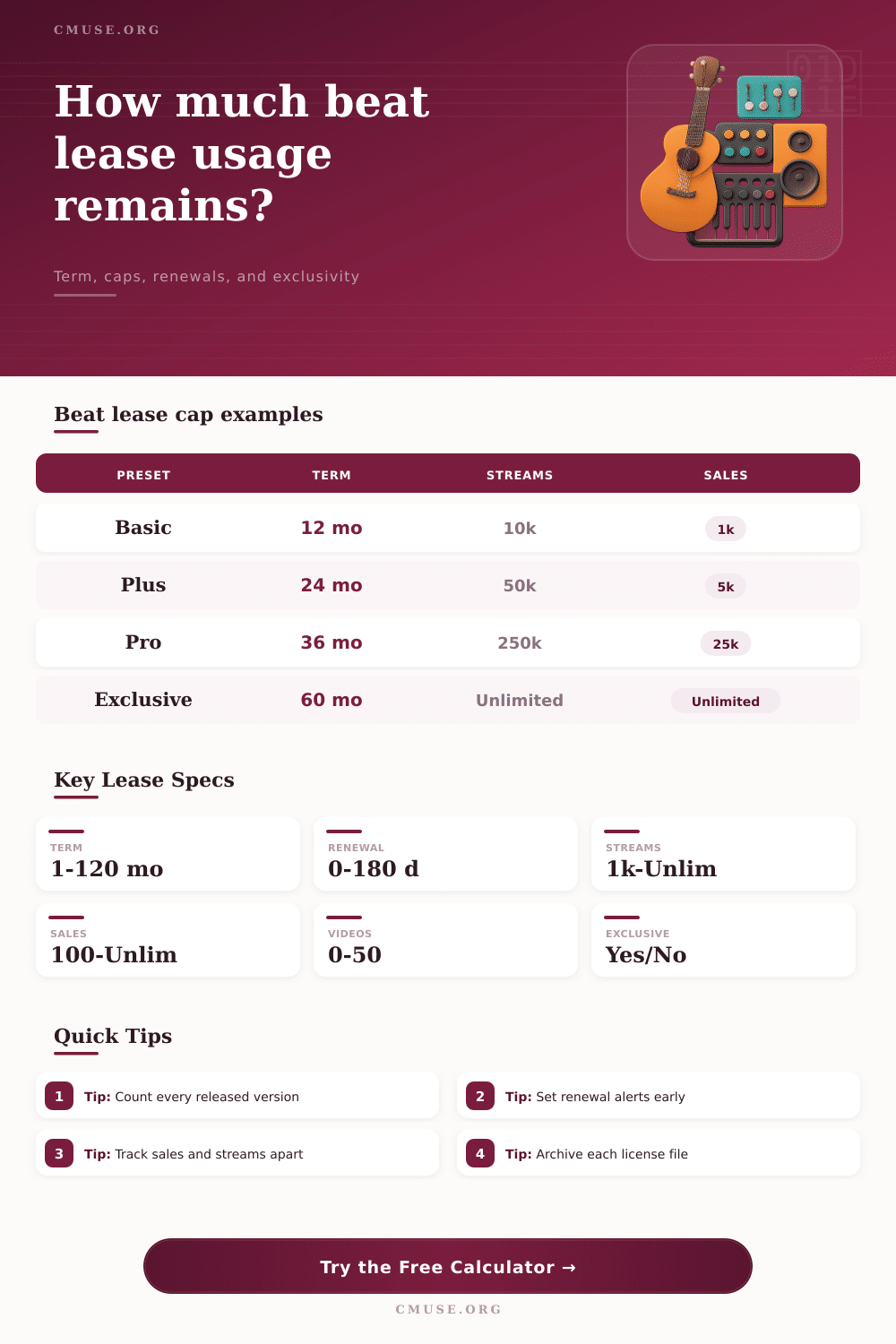
| Preset | Term | Stream allowance | Sale allowance |
|---|---|---|---|
| Starter MP3 Lease | 12 months | 10,000 streams | 1,000 sales/downloads |
| Standard WAV Lease | 24 months | 50,000 streams | 5,000 sales/downloads |
| Premium Trackout | 36 months | 250,000 streams | 25,000 sales/downloads |
| YouTube Creator | 12 months | 75,000 streams/views | 1,500 paid units |
| Pro Unlimited Lease | 48 months | Unlimited | Unlimited |
| Exclusive Buyout | 60 months | Unlimited | Unlimited |
Preset values are planning templates. Replace them with the exact caps written in the beat license before relying on the output.
| Cap type | What to count | Remaining formula | Risk signal |
|---|---|---|---|
| Streams | DSP plays, approved video views, monetized platform plays | Stream cap minus current streams | Watch when usage passes 80% |
| Sales/downloads | Paid downloads, physical units, direct digital copies | Sale cap minus current sales | Stop or renew when the cap is reached |
| Music videos | Official video, lyric video, visualizer, shorts campaign | Video cap minus current videos | Check license language before extra uploads |
| Paid performances | Ticketed shows, paid streams, compensated showcases | Performance cap minus current performances | Renew before the next paid run if close |
| License term | Typical renewal window | Best fit | Calculator note |
|---|---|---|---|
| 6 to 12 months | 15 to 30 days | Demo, social-only, early testing | Short windows need fast tracking |
| 18 to 24 months | 30 to 60 days | Standard single release | Good default for moderate campaigns |
| 36 to 48 months | 60 to 90 days | Album, regional push, broad video use | Review caps before the second campaign |
| 60 months or longer | 90 to 180 days | Exclusive or high-scope release | Check ownership and transfer terms carefully |
| Status | Beat availability | Cap behavior | Planning note |
|---|---|---|---|
| Non-exclusive lease | Producer may lease the beat again | Usage caps usually remain active | Track caps per artist and release |
| Exclusive option held | Beat may be reserved during option period | Caps may freeze or convert later | Confirm option expiration and conversion rules |
| Exclusive license / buyout | Beat is removed from further leasing | Caps are often unlimited or custom | Verify master rights, publishing, and prior leases |
| Unlimited non-exclusive | Beat can still be leased to others | Usage is unrestricted inside the term | Term expiry can still require renewal |
A beat license contain a series of rules regarding the use of the beat. The license will tell you for how long you can use the beat and how many times you can use the beat. More specificaly, the license will define the length of time that the license are valid, and the license will also define the number of stream, sales, video and performance that can be made using the beat.
By understanding these limits, you can ensure that the license remain valid for your use of the beat; if you reach the limit for any cap, the license may no longer be valid. One limitation that might exist within the license is that the songs can have many stream, but only a few sales; or, the license may state that the number of sales for the song will be reached prior to the number of streams that can be made. In these cases, the limitation of sales would be the most important limit for the release of the song.
How to Track Your Beat License Limits
Thus, it is important for song creator to understand all of the cap that exist within a beat license. The calculator will help song creators to manage the beat license according to the beat license agreement. The term length, renewal window, and current number of streams, sales, videos and performance can be entered into the calculator.
The calculator will show the number of streams, sales, video and performance that is left for each of these caps. Additionally, if any of these caps are near being exhausted, the calculator will let the song creators know when the streams or sales reaches 80% of the defined cap. Furthermore, it will show whether the renewal date have passed or not.
These outputs help to turn the different report from different platform into one single report regarding the song and the beat license. Exclusivity is a feature of the beat license agreement. For non-exclusive licenses, the music producer can license the beat to other individual; therefore, the song may have less value due to other songs using the same beat.
For exclusive license, the song creator can purchase the beat; however, the feature might limit the song creator’s use of the beat while negotiating for the purchase. The calculator can keep track of this feature for song creators to understand the implication of reaching a cap on the pressure index for the song. The term length and renewal window for a beat license interact with one another.
For example, a short-term length with a short renewal window means that there is little time to renew the beat license after the song become popular. With a long-term length and a long renewal window, there is more time to renew the license; however, there is more time until the cap are reached for the song. The song creator should place the renewal date on a song creator’s calendar so that they can plan to renew the beat license prior to the momentum created by the song that is using the beat.
The scope of a song relate to the number of platforms that can play the song and use the beat. For example, if the beat is licensed for use on social media platform only, the scope is different than licensing it to digital service provider, radio and live performance. Additionally, if a beat is licensed for more platform, the cap for the song will be reached more quickly.
The calculator weigh the scope of the license for the song in the calculation of the pressure reading for the song. Many song have different version; the official audio, a clean beat, a sped-up beat and a lyric video. Each of these can utilize the same beat license.
Additionally, each of these version uses the same cap for the song. Therefore, you can enter the number of version into the calculator; each additional version of a song will multiply the number of stream, sales, video and performance that the song creator must make to stay within the beat license. Thus, if there are many version of a song, the cap will be reached more quickly than if there are only a few version of the song.
One habit that can be followed to protect the release is to keep track of the start date of the beat license, the renewal window for that license and the four cap for that license. Furthermore, the number of stream, sales, video and performance can be updated each month. Additionally, if the calculator indicate that the song and beat are reaching the watch zone for the cap, the song creator should of a conversation with the music producer regarding renewing the beat license.
By keeping the number in check and tracking how close the song is to each cap, song creators ensure that they are following the rule set for them in the beat license.