Beat Frequency Calculator
Compare two tones, harmonics, or detuned oscillators to find beat frequency, beat period, cents separation, and interference timing.
🎹Real Music And Audio Presets
🎧Frequency Inputs
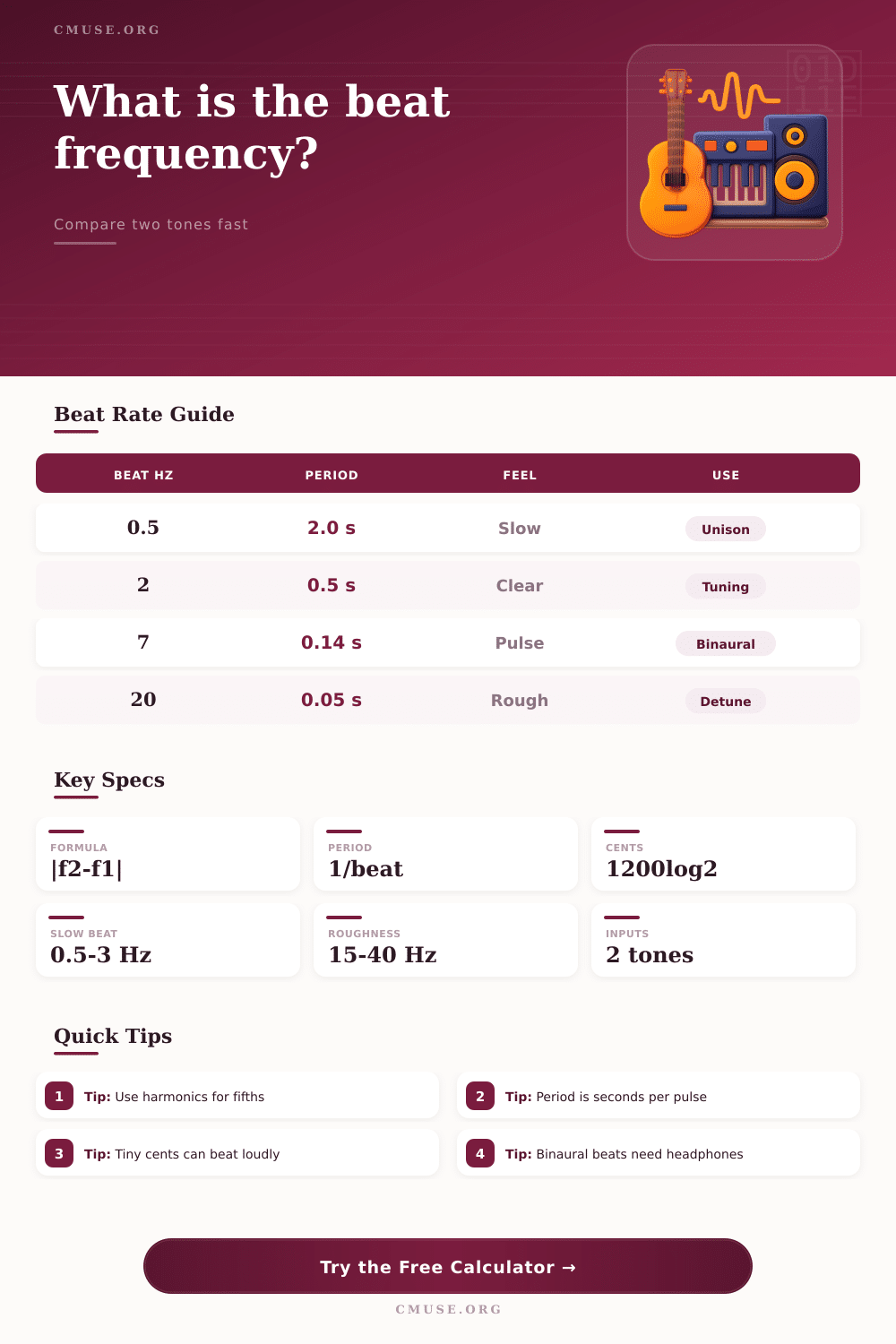
Core formulas: beat frequency = |f2 - f1|, beat period = 1 / beat frequency, harmonic beat = |f2 x h2 - f1 x h1|.
Formula Breakdown
📊Beat Frequency Spec Grid
📐Reference Tables
| Beat Rate | Beat Period | How It Feels | Typical Audio Use |
|---|---|---|---|
| 0.25 Hz | 4.000 s | Very slow swell | Piano unison checks and long sustain listening |
| 0.5 Hz | 2.000 s | Slow pulse | Fine tuning strings, reeds, and vocal drones |
| 1 Hz | 1.000 s | Clear countable beat | Easy reference for matching two steady tones |
| 2 Hz | 0.500 s | Fast tuning beat | Noticeable detuning around A4 440 vs 442 |
| 7 Hz | 0.143 s | Strong flutter | Binaural examples and modulation references |
| 20 Hz | 0.050 s | Roughness zone | Synth detune, chorus thickness, close clusters |
| Preset | f1 | f2 | Expected Difference |
|---|---|---|---|
| A4 440 vs 442 | 440.00 Hz | 442.00 Hz | 2.00 Hz beat, 0.500 s period |
| Piano C4 Unison | 261.63 Hz | 262.13 Hz | 0.50 Hz beat, 2.000 s period |
| Guitar A String | 110.00 Hz | 110.70 Hz | 0.70 Hz beat, 1.429 s period |
| Binaural Headphones | 200.00 Hz | 207.00 Hz | 7.00 Hz beat, 0.143 s period |
| Sub Bass Detune | 55.00 Hz | 56.00 Hz | 1.00 Hz beat, 1.000 s period |
| Power Hum Compare | 50.00 Hz | 60.00 Hz | 10.00 Hz difference reference |
| Interval Check | Compare These Partials | Clean Result | Why It Works |
|---|---|---|---|
| Octave | f1 x 2 vs f2 x 1 | Near 0 Hz | The upper tone should align with the lower tone octave. |
| Perfect fifth | f1 x 3 vs f2 x 2 | Near 0 Hz | A pure 3:2 fifth has matching third and second partials. |
| Major third | f1 x 5 vs f2 x 4 | Near 0 Hz | A pure 5:4 third aligns the fifth and fourth partials. |
| Minor third | f1 x 6 vs f2 x 5 | Near 0 Hz | A pure 6:5 third aligns the sixth and fifth partials. |
| Equal temperament | Chosen partials | Small beat | Tempered intervals usually keep a controlled residual beat. |
| Result Range | Interference Type | Calculation Note | Practical Reading |
|---|---|---|---|
| 0 Hz | No beat | f1 and f2 match after multipliers | The tones are aligned for this comparison. |
| 0.1-3 Hz | Slow beat | Period is easy to count | Useful for fine tuning sustained notes. |
| 3-10 Hz | Flutter | Pulse becomes fast | Good for binaural or deliberate modulation checks. |
| 10-40 Hz | Roughness | Cycles blur together | Often heard as thickness, chorus, or harshness. |
| Above 40 Hz | Separated pitch | Difference acts like its own rate | Usually perceived less as countable beating. |
💡Beat Calculation Tips
A beat frequency occurs when two tone are placed close to one another in pitch. When two tones are placed close to one another in pitch, the air between the two tones pulse. This pulsing is referred to as a beat frequency, and the beat frequency can be heard as a swelling sound or a flutter sound.
The frequency with which the air pulses is dependent upon the distance between the two tones in frequency. Thus, the beat frequency can be used to determine whether two tones are in tune with one another or out of tune with one another. By understanding how to calculate the beat frequency, vague perceptions of when two tones are in tune can be replaced with a precise measurement of the difference between the two tones.
What Is a Beat Frequency and How to Use It
The difference between the two tones create the characteristics of the beat frequency. To calculate the number of beats per second create between the two tones, the frequency of each tone is subtracted from the other tone. The result of this calculation is the beat rate in hertz.
For instance, a beat rate of one-half hertz will result in the sound swelling once every two second. A beat rate of three hertz indicates that the sound will create three pulses of sound per second. Around fifteen hertz, the sound will start to sound rough to the listener.
Around forty hertz, the ear will no longer hear a pulsing sound of the two tones combine, but will instead hear two separate tones in the air. Calculations can be performed with the beat frequency create by the two tones. Each professional utilizes the beat frequency for different tasks in their job.
A piano technician uses the beat frequency to ensure that slow beat frequencies are created between the keys of the piano, as it is easier for the technician to both count and correct these slow beat frequencies. Synthesizer players may desire to create a wider range of beat frequencies create by the synthesizer keys to provide movement to the sound that is created. Audio engineers often use a fifty hertz hum or a sixty hertz hum to determine if the interference with the sound is slow in nature or if the interference is faster than desired.
Each task requires the same calculation of the beat frequency of the two tones, but the decision of what is done with that calculated frequency may differ according to each professional’s job. Harmonics complicate the understanding of beat frequencies yet also provide additional use for understanding beat frequencies. For instance, the third harmonic of a given tone can be compared to the second harmonic of another tone to determine if the interval between the two notes is a perfect fifth.
If the two notes contain the same harmonics in the same number, the intervals is said to be “pure.” However, if there is a beat frequency create by those two intervals, the interval between the two tones is deemed to be out of tune. This same application can be used for measuring octaves, major thirds or minor thirds. Additionally, each of these instruments will naturaly emit some of these harmonics, allowing for these comparisons to take place.
Another way to measure the distance between the two tones is in terms of cents. There are twelve hundred cents within a single octave. For instance, if the difference between two tones is seven cents, the difference between the two tones is small.
However, that same difference in cents will create a beat frequency in the higher octave. The concept of tempo and beats per minute (BPM) relate to the beat frequency. For instance, if the beat rate in hertz is known, that value can be translated into the number of beats that will relate to the BPM of the song.
For instance, a two hertz beat will create eight pulses within a four-beat bar for music with a tempo of 120 BPM. Thus, the relationship between the two allow for understanding why certain chorus effects may sound better at one tempo than another. Each of the conditions in which the songs are played can impact how the beat frequency is heard.
For instance, a slow beat frequency may be easily heard when playing headphones, but may not be heard in a large room with alot of reverberation. Fast rough frequencies may be heard harshly when each sound is played separately, but may be enjoyed by listening to the sound blended with other instruments. Binaural beats require separate tone to each ear.
Thus, binaural beats will dissapear when the two tones reach each ear at the same time. Thus, each of these factor can impact the hearing of the beat frequency. Tables can provide reference information regarding beat frequencies.
For instance, slow beat frequencies will be under three hertz and will be used for fine tuning of instruments. The seven hertz zone is used in binaural beat examples. Rough frequencies are between fifteen and forty hertz.
Anything beyond forty hertz will be perceived as two separate tones. These range allow individuals to understand if a beat frequency is normal or requires fixing. Individuals should of learn to use the concept of beat frequencies as information in creating music rather than attempting to make every interval between tones have a zero beat rate.
For instance, some musical intervals are specifically “tempered” to have a small beat rate, and removing that beat rate may make the music sound lifeless. In other instances, such as when two singer are attempting to match pitch with each other, the singer will need to utilize some patience to ensure that any created beat frequency is only one pulse every two or three second. Each of these examples indicate that the difference between these tasks is not in the calculation of the beat rate, but in the musical goal of the individual that calculates the rate.
In addition to the information regarding beat rate, individuals must pay attention to how long the tones exist in the air. For instance, if the beat frequency takes four second to complete, the tone must last for at least four seconds to allow for individuals to hear the beat frequency. Any sound that are short and percussive will hide the beat frequency.
This is why piano tuners allow the notes to decay over time. This is also the reason that guitarists may have difficulty hearing beat frequencies on their lower string of the guitar. The calculation of the beat frequency will be the same, but the ear will not hear the beat frequency without allowing the sound to continue for at least the same length of time.
The beat frequency is information regarding the interaction between the two vibration. The calculator translates that information into number that an individual can read. What is done with those number is up to the individual and the music that they are creating with those instruments.