Bb Instrument Transposition Calculator
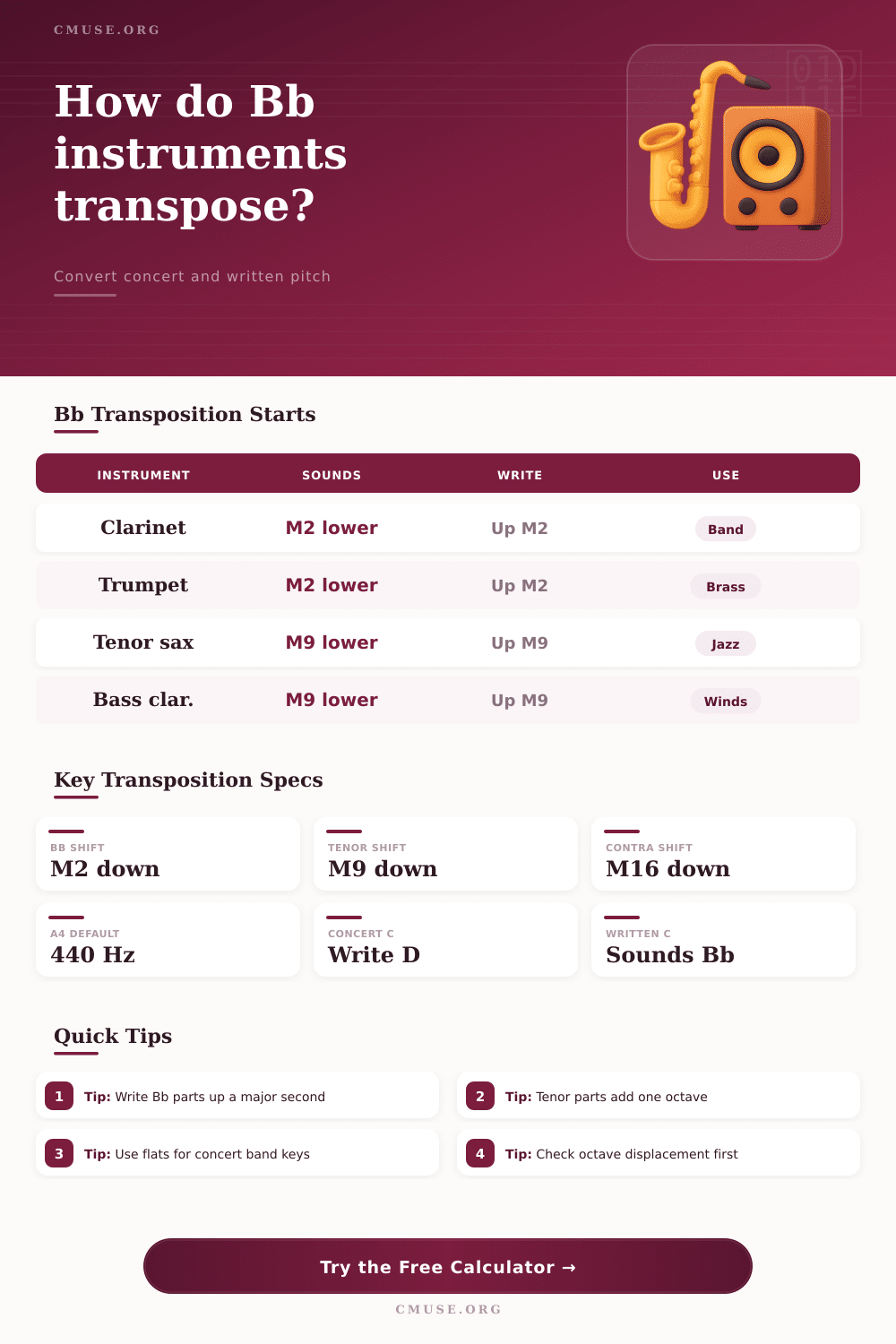
Convert between concert pitch and written pitch for B-flat clarinet, trumpet, cornet, flugelhorn, soprano sax, tenor sax, bass clarinet, euphonium treble clef, bass sax, and contrabass clarinet parts.
Load a named transposition situation, then adjust the source note, octave, key, spelling, tuning reference, and cents offset. Standard B-flat treble instruments sound a major second lower than written; tenor and low B-flat parts add octave displacement.
Calculation Breakdown
Sounds below written
Concert to written
Typical written range
Common notation
| Instrument Profile | Written C Sounds | Concert To Written | Written To Concert | Typical Use |
|---|---|---|---|---|
| Bb clarinet | Bb, major second lower | Write up major second | Sound down major second | Band |
| Bb trumpet, cornet, flugelhorn | Bb, major second lower | Write up major second | Sound down major second | Brass |
| Bb soprano saxophone | Bb, major second lower | Write up major second | Sound down major second | Sax choir |
| Bb tenor saxophone | Bb an octave plus major second lower | Write up major ninth | Sound down major ninth | Jazz band |
| Bb bass clarinet, treble notation | Bb an octave plus major second lower | Write up major ninth | Sound down major ninth | Wind band |
| Bb bass sax and contrabass clarinet | Bb two octaves plus major second lower | Write up major sixteenth | Sound down major sixteenth | Low reeds |
| Concert Key | Standard Bb Part | Tenor Or Bass Clef Octave | Quick Check |
|---|---|---|---|
| C major / A minor | D major / B minor | D major / B minor | Add two sharps |
| F major / D minor | G major / E minor | G major / E minor | Remove one flat |
| Bb major / G minor | C major / A minor | C major / A minor | Remove two flats |
| Eb major / C minor | F major / D minor | F major / D minor | Remove two flats |
| Ab major / F minor | Bb major / G minor | Bb major / G minor | Keep flats simple |
| G major / E minor | A major / F# minor | A major / F# minor | Add two sharps |
| Concert Note | Bb Clarinet / Trumpet | Tenor Sax / Bass Clarinet | Low Bb Reed |
|---|---|---|---|
| Concert Bb3 | Write C4 | Write C5 | Write C6 |
| Concert C4 | Write D4 | Write D5 | Write D6 |
| Concert F4 | Write G4 | Write G5 | Write G6 |
| Concert G4 | Write A4 | Write A5 | Write A6 |
| Written C5 | Sounds Bb4 | Sounds Bb3 | Sounds Bb2 |
| Written D5 | Sounds C5 | Sounds C4 | Sounds C3 |
| Written Pitch | Standard Bb Sound | Tenor Bb Sound | Concert Frequency At A4 440 |
|---|---|---|---|
| C4 | Bb3 | Bb2 | 233.08 Hz / 116.54 Hz |
| D4 | C4 | C3 | 261.63 Hz / 130.81 Hz |
| G4 | F4 | F3 | 349.23 Hz / 174.61 Hz |
| C5 | Bb4 | Bb3 | 466.16 Hz / 233.08 Hz |
| F5 | Eb5 | Eb4 | 622.25 Hz / 311.13 Hz |
| A5 | G5 | G4 | 783.99 Hz / 392.00 Hz |
This is especially true when trying to transpose for a wind band, where you try to turn all those headache-inducing sharps and flats into something close to original melody in your head. That melody in your head are in C major, but the trumpet part has to be written out in D major. The tenor sax player need that same melody written up an octave more than the clarinetist.
If you’ve ever looked at a blank score and wondered if a note should be a B-flat, a C, or a D, then you will be familiar with the confusion of transposition. It depends not on advanced maths but simply on knowing fixed relationships between what you write and what you hear. Once you set up your instrument profile, the tool do the work for you, no more counting semitones one note after another.
How Transposition Works for Wind Instruments
It’s a simple idea at its heart but one that can easily trip you up unless you’re in a hurry. What does it mean? Any instrument in Bb sounds as if it is a major second (a whole step) lower different than actual pitch. So when a clarinettist sees a C on their part, what they’ll hear coming from the end of their instrument is not a C at all but rather a B flat just under middle C. If you wish them to perform that C concert, then they need to be given a D to play. It’s called a major second upwards jump. Soprano saxophones, cornet and trumpet players all plays by the same rule. The interval leap is automated by calculator leaving your mind free to consider the harmonic context without fear of a slip with arithmetic.
The additions of bass clarinet and tenor saxes is more subtle. Here again, instrument pitches a major second below, but it has an octave added. This means that written note of C4 is actualy a Bb3 (a whole step down plus an octave) on the tenor saxophone. Many players fail to account for this octave changeover when transcribing their part from a lead sheet into a fully orchestrated piece. Luckily, the calculator know the profile of each and will place woodwind or low brass part in the right register for the performing musician. Simply choose the instrument type, enter the concert pitch and software outputs where you need to write on the score.
The same applies when you come across a change of key signature. This time, you also have to be aware of how to spell accidentals correctly. So if you’re playing in F major (one flat), you’ll have the key signature of G major (one sharp) for all B-flat instruments. Many learners stumble here as they anticipate the key signature would move up circle of fifths unchanged except that it turns from flats into sharps. That’s the rub! Think of transposing as more of a translation exercise than a mathematical formula. You aren’t just shifting the notes around; you are translating between languages. In terms of notation, the way we choose to spell things does make a world of difference. To the untrained ear, an A-sharp and a B-flat may sound the same on the piano, yet if you are trying to read some advanced horn music, it’s going to confuse them. As such, B-flat instruments naturaly sit in Bb major as their home key with flats being the standard way to write them. Sharps can transform what should of been easy scales into chromatic nightmares. Thankfully the calculator let you switch between spelling preferences so you can write how you feel is most readable, even if it isn’t strictly theoretically equal. It’s a small change that makes a huge difference in cleanliness of your finished score.
Another thing that affects precision is tuning standard. Digital instruments all presume 440 Hertz as their A4 but most wind players do not. To compensate for the natural sharpness of woodwind and brass instruments they frequently tune to 442 or 443 Hertz respectively in warmer rooms. Being able to alter the reference pitch means that what comes out of the speakers will be relative to the reality of the room you practice in. It’s a little thing but something worth considering if you’re using a drone or synthesizer to check your intonation.
Transposing can be learned over time and knowing how intervals relates to each other will make it easier. Since B-flat instruments are just one step above concert pitch, you can simply add a whole step to find the right notes without needing to know exactly which note goes where. That’s the beauty of this calculator. When you hit an octave jump or a difficult accidental, it’s there like a security blanket to confirm your efforts. As you learn the ‘why’ behind the note shifts, these become more of a second thought than the instruments themselves. Eventually, you begin to hear the transposition in your head before you even put pencil to paper, transforming the initial stumbling block into a normal step in your arranging workflow.