Batter Resonant Pitch Ratio Calculator
Compare top and bottom drumhead pitches, convert the ratio into cents, estimate relative tension balance, and find a target resonant pitch for snare, tom, and kick tuning.
Choose a practical tuning starting point, then refine the drum size, head profiles, measured pitches, lug spread, and sustain target. Enter the average pitch you hear near the rim for each head after the lugs are evened.
Calculation Breakdown
| Resonant / Batter Ratio | Cents Offset | Typical Drum Use | Audible Result | Adjustment Cue |
|---|---|---|---|---|
| 0.80 to 0.90 | -386 to -182 cents | Kick drum or short floor tom effect | Deep drop, fast decay, less open ring | Raise resonant head if the note feels choked. |
| 0.90 to 0.97 | -182 to -53 cents | Warm tom and low resonant floor tom | Pitch falls after attack, rounded sustain | Use even lug taps to keep the fall smooth. |
| 0.98 to 1.02 | -35 to +34 cents | Matched toms, concert toms, open tuning | Stable center pitch and longest perceived note | Control ring with small damping, not large pitch gaps. |
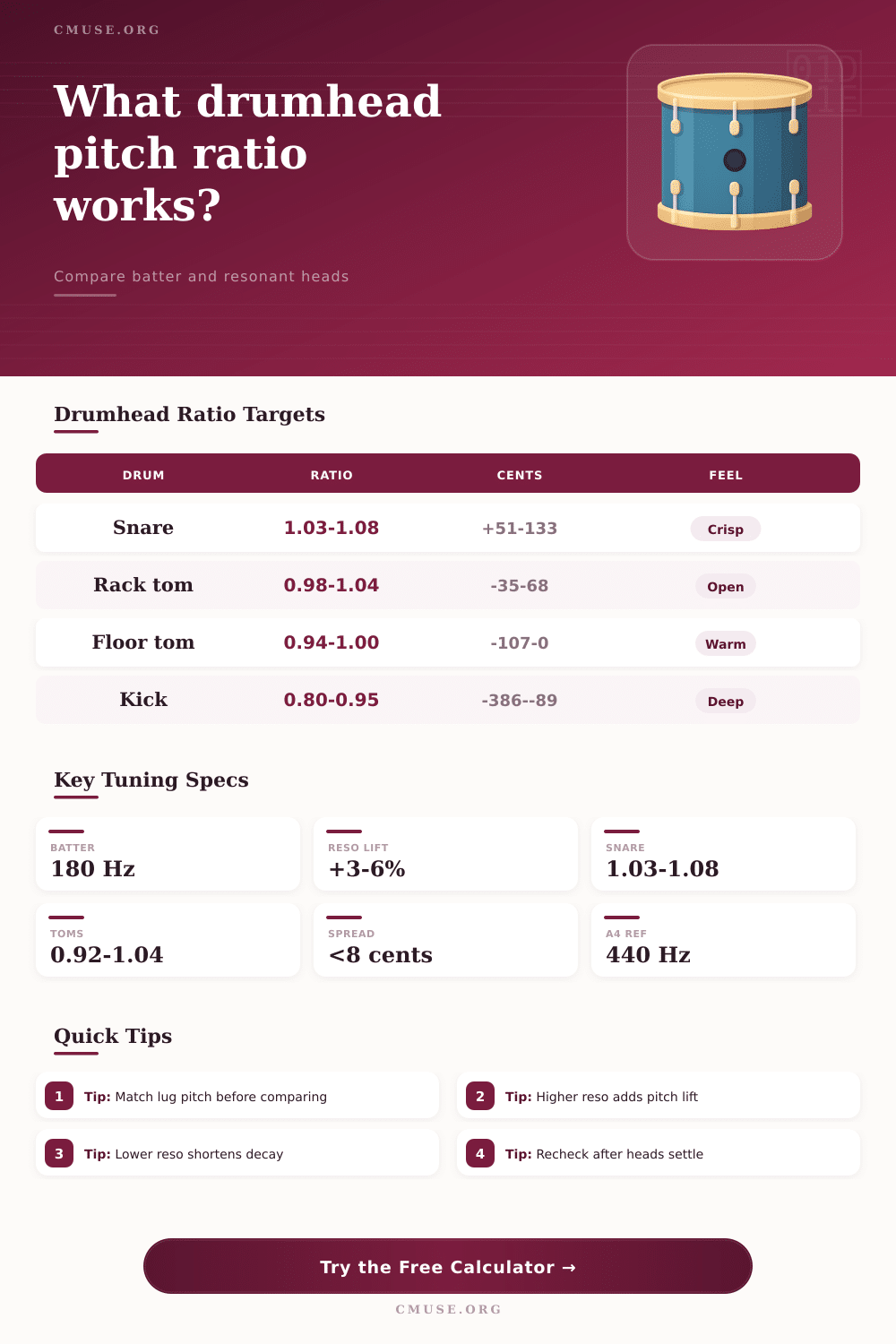
| 1.03 to 1.08 | +51 to +133 cents | Snare clarity and open rack tom lift | Pitch rises slightly, with extra articulation | Good zone for crisp response without sounding thin. |
| 1.09 to 1.16 | +149 to +257 cents | Bright snare, piccolo, effect toms | Noticeable upward bend and shorter body | Watch for bottom-head tension overload. |
| Above 1.16 | Above +257 cents | Special effects and very tight resonant heads | Sharp lift, papery bottom, reduced depth | Lower resonant head unless that bend is intentional. |
| Drum | Size | Batter Pitch Range | Resonant Ratio | Practical Character |
|---|---|---|---|---|
| Piccolo snare | 13 x 3 to 13 x 4 in | 250 to 360 Hz | 1.06 to 1.15 | Fast attack, tight snare response, bright shell note. |
| Standard snare | 14 x 5 to 14 x 6.5 in | 180 to 280 Hz | 1.03 to 1.10 | Good wire response with enough body for backbeats. |
| Small rack tom | 8 to 10 in | 180 to 300 Hz | 0.98 to 1.05 | Open note and clear melodic placement in fills. |
| Medium rack tom | 12 to 13 in | 120 to 210 Hz | 0.96 to 1.04 | Balanced sustain without a steep pitch drop. |
| Floor tom | 14 to 18 in | 65 to 140 Hz | 0.92 to 1.00 | Warm bloom, controlled tail, and deeper fundamental. |
| Kick drum | 18 to 24 in | 45 to 95 Hz | 0.80 to 0.95 | Front head shapes depth, punch, and decay length. |
| Head Profile | Relative Mass | Damping | Best Role | Ratio Note |
|---|---|---|---|---|
| Thin resonant 7 mil | 0.72 | Very low | Tom resonant head | Reaches high pitch with less tension than a batter head. |
| Snare-side 3 mil | 0.34 | Very low | Snare bottom head | Use pitch ratio for response, not equal physical tension. |
| Clear single-ply 10 mil | 1.00 | Low | Open batter or resonant head | Closest to direct pitch-ratio tension comparison. |
| Coated single-ply | 1.06 | Medium-low | Snare and tom batter | Slightly more mass softens the same pitch. |
| Double-ply 14 mil | 1.48 | Medium | Rock tom batter | Needs more tension for the same measured pitch. |
| Hydraulic head | 1.70 | High | Short controlled batter sound | Ratio may look normal while sustain stays short. |
| Preset | Drum Size | Batter / Resonant | Target Ratio | Reason To Use It |
|---|---|---|---|---|
| 14 Snare Crisp Pop | 14 x 5.5 in | 220 / 235 Hz | 1.06 | Crisp articulation with a clear upward bottom-head lift. |
| 14 Snare Fat Backbeat | 14 x 6.5 in | 185 / 190 Hz | 1.03 | Lower batter tone with enough resonant support for wires. |
| 12 Rack Tom Open | 12 x 8 in | 165 / 168 Hz | 1.02 | Open melodic tom without a dramatic pitch bend. |
| 16 Floor Tom Warm | 16 x 16 in | 92 / 88 Hz | 0.96 | Warm decay and lower tail for rock or studio tuning. |
| 22 Kick Punch | 22 x 16 in | 62 / 52 Hz | 0.86 | Low front-head tuning for depth and controlled punch. |
| Jazz Tom Long Note | 13 x 9 in | 150 / 153 Hz | 1.02 | Matched ringing tom voice for open acoustic kits. |
If most drummers are like me they think that once you have all the lugs on the batter head matched in pitch then you’re done. But even if it takes you twenty minutes to balance out the rim so it sounds the same, if you play hard on the drum it will still be choked or dull sounding. No, it’s not because of how you tune. It’s probably because of what happens with both head together.
The way they interact affects the sound of this instrument more than just one single head do. This leaves us with the batter resonant pitch ratio calculator. Essentially it does all the hard work for you. It will compare the resonance of one end of the shell (the other head) against the frequency of what you play on that same side of the drum.
How to Use the Drum Pitch Ratio Calculator
This allows you to see if you have a warm sound, a sustained sound, or a punchy sound from the drum. All you do is pick the type of drum and put in the Hertz values for each head. Then, select your desired ratio. The tool will tell you how many cents away you are and where you need to adjust.
To understand this we have to look beyond feelings and into the physics. The drum isn’t one membrane that vibrates; it’s two, and between the two is a column of air. Altering the tension in one alters its pitch compared to the other. The closer together the pitches, the stronger the coupling of the air in the column which produces a rich sustain.
But the greater difference in pitch mean the lower resonant head becomes more like a dampener, killing overtones and reducing decay. That’s why snare drums needs a higher resonant head for crispness, while floor toms sound best with a lower bottom head. These considerations can be played around with using the calculator, no guess work needed.
On a snare drum for instance, the common ratio would be in the range 1.03- 1.08 as this will pull the pitch up a little on the rebound while still giving the wires room to sing. Crowded together they can overpower the fundamental note. Toms vary. An open, melodically tuned rack tom with a small resonant drop or matched heads is open and sings. If you push the resonant head too far above the batter, you get a sharp attack, but the body of the sound is killed. It becomes thin and glassy.
The reference table on the page details the areas to give an idea of where different genres lie. The other thing is the real world aspect of the heads themselves. A two ply covered head is heavier than a single ply clear head. This means that the resonant head often needs significantly less tension to reach the same pitch as the batter.
Many players pull on their bottom head too tightly, thinking equal tension means equal pitch, but that is rarely true unless both heads are identical. The calculator takes this into account and estimates how much balance there should of be between the two based off head profile. This helps ensure you don’t snap a thin film head or overstress the shell.
There’s another more subtle factor: temperature. As we all know, heat impacts air density which will change the resonance of that air column within the shell. What sounds perfectly tuned in your warm studio can be just a little flat in your cold-weather venue. This is where the ability to enter the room temperature into the tool to adjust for that variable in various locations becomes important. It may seem like a small thing but on gig after gig, chasing consistency makes it matter.
Presets aren’t always the silver bullet. Think of them as a launching pad. Even out the lugs then plug in your measured pitches. First, adjust the higher lug if needed until the cents offset is low enough. Millimeters is where fine tuning occurs. After you’ve stabilized the heads, use the ratio to form the character.
Do you want a ring? Lift the resonant head nearer to the batter pitch. Do you want a punch? Drop it lower. Control This is control. Knowing why that snare cuts in the mix. Why does that floor tom feel warm? Because it’s not magic. Tension and geometry are at work.
Learn the ratio. Stop guessing and start engineering your sound. That brings clarity to every practice session. It makes them more productive. And the trick is knowing what the hell is really being measured. Now you’ve got the numbers to prove it.