🎸 Bass Calculator
Calculate coverage, volume, and material quantities for bass acoustic treatment projects
lbs / cu yd
lbs / cu yd
lbs / cu yd
lbs / cu yd
lbs / cu yd
lbs / cu yd
lbs / cu yd
lbs / cu yd
| Depth | Sq Ft / Cu Yd | Sq M / Cu M | Cu Ft / Cu Yd |
|---|---|---|---|
| 1 in (2.54 cm) | 324 sq ft | 30.1 m² | 27 cu ft |
| 2 in (5.08 cm) | 162 sq ft | 15.1 m² | 13.5 cu ft |
| 3 in (7.62 cm) | 108 sq ft | 10.0 m² | 9.0 cu ft |
| 4 in (10.16 cm) | 81 sq ft | 7.5 m² | 6.75 cu ft |
| 6 in (15.24 cm) | 54 sq ft | 5.0 m² | 4.5 cu ft |
| 8 in (20.32 cm) | 40.5 sq ft | 3.8 m² | 3.4 cu ft |
| Bag Size | Volume / Bag | Bags / Cu Yd | Coverage @ 3 in |
|---|---|---|---|
| 2 cu ft bag | 2 cu ft | 13.5 bags | 8 sq ft |
| 3 cu ft bag | 3 cu ft | 9 bags | 12 sq ft |
| Bulk (1 cu yd) | 27 cu ft | 1 unit | 108 sq ft |
| Half pallet | 13.5 cu ft | 0.5 yd | 54 sq ft |
| Full pallet | 54 cu ft | 2 yd | 216 sq ft |
| Project | Area (sq ft) | Cu Yds @ 3 in | Bags @ 3 in (2 cu ft) |
|---|---|---|---|
| Vocal Booth 4x4 | 16 sq ft | 0.15 yd | 2 bags |
| Recording Booth 5x5 | 25 sq ft | 0.23 yd | 3 bags |
| Home Studio 10x12 | 120 sq ft | 1.11 yd | 15 bags |
| Practice Room 8x8 | 64 sq ft | 0.59 yd | 8 bags |
| Drum Room 12x12 | 144 sq ft | 1.33 yd | 18 bags |
| Live Room 15x20 | 300 sq ft | 2.78 yd | 38 bags |
| Stage Area 20x16 | 320 sq ft | 2.96 yd | 40 bags |
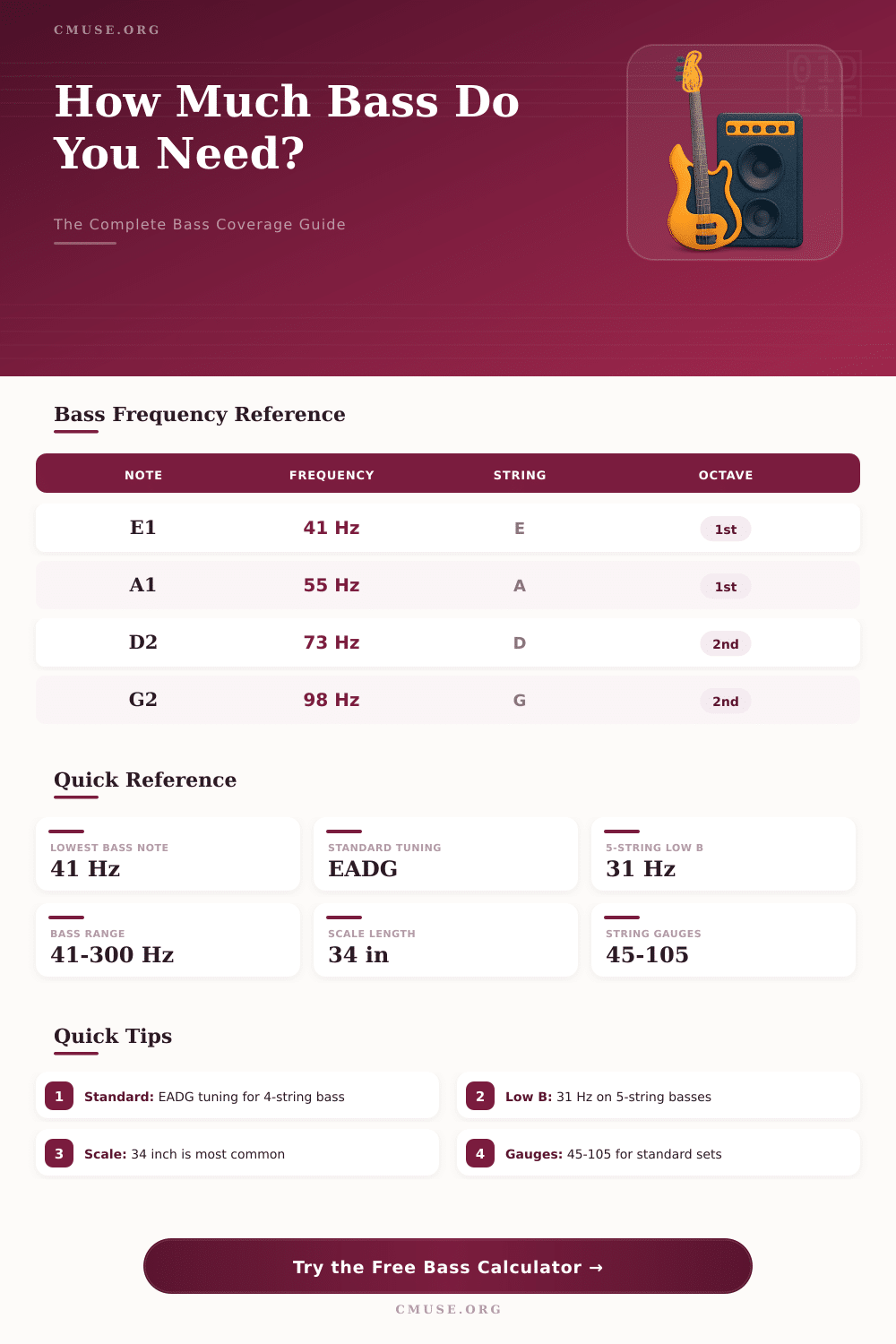
| Note | Frequency (Hz) | Bass String | Wavelength (ft) |
|---|---|---|---|
| B0 (5-string) | 30.87 Hz | Low B | 36.2 ft |
| E1 (open E) | 41.20 Hz | E string | 27.1 ft |
| A1 (open A) | 55.00 Hz | A string | 20.3 ft |
| D2 (open D) | 73.42 Hz | D string | 15.2 ft |
| G2 (open G) | 98.00 Hz | G string | 11.4 ft |
| C2 (low C) | 65.41 Hz | C string (6) | 17.1 ft |
“Bass” is one of those words that requires much clarity to escape confusion. It can point to species of fish, musical instrument or low sound frequency. Because all those meanings are different it is worth looking into them one after the another.
If you talk about fish, “bass” relates to a group of various species in the ray-finned fish family, most commonly in the orders Perciformes and Moroniformes. One finds them in freshwater lakes and rivers, as well as in salt water. The saying rhymes with “class”, not with “base”.
What Bass Means
They are used for food and appear in various families as Centrarchidae, Serranidae and Percichthyidae. Fishing of bass is really popular. For instance, Oregon became known because of its great places for bass fishing.
Professional events, as the Bassmaster Classic, attract many fisherfolk, and the sport even includes kayak-based tournaments in the Bassmaster network. There is a whole wrold of fans dedicated to that game.
Now we turn to the bass guitar. This instrument covers the bottom part of the guitar family, really the lowest voice in the group. It looks like an electrical guitar, but with a much longer neck and scale.
A normal model has four strings, set to E-A-D-G. These match the lowest four strings of a regular guitar, only one octave lower. Some musicians choose five or even six strings.
In styles like rock, pop, R&B, metal, reggae, funk or jazz fusion; you name it, the bass guitar stays the core that keeps the harmony and gives rhythm to modern music.
Names like Nathan East, Tony Kanal, Billy Sheehan, Glenn Hughes, Peter Hook and Jack Gibson all turned too the Yamaha BB-bass after its launch in 1977. Acoustic bass guitars exist, but really they do not work well in concerts. So they stay rare.
The electrical bass fully changed popular music during the past fifty years, almost replacing the role of the upright or double bass that one used before.
Here is the place where it gets really interesting in music: the bass defines the color and the type of chords. If you play low C under the notes C-E-G, you have a C-major chord. Change that C to low G under the same notes, and now it becomes G-minor.
When the melody rests on the root note in the bass, the sound seems deeper. Most bass lines use patterns based on the root, fifth and octave.
In the area of frequencies, “bass” as a concept covers low sounds of around 16 Hz until about 250 Hz. What is surprising is that bass is not only heard; you really feel it in your body. That is why earphones fail todeliver real deep sound; they simply are not made for that.