🔊 Bass Reflex (Ported) Speaker Calculator
Design your ported enclosure: box volume, port dimensions & tuning frequency
| Port Dia (in) | Port Dia (cm) | Fb 30 Hz (cm) | Fb 40 Hz (cm) | Fb 50 Hz (cm) | Fb 60 Hz (cm) |
|---|---|---|---|---|---|
| 1.5" | 3.81 cm | — | 8.5 | 4.8 | 2.5 |
| 2" | 5.08 cm | 18.2 | 11.4 | 6.8 | 4.0 |
| 3" | 7.62 cm | 32.5 | 20.2 | 12.3 | 7.8 |
| 4" | 10.16 cm | 56.8 | 35.4 | 21.8 | 14.1 |
| 6" | 15.24 cm | 128.0 | 79.8 | 49.2 | 32.0 |
✱ Values approximate for Vb = 40L with 1 port. Actual length varies with box volume.
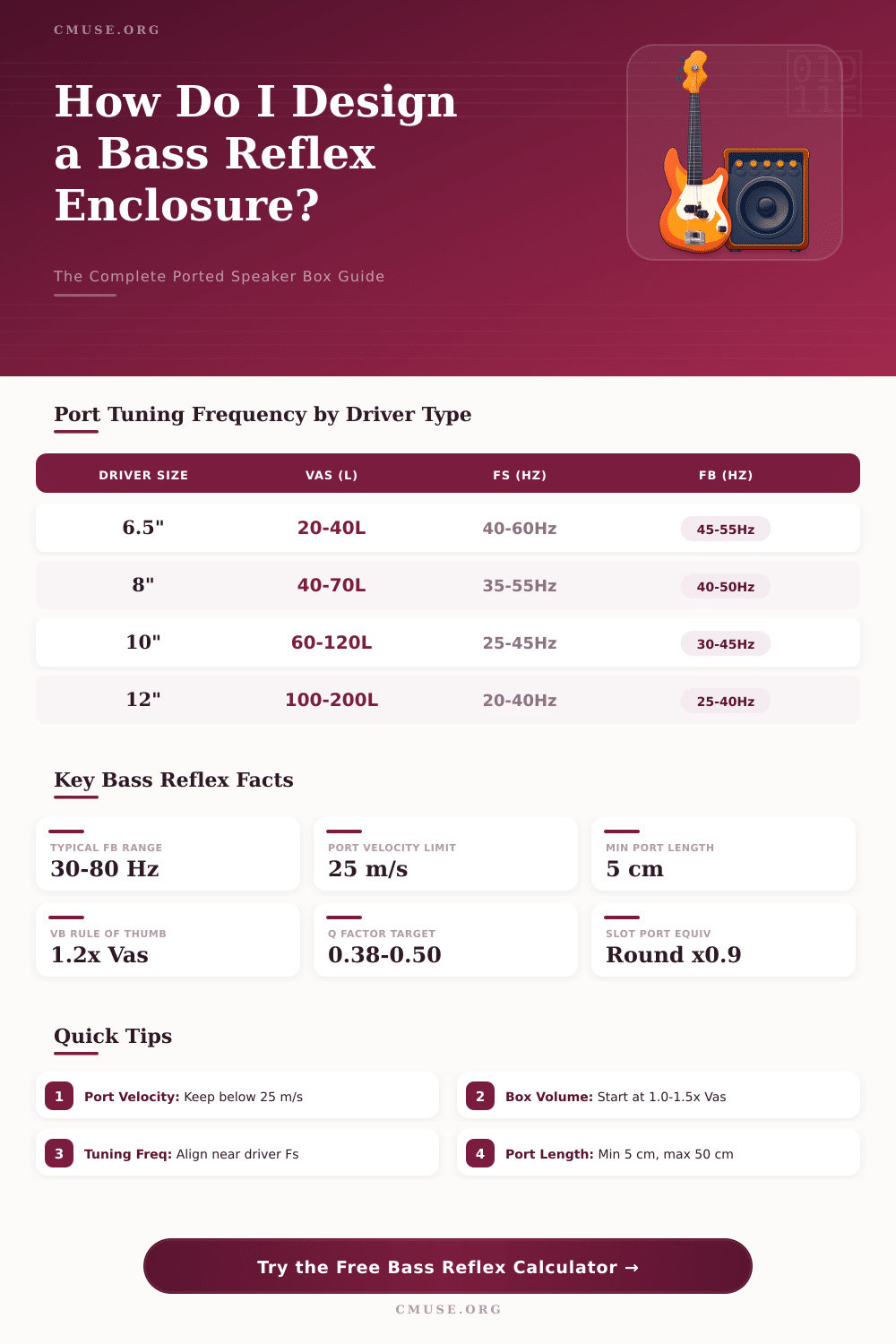
| Driver Size | Min Vb (L) | Typical Vb (L) | Max Vb (L) | Min Vb (cu ft) | Typical Vb (cu ft) |
|---|---|---|---|---|---|
| 4" | 2 | 4 | 8 | 0.07 | 0.14 |
| 5.25" | 5 | 8 | 15 | 0.18 | 0.28 |
| 6.5" | 12 | 20 | 40 | 0.42 | 0.71 |
| 8" | 20 | 40 | 80 | 0.71 | 1.41 |
| 10" | 35 | 65 | 150 | 1.24 | 2.30 |
| 12" | 55 | 90 | 200 | 1.94 | 3.18 |
| 15" | 100 | 180 | 400 | 3.53 | 6.36 |
| Velocity (m/s) | Rating | Port Condition | Recommendation |
|---|---|---|---|
| < 10 m/s | ⭐⭐⭐ Excellent | Silent, no chuffing | Ideal for high-SPL |
| 10–17 m/s | ⭐⭐ Good | Minor noise possible | Acceptable for most |
| 17–25 m/s | ⭐ Marginal | Chuffing may occur | Increase port area |
| > 25 m/s | ⚠ Poor | Audible chuffing | Redesign required |
The Bass Reflex box forms a key part in the building of speakers. In such box, the port allows the air to flow freely in and from all directions from the inside. That structure improves the response to low tones and ensures a cleaner sound than in closed models.
Beyond that, it strengthens the impact and lowers the noise, directing the back wave of the speaker cone through the port.
How a Bass Reflex Box Works
The size of the inner space in the box must one care a lot. It acts directly on the resonant frequency of the whole device. Depending on that frequency certain bass tones receive a boost.
When the inner space grows, the resonant tone lowers. To reach the right size of the box, that truly matters, if one wants good response to the bass.
From a physical viewpoint, the Bass Reflex speaker box acts like a vibrating spring with mass above it. The whole air content in the main part acts as the elastic element. The air inside the port pipe works as the mass bit.
Together, the volume of the box, the length and the width of the port create a Helmholtz resonator. If one does it well, it boosts the bottom tones without producing too much excess or week duration of the sound.
In practical building, there are other spots, that one must consider. The speaker itself takes up some space inside. The inner stiffening and the thickness of the material walls also take from the space.
Even a tiny change in the volume of the material or in the length of the port can fully change the resonant tone, the range of the bass or the smoothness of the bottom sound.
The port of the Bass Reflex box affects only the bass zone. Middle and upper frequencies must stay absorbed inside. In a closed box, layers of absorbing material indeed expand the felt size.
So in Bass Reflex type, where one lays only one thin layer to cover the walls, that does not help truly.
Bass Reflex boxes are simpler, cost less and can be made smaller compared to bandpass type. Some of the most faithful speakers that ever were built, are those with a port. Some parts of the ported design stop it from being very precise.
Even so, reflex boxes show a more sudden drop of 24 dB each octave under the resonant spot. The closed speaker below his limit drops more slowly, while the reflex version drops morequickly.
To control the bass, if it sounds too boomy, one can stuff the ports. That gives a tighter and cleaner tone. Extending the tube of the Bass Reflex port forms another chance to try.
The position also matters. In rear-ported monitors, one places the port away from the listener, to lower the noise from it. Basically, the Bass Reflex system trades a bit of accuracy for more sound or deep range in a smaller, cheaper box.