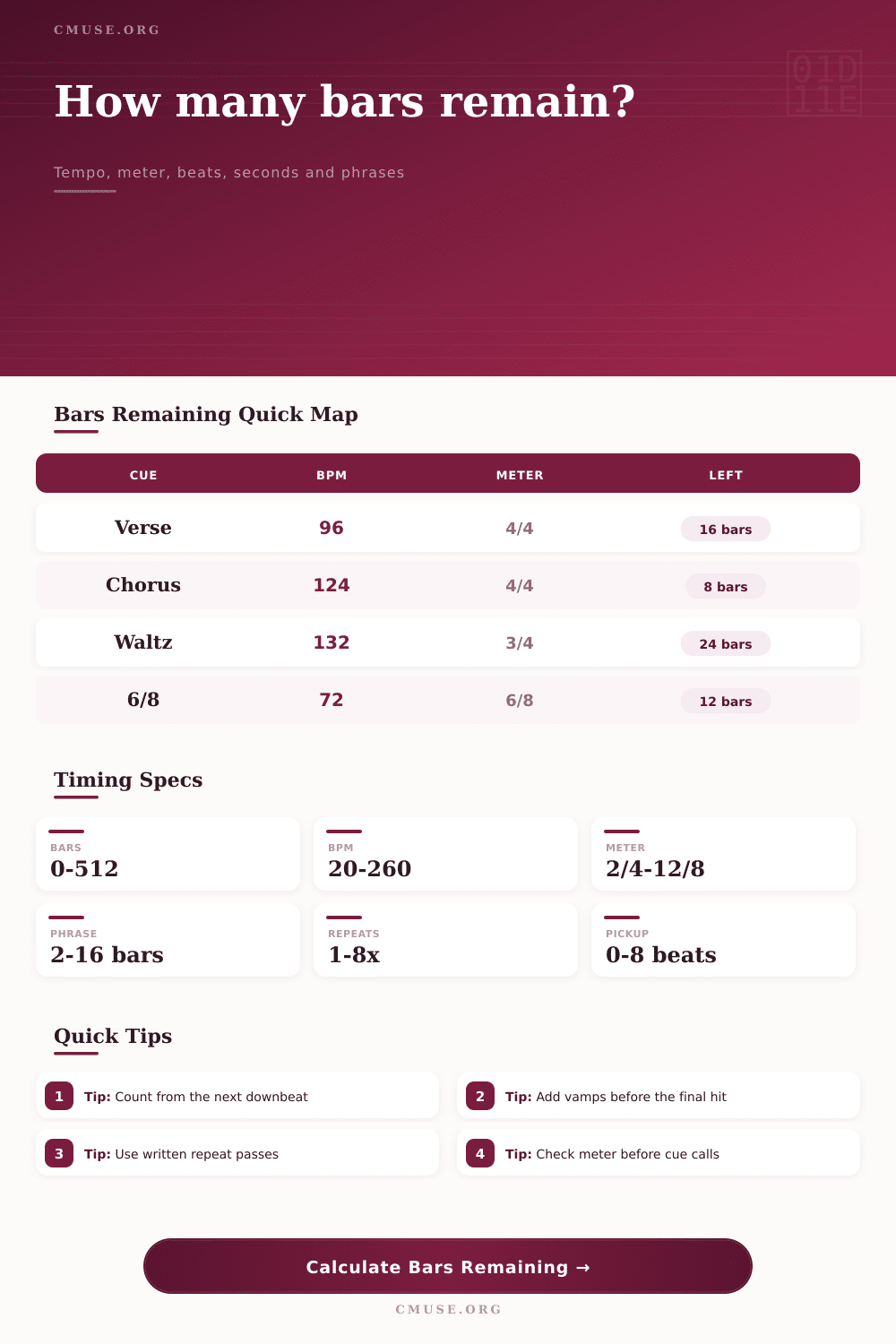
Bars Remaining at Tempo Calculator
Convert the current cue position, destination bar, BPM, meter, pickup beats, repeats and vamps into exact remaining bars, seconds, beats and phrase counts.
Preset use: Load a real cue situation, then adjust the current bar, destination bar, meter, tempo, repeats and phrase length for your chart.
Full Breakdown
| Scenario | Tempo | Bars Left | Remaining Time | Cue Use |
|---|
| BPM | One beat | One bar | 8 bars | 16 bars |
|---|---|---|---|---|
| 72 | 0.833 s | 3.333 s | 26.667 s | 53.333 s |
| 96 | 0.625 s | 2.500 s | 20.000 s | 40.000 s |
| 112 | 0.536 s | 2.143 s | 17.143 s | 34.286 s |
| 124 | 0.484 s | 1.935 s | 15.484 s | 30.968 s |
| 128 | 0.469 s | 1.875 s | 15.000 s | 30.000 s |
| 160 | 0.375 s | 1.500 s | 12.000 s | 24.000 s |
| Meter | Quarter-note units | At 90 BPM | At 120 BPM | Common cue feel |
|---|---|---|---|---|
| 2/4 | 2.00 | 1.333 s | 1.000 s | March, two-feel pickup |
| 3/4 | 3.00 | 2.000 s | 1.500 s | Waltz or theater scene |
| 4/4 | 4.00 | 2.667 s | 2.000 s | Pop, rock, click cues |
| 5/4 | 5.00 | 3.333 s | 2.500 s | Odd-meter section count |
| 6/8 | 3.00 | 2.000 s | 1.500 s | Compound ballad pulse |
| 7/8 | 3.50 | 2.333 s | 1.750 s | Grouped 2+2+3 cues |
| Meter | One bar | 4 bars | 8 bars | 16 bars |
|---|
| Phrase Size | Bars Remaining | Full Phrases | Leftover Bars | Call Timing |
|---|
In a song, there is often a moment where the band leader has to stand up, put on his serious face, and get ready for the cue or that final chord. He can’t do this by ear because when the tempo drag or pushes slightly, there is no way to guess exactly when the cue is coming just by listening.
You need a clear map to tell you how much more time it takes you to be where you want to be. Put your meter, your BPM, your starting bar, your ending bar and repeats if needed into the tempo calculator and it does all the maths for you at those bars. You don’t have to do any mental arithmetic on the fly at some critical point while on stage.
Why Use a Tempo Calculator?
It shows you exactly how many more phrases you need to perform. It give you a sense of concrete numbers of time rather than the abstract measure of distance in music. This is transformative when playing as a band together and when relating to an audience.
As you’d imagine, inputting it takes a little consideration as the music isn’t always neatly aligned. If your cue starts on beat three rather than one then this is accounted for on the tool at the beginning of the piece with any half-bars. It will also deal with more difficult time signatures like 7/8 or 6/8, it translates these into a more familiar quarter note equivalent.
You can add repeat bars and extra tags to make a section longer then what is shown in the written chart. This flexibility is essential as when playing live there’s an element of improvisation that won’t be captured in sheet music.
This enables you to correctly apply the output but only if you understand what the setting is. For example, not allowing for a two-beat pickup note mean that your calculation is out by half a bar. Likewise, not factoring in an additional vamp loop will mean the singer rushes ahead too soon or sits awkward waiting in silence.
Below is a table of reference showing the impact that tempos has on the length of typical phrases. Take a song that’s played at a slow ballad tempo and one that is faster paced like punk rock. A sixteen-bar phrase played at 72 BPM takes considerably longer to reach the end than when played at 120 BPM. There is far less leeway here.
In this case, the calculator translates this into number of beats and seconds allowing you to get a sense of how long it actualy takes to play through. It connects the chart-reading experience to the playing experience itself.
The concept of temporal space has been shown to be something that is not well understood by many during rehearsal situations. It may have felt like it was dragging but it was fine in rehearsal because of the energy in the room. If you know how many more phrases there are then you can plan to play those phrases with knowledge and confidence. You can decide to build a sense of anticipation or simply hold the pedal down and push on through.
It gives the musician power over the performance instead of being at the mercy of cues. This works well when organising tunes too and making changes. You can experiment with solos, intros and ending bars of length and fit them into your desired running time as you write new work. You can also add vamp bars in between repeat passes and adjust these so you can try out extending passages live but not having to play through the entire song several times over. It saves valuable rehearsal time and reduces frustration among band members who want to get home on schedule.
Different musicians think differently. We’ve included a breakdown from our tool that includes counts for phrases, pulses, and beats. For example, drummers will commonly be thinking in pulses or even subdivisions. Guitarists might think in chord changes per bar. Vocalists tend to be concerned with lyrical phrase. Having this all available helps you speak the same language when it matters. It removes any ambiguity and stops those uncomfortablely breaks in the flow of the gig.
There is no requirement to know any mathematics to apply it well. Simply input your current bar position and your destination bars. The calculator automatically applies standard musical ratios and tempo conversions. You can also save common situations as presets, such as jazz solo forms or verse-to-chorus transitions. These allow you to find your way quickly so you don’t have to fiddle around with each individual parameter from scratch.
Ultimately, then, timing is just as important as tone and pitch when it comes to making music. Having an idea of how many bars are left based off the speed you’re playing them allows you that edge of strategy. It replaces doubt with certainty. If you play in a rock band, lead a worship team, or perform in a theatre pit, knowing approximately how long is left makes the music tight. That’s the difference between a good gig and a great one.
From there, you command the flow instead of wondering where it goes.