🪕 Banjo String Tension Calculator
Calculate precise string tension by gauge, scale length & tuning — for 4-string, 5-string & 6-string banjos
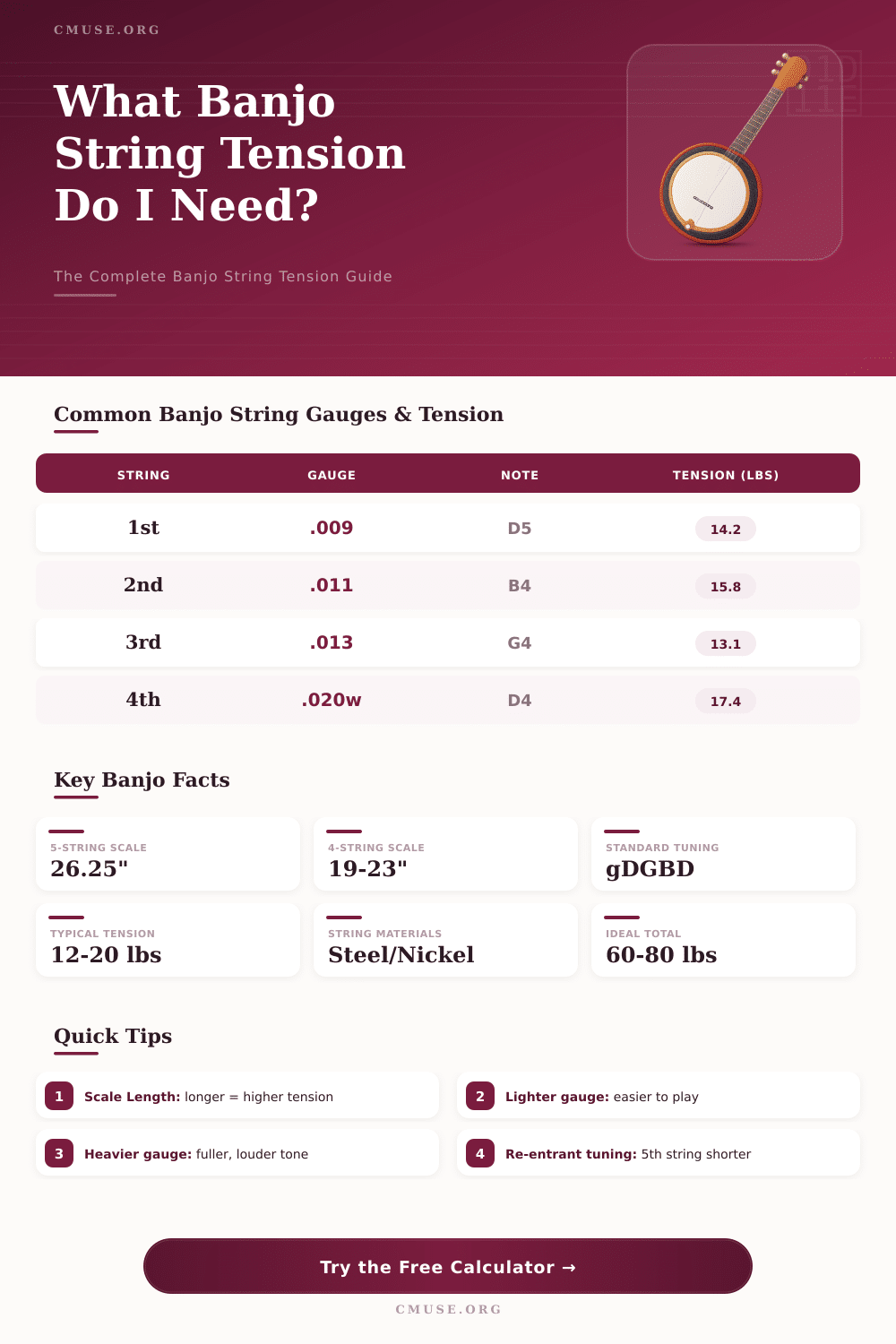
| String | Note | Gauge | Type | Tension (lbs) | Tension (kg) |
|---|---|---|---|---|---|
| 1st (highest) | D5 | .009 | Plain Steel | 14.2 | 6.4 |
| 2nd | B4 | .011 | Plain Steel | 15.8 | 7.2 |
| 3rd | G4 | .013 | Plain Steel | 13.1 | 5.9 |
| 4th | D4 | .020w | Nickel Wound | 17.4 | 7.9 |
| 5th (re-entrant) | G5 | .009 | Plain Steel | 16.3 | 7.4 |
| Total Set Tension | 76.8 | 34.8 | |||
| Note | Octave | Frequency (Hz) | MIDI # |
|---|---|---|---|
| G | 4 | 392.0 | 67 |
| G | 5 | 784.0 | 79 |
| B | 4 | 493.9 | 71 |
| D | 4 | 293.7 | 62 |
| D | 5 | 587.3 | 74 |
| C | 3 | 130.8 | 48 |
| A | 4 | 440.0 | 69 |
| E | 2 | 82.4 | 40 |
| Scale Length | Common Use | Relative Tension vs 26.25" | Scale (mm) |
|---|---|---|---|
| 19.0" | Short-scale Tenor | −47% | 482.6 mm |
| 22.5" | Standard Tenor | −27% | 571.5 mm |
| 26.25" | 5-String Standard | Baseline | 666.8 mm |
| 26.5" | Plectrum Banjo | +2% | 673.1 mm |
| 27.0" | Long-scale 5-string | +6% | 685.8 mm |
| 28.0" | Extended Scale | +13% | 711.2 mm |
| Style | Set Name | Gauges (1st–4th/5th) | Approx. Total Tension |
|---|---|---|---|
| Bluegrass | Light | .009 .011 .013 .020w / .009 | ~74 lbs |
| Bluegrass | Medium-Light | .010 .012 .016 .023w / .010 | ~82 lbs |
| Clawhammer | Medium | .011 .013 .017 .026w / .010 | ~88 lbs |
| Old-Time | Light-Med | .010 .012 .016 .024w / .009 | ~79 lbs |
| Tenor CGDA | Standard | .012 .016 .024w .036w | ~72 lbs |
| Plectrum CGBD | Standard | .011 .014 .022w .034w | ~76 lbs |
The tension of banjo strings can seriously affect the sound and the feel of the instrument. For every string on a banjo aim for around 15 to 16 pounds. If one lays all strings at almost same tension, they sound and play best.
Note that up to 23 pounds for one string would pass the needs of most setups.
How to Set Banjo String Tension
Banjos usually have lower tension than some other string instruments. Three things determine the tension of any string: the thickness of the string, the setup and the distance of the nut to the bridge. The first two one can control, but the scale lenght stays set for a given instrument.
A typical set for a five-string banjo can be made up of thicknesses like 0.010 for the D-string, 0.012 for the B-string, 0.016 for the bottom G-string, 0.023 for the C-string and 0.010 for the upper G-string. That type of set reaches total tension of about 74.6 pounds, which helps to easily reach rich tone with lively feel.
There are tools and calculators to exactly estimate the Banjo String Tension, scale length and fixed thickness. They allow you to change thicknesses of strings and their materials along with the scale length, because everything affects the hole tension. Even so those calculators do not show everything.
Sometimes a short and heavy string is too stiff for good tone or good attack. Because of that one must usually try different thicknesses. At least the calculators help to compare fairly.
They show the difference between a 26½-inch scale and a 25½-inch scale for tension and sound.
Also it matters how one winds the strings to the tuning pegs. If the winds are well done, the tension rests on the winds themselves. Otherwise the tension falls on the part of the string that exits from the hole in a sharp 90-degree corner, which can cause a break.
Whether one strings a guitar or banjo, the method is basically the same.
A setup higher than usual also raises the tension. If strings are set one or two halves too high, the extra tension can even warp parts of the instrument over time. Low setup of phosphor-bronze strings in half step can sound great, especially for hammer play in double C-setup.
Non-metallic types like nylon strings also work on banjos, although set to higher tone on longinstruments they risk break of string because of high tensions.