🪕 Banjo String Gauge Calculator
Calculate ideal string gauges and tension for any banjo tuning, scale length, and playing style
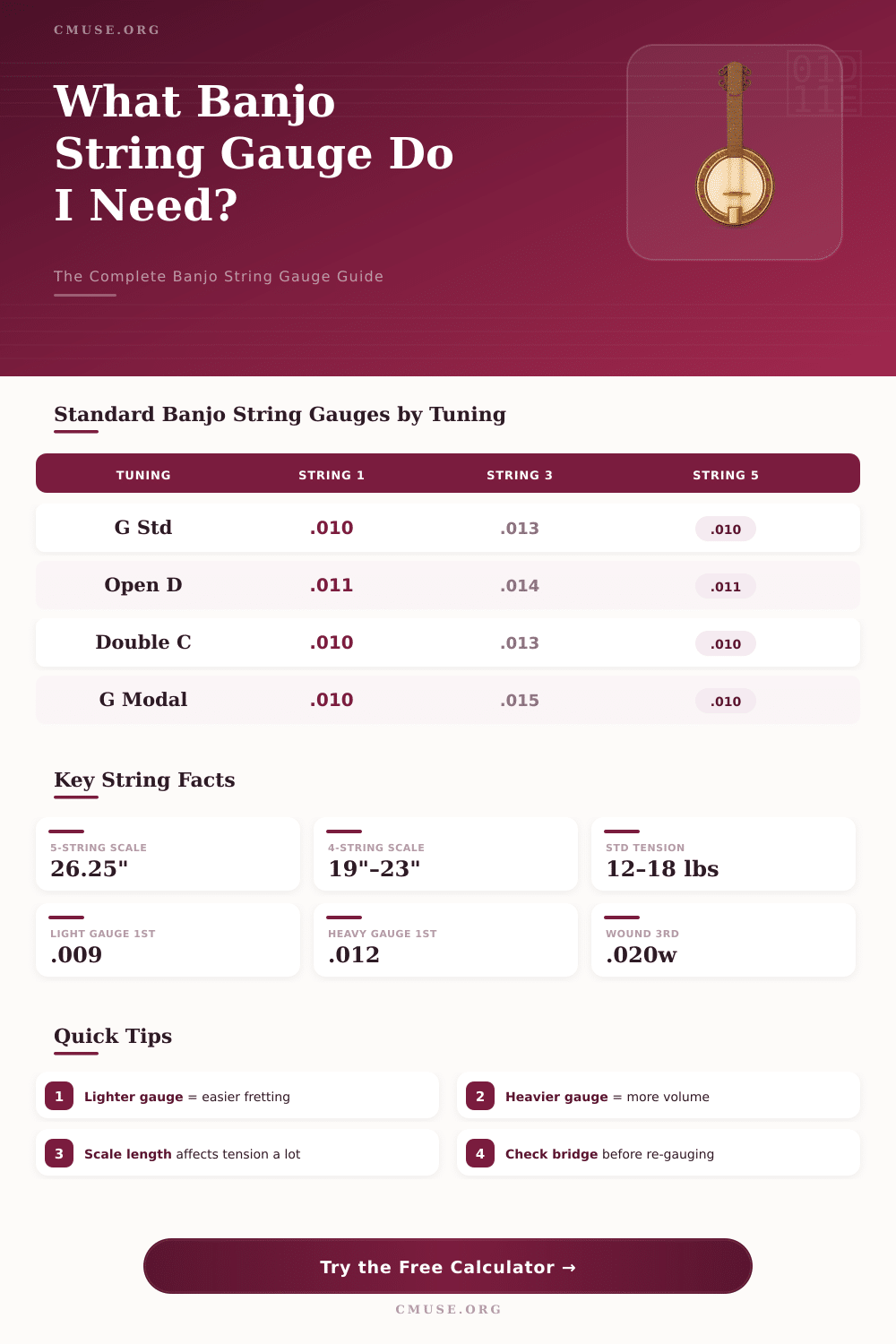
| Style / Set | 1st String | 2nd String | 3rd String | 4th String | 5th String |
|---|---|---|---|---|---|
| Extra Light | .009 | .010 | .013 | .020w | .009 |
| Light | .010 | .011 | .013 | .020w | .010 |
| Medium-Light | .010 | .012 | .014 | .022w | .010 |
| Medium | .011 | .012 | .015 | .023w | .010 |
| Heavy | .012 | .013 | .016 | .024w | .012 |
| Clawhammer | .011 | .013 | .015 | .024w | .011 |
| Tuning / Scale | 1st String | 2nd String | 3rd String | 4th String |
|---|---|---|---|---|
| Irish Tenor GDAE (17") | .010 | .014 | .022w | .032w |
| Chicago CGDA (19") | .011 | .015 | .022w | .032w |
| Standard CGDA (23") | .012 | .016 | .024w | .036w |
| Plectrum CGBD (26.25") | .011 | .013 | .017 | .024w |
| Plectrum DGBD (26.25") | .010 | .012 | .016 | .022w |
| Gauge | 17" Scale (lbs) | 22" Scale (lbs) | 23" Scale (lbs) | 26.25" Scale (lbs) |
|---|---|---|---|---|
| .009 (plain) | 9.2 | 13.8 | 15.1 | 18.9 |
| .010 (plain) | 11.4 | 17.0 | 18.6 | 23.2 |
| .011 (plain) | 13.8 | 20.6 | 22.5 | 28.1 |
| .012 (plain) | 16.4 | 24.5 | 26.8 | 33.5 |
| .020w (wound) | 11.2 | 16.7 | 18.3 | 22.8 |
| .024w (wound) | 14.8 | 22.1 | 24.2 | 30.2 |
| Material | Tone Character | Tension Feel | Best For |
|---|---|---|---|
| Nickel-Wound | Warm, balanced | Medium | Bluegrass, general |
| Stainless Steel | Bright, crisp | Slightly higher | Recording, projection |
| Phosphor Bronze | Warm, full | Medium | Old-time, parlor |
| 80/20 Bronze | Very bright | Medium | Bright tones |
| Nylon | Mellow, soft | Low | Classical style |
The Banjo String Gauge relates mainly to the diameter of those strings. That maybe seems a small thing, but it affects a lot the sound of the banjo and the feeling during play. There are strings of light medium and heavy gauges, and every type adds different character to the sound.
Banjo strings usually are made of steel or materials wrapped with nickel. Nickel resists a bit more well than brass or bronze, so it lasts more long against the rubbing of fingers or picks. Some players choose bronze for the fourth string, although that commonly is more for beauty than for sound.
Banjo String Gauges: How Size Changes Sound and Play
D’Addario offer strings from stainless steel, nickel-covered steel and bronze across various popular gauges.
The strings of light gauges are the most liked according to sales numbers. Most banjos leave the factory with such strings, because they ease the play. Also they give more brightness to the sound.
A common set of light strings has diameters near 10, 11, 13, 20 and 10. Those lighter gauges put fewer tension on the neck, bridge and head of the banjo. But such strings limit in a ceratin degree of power and volume before they sound their best.
Heavy gauges of strings give bigger volume and length. They create thick tone with more depth. At same pitch, heavy Banjo String Gauge creates stronger tension in the strings.
Medium gauges for banjo strings ensure strong and balanced sound, that projects in mixes.
Between the makers of strings there is no agreement about what is light and what is medium. Before the whole set was 10-11-12-20. Currently GHS calls their set 10-12-14-22 light, although many players would sea it as medium.
The set GHS PF175 has a bit heavier gauges on the first and fifth strings, with medium-light in the centre. Its gauges are fifth.11, fourth.22, third.13, second.12 and first.11.
Lighter stainless steel string helps to reach more real ring and pluck in the sound. Using nylon strings is also possible for certain banjos. One method combines nylon strings of classical guitar with fishing line for the fifth string.
It matters to match the type of string to the banjo. Steel strings work for banjos designed for steel, while nylon ones go to those for nylon or gut.
Guitar strings can serve for banjo, but guitar strings usually are thicker, banjos use fewer wounds and the scale length is different. There are calculators for tension of strings, that help to find the right gauge for any banjo setup andscale length. Brands like D’Addario, GHS, Ernie Ball, Martin and Elixir all produce banjo strings, that deserve a test.