🪕 Banjo String Gauge Calculator
Calculate string tension for any banjo tuning, scale length & gauge set. Get per-string tension and total set data instantly.
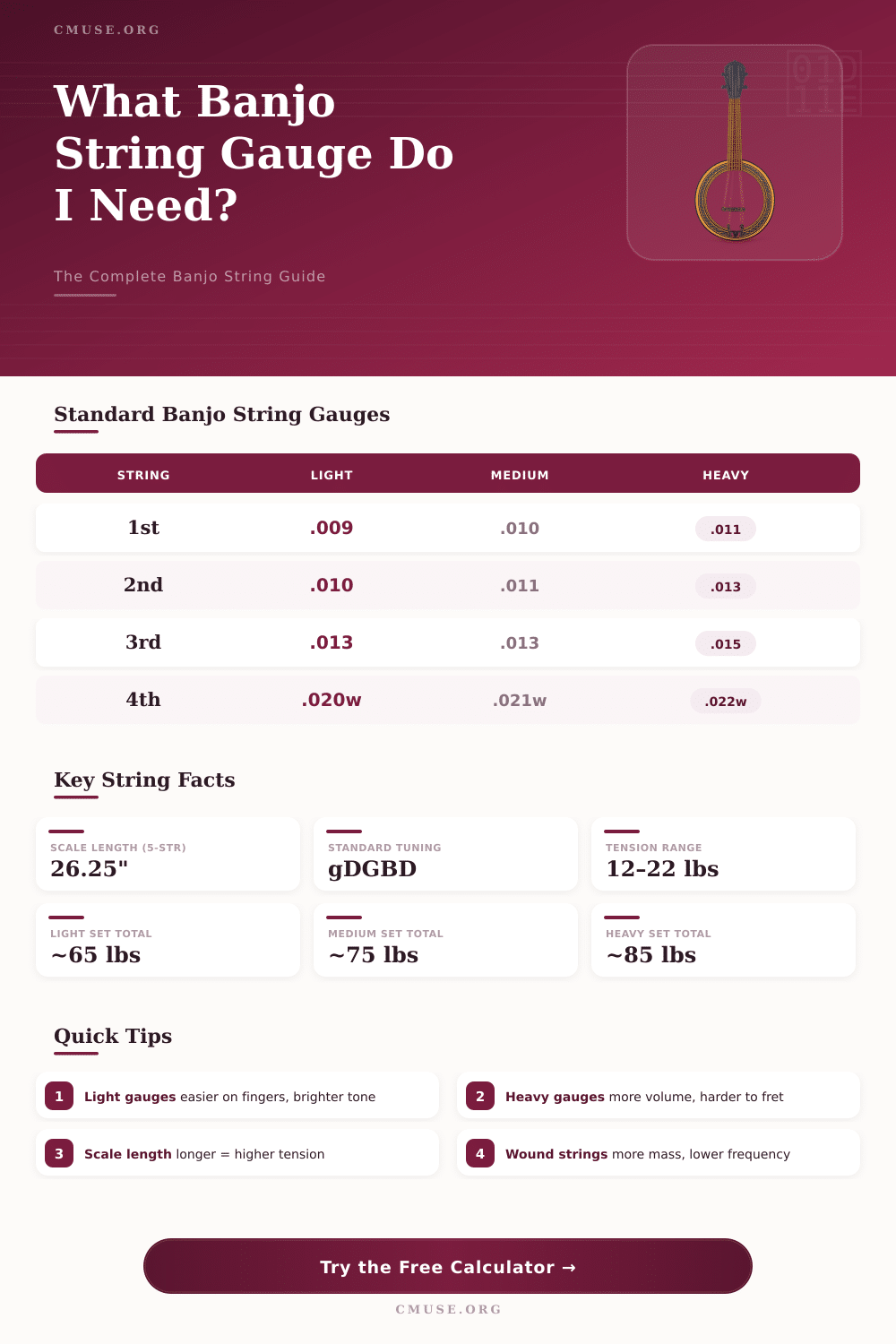
| String / Position | Extra Light | Light | Medium Light | Medium | Heavy |
|---|---|---|---|---|---|
| 1st (high D) | .009 | .009 | .010 | .010 | .011 |
| 2nd (B) | .010 | .010 | .011 | .011 | .013 |
| 3rd (G) | .013 | .013 | .013 | .013 | .015 |
| 4th (D wound) | .018w | .020w | .021w | .021w | .022w |
| 5th (high g) | .009 | .010 | .010 | .011 | .011 |
| Approx. Total Tension | ~58 lbs | ~65 lbs | ~72 lbs | ~76 lbs | ~85 lbs |
| Note | Octave | Frequency (Hz) | Banjo Position |
|---|---|---|---|
| D5 | 5 | 587.33 Hz | 1st string (standard) |
| B4 | 4 | 493.88 Hz | 2nd string |
| G4 | 4 | 392.00 Hz | 3rd string |
| D3 | 3 | 146.83 Hz | 4th string (wound) |
| G4 | 4 | 392.00 Hz | 5th string (short drone) |
| C4 | 4 | 261.63 Hz | Plectrum 1st string |
| G3 | 3 | 196.00 Hz | Tenor 1st string |
| D3 | 3 | 146.83 Hz | Tenor 2nd string |
| A3 | 3 | 220.00 Hz | Irish Tenor 1st string |
| Gauge | Note / Freq | Tension (lbs) | Tension (kg) |
|---|---|---|---|
| .009 | D5 / 587 Hz | 14.2 lbs | 6.4 kg |
| .010 | D5 / 587 Hz | 17.5 lbs | 7.9 kg |
| .010 | B4 / 494 Hz | 12.4 lbs | 5.6 kg |
| .011 | D5 / 587 Hz | 21.2 lbs | 9.6 kg |
| .013 | G4 / 392 Hz | 15.8 lbs | 7.2 kg |
| .020w | D3 / 147 Hz | 17.2 lbs | 7.8 kg |
| .021w | D3 / 147 Hz | 19.0 lbs | 8.6 kg |
| .022w | D3 / 147 Hz | 20.8 lbs | 9.4 kg |
| Banjo Type | Scale Length (in) | Scale Length (mm) | Typical Tuning |
|---|---|---|---|
| 5-String (standard) | 26.25" | 667 mm | gDGBD |
| 5-String (short) | 25.5" | 648 mm | gDGBD |
| 4-String Plectrum | 26.25" | 667 mm | CGBD |
| 4-String Tenor (long) | 23.0" | 584 mm | CGDA |
| 4-String Tenor (short) | 21.0" | 533 mm | CGDA |
| Irish Tenor | 23.0" | 584 mm | GDAE |
| 6-String Banjo-Guitar | 25.5" | 648 mm | EADGBE |
| Banjo Ukulele | 13.5" | 343 mm | GCEA |
String tension is calculated as: T = UW × (2 × L × f)² where UW = unit weight per inch, L = scale length in inches, and f = frequency in Hz. Increasing gauge raises UW and thus tension at the same pitch. Increasing scale length also raises tension significantly.
For bluegrass picking, medium sets (.010–.021w) offer crisp attack and volume. For clawhammer or fingerstyle, lighter sets (.009–.020w) are easier on the fingers and allow more expressive dynamics. Heavier gauges produce more sustain and volume but require more fretting force — especially important on banjos without adjustable truss rods.
The Banjo String Gauge relates directly to the diameter of those strings. That seriously affects how the instrument sounds and how it feels during play. Various kinds, like lightweight, intermediate and heavy Banjo String Gauge each add their own unique quality to the sound.
Lightweight strings are the most liked, according to sales numbers. Most banjos from the factory come with lightweight strings, because they are easy to use. These give more shine to the sound together with strong deep tone.
Banjo String Gauges: Types, Sound and Feel
The small sizes like this lower the pressure on the neck, bridge and head of the banjo. Even so, lightweight strings limit to a certain level of loudness and force. A typical lightweight set is made up of 10, 11, 13, 20 and 10.
Heavy strings give bigger loudness and duration. They create thick tone with a bit more depth. For the same pitch, heavy Banjo String Gauge causes stornger tension in the strings.
Intermediate Banjo String Gauge, for instance set 10-23 with wound strings, offer mighty and balanced sound, that works well on stage or in studio.
Between the makers of strings there is no full agreement about what is lightweight and what intermediate. Years ago, the standard set was 10-11-12-20. Today, GHS calls their set 10-12-14-22 lightweight, although many would judge that as intermediate.
The set GHS PF175 has a bit heavy ratings for the first and fifth strings, while intermediate lightweight stays in the centre. That helps too reach balanced tone, which matters for the banjo.
Banjo strings usually are made up of steel or materials wound with nickel. Nickel lasts a bit more than brass or bronze and stays longer against the wear from fingers or picked tools. Bronze wound strings became more common lately, but that seems mostly for beauty, not for important sound difference.
Brands like D’Addario offer stainless steel, nickel-covered steel and bronze for popular ratings. Other known brands are GHS, Ernie Ball, Martin and Elixir.
Using heavy stainless steel strings can help get more real ring and pluck in the sound. Guitar strings can be used on a banjo, but guitar wraps usually have bigger Banjo String Gauge, banjos need less wound strings and the scales differ. Banjo strings quickly wear out, so removing them at thefirst sign of wear is good practice.
The choice of strings truly depends on trying, to find the Banjo String Gauge that feels the best.