🪕 Banjo Fret Calculator
Calculate precise fret positions for any banjo scale length using the Rule of 17.817
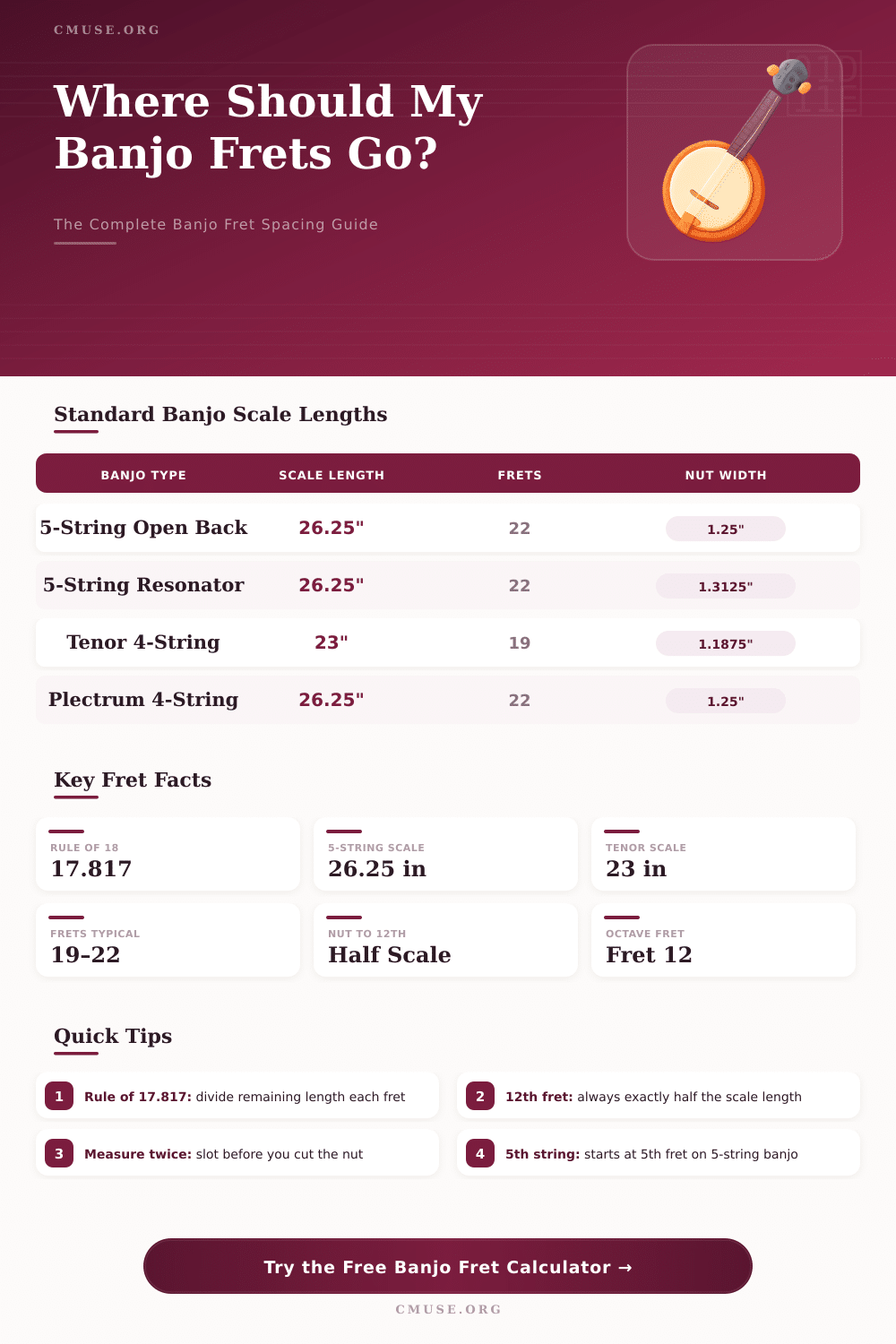
📏 Complete Fret Position Table
| Banjo Type | Scale Length | Scale (mm) | Typical Frets | Nut Width | 12th Fret Position |
|---|---|---|---|---|---|
| 5-String Open Back | 26.25" | 667mm | 22 | 1.25" | 13.125" |
| 5-String Resonator | 26.25" | 667mm | 22 | 1.3125" | 13.125" |
| 4-String Tenor | 23" | 584mm | 19 | 1.1875" | 11.5" |
| 4-String Irish Tenor | 19" | 483mm | 17–19 | 1.1875" | 9.5" |
| 4-String Plectrum | 26.25" | 667mm | 22 | 1.25" | 13.125" |
| 6-String (Guitjo) | 25.5" | 648mm | 22 | 1.6875" | 12.75" |
| Fret # | 26.25" Scale (in) | 23" Scale (in) | 19" Scale (in) | 26.25" Scale (mm) | Note (Open G) |
|---|---|---|---|---|---|
| 1 | 1.474" | 1.292" | 1.067" | 37.4mm | G#/Ab |
| 2 | 2.864" | 2.511" | 2.073" | 72.7mm | A |
| 3 | 4.174" | 3.659" | 3.019" | 106.0mm | A#/Bb |
| 4 | 5.409" | 4.741" | 3.912" | 137.4mm | B |
| 5 | 6.573" | 5.761" | 4.754" | 166.9mm | C |
| 6 | 7.669" | 6.721" | 5.549" | 194.8mm | C#/Db |
| 7 | 8.702" | 7.625" | 6.291" | 221.0mm | D |
| 8 | 9.675" | 8.477" | 6.994" | 245.7mm | D#/Eb |
| 9 | 10.592" | 9.282" | 7.659" | 269.0mm | E |
| 10 | 11.455" | 10.043" | 8.285" | 291.0mm | F |
| 11 | 12.269" | 10.761" | 8.876" | 311.6mm | F#/Gb |
| 12 | 13.125" | 11.500" | 9.500" | 333.4mm | G (Octave) |
| Banjo Type | Standard Tuning | String Gauges | 5th String Note | Capo Style |
|---|---|---|---|---|
| 5-String Bluegrass | G D G B D (gDGBD) | .009 .013 .017 .023 .009 | G (high) | Open G |
| 5-String Classic | A E A C# E | .010 .012 .016 .024 .010 | A (high) | C Tuning |
| 4-String Tenor | C G D A | .010 .014 .024 .034 | N/A | Chicago |
| 4-String Irish Tenor | G D A E | .010 .014 .024 .034 | N/A | Irish |
| 4-String Plectrum | C G B D | .011 .013 .022 .030 | N/A | Plectrum |
| 6-String (Guitjo) | E A D G B E | .010 .013 .017 .026 .036 .046 | N/A | Standard |
The scale-length is the key for understanding the spacing of banjo fret on a banjo. Simply said it shows the distance from the nut to the bridge, and longer scales naturally spread the frets. Typical banjos with 22 frets have around 25 inches, while those with long neck, as the one of Pete Seeger, reach almost 32 inches.
That extra seventh inch explains the difference in the layout between various models of banjos.
How scale length changes banjo fret spacing
For reaching right spacing of frets, accuracy matters according to the particular scale-length one works with. Makers so favor sticking to set scale-lengths instead of always changing them. The accuracy of the notes depends entirely on whether the positions of frets are right.
It is possible to use online calculators, where one enters their scale-length and receives the needed measures. Such resources work for every instrument based on the western chromatic scale, like guitars, ukuleles or banjos. All of them follow the same basic prniciples.
Here is where things become tricky. Guitar and banjo, both with 25 inches, have same layout of frets. This opens interesting creative ideas.
In theory, one could use a ready fretboard designed for something more than 26 inches, remove the first frets (that indeed are the biggest), and finally get a new scale under 24 inches. After such change, the bridge must move to a distance double that of the new 12th fret.
The 12th fret points to the center of the weigh between nut and bridge. Moving the bridge can mess up the tuning, so good setup is needed. Something to note: when one lays a capo on a fret, it becomes the temporary nut.
The space between that capo and the next fret shrinks compared to that between the real nut and the first fret.
In higher positions on the neck, the frets get closer together. So finally one would have too many frets too close to the bridge. Most banjos have at most 22 frets, with position marks at the 3rd, 5th, 7th, 10th and 12th, a bit different than on guitars.
Even so, the banjo has its own character. The short fifth string is probably the weirdest feature. Although a lot of tools for a range of fretboards exist, one commonly struggles with the particular shape of five-string banjo.
One interesting case was mentioned: an old fretboard matched well with another neck, if one simply skipped the first fret, the gap between one and two on the old matched that between two and three on the new.
The wire of banjo fret slots is clearly thinner than that used on guitars. Even medium guitar frets seem huge in comparison. Smaller frets wear out more quickly over time.
Also the placing of fingers matters: one must press only behind the fret itself, not in the center of the space. That tiny difference makesthe difference between clear and dull notes.