Baffle Diffraction Calculator
Estimate baffle step frequency, driver-to-edge distances, diffraction ripple, wavelength, and first-pass correction EQ for loudspeaker cabinet layouts.
Baffle grid
Calculation breakdown
Edge distance and frequency
| Edge | Distance | First ripple | Risk |
|---|
Frequency landmarks
| Landmark | Frequency | Wavelength | Use |
|---|
Correction EQ guide
| Filter | Frequency | Gain | Q |
|---|
Offset comparison
| Layout | X center | Ripple | Comment |
|---|
Build a speaker, set it inside its cabinet and hear how boring it is. Move it out onto shelf and hear how nice it’s now. To address this, you replace drivers and perhaps try new crossovers. It’s rarely about your soldering technique or choice of components. No, it’s about geometry.
Sharp edges reflect sound wave in consistent patterns. These cause ripples in your frequency response, which can be partially corrected by eq, yet at the cost of phase coherence. This baffle diffraction calculator will estimate the primary impacts of a loudspeaker front baffle. It helps you anticipate these issues before setting up your listening room.
Understanding Baffle Diffraction and Speaker Design Tips
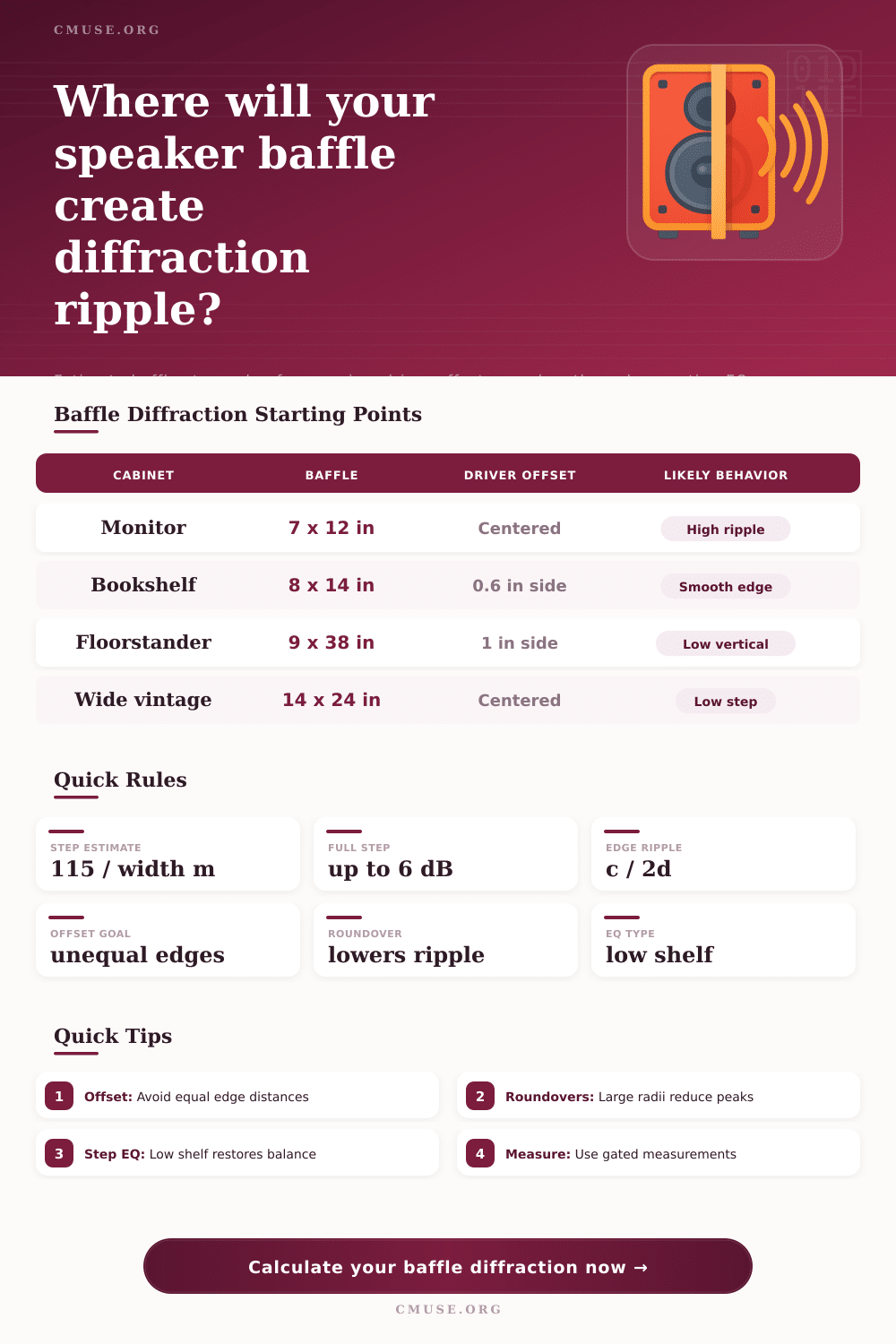
It’s just plain old physics. When a sound wave encounter a hard corner, it diffracts. That diffused energy reflect back towards your ear or the mic. It combines with the direct sound coming straight from driver. If the path-length difference equals half of a wavelength, then it cancels out. What you have is a notch in the response. If it equals a whole wavelength, you’ve got a peak. The end result is a muddled frequency response that depends on where you sit.
Enter your baffle dimensions and position of the driver into the calculator and it figures all that math for you. You won’t have to guess which edge is causing problems. First thing to do: enter the dimensions of the visible width & height of the front panel. Do not use inside cabinet dimensions. That’s what radiates.
A large old speaker may be showy, but it also sets the stage for baffle step, the frequency when its wavelength matches the width of the baffle. From then on, the speaker is no longer behaving like an infinite baffle, it now acts more like a radiator in free space, which means bass output begins rolling off. The tool calculates the frequency where that switch-over occurs, enabling you to factor it into your crossover design. If the baffle step occur around 800 Hz, that calls for different compensation than if it were at 300 Hz.
Where you place drivers also make a difference. Placing them symmetrically results in equal edge distances, which produces sharp diffraction nulls and peaks. Sharp equals bad. If your driver is offset on one side or the other, the energy is split up between different frequencies. A single deep valley becomes several shallow valleys that are less difficult to control.
The calculator also displays this setup helper. By viewing it, you can see precisely where the driver sits relative to every edge. That spreads the diffraction energy out and softens the total sound. Rounding edges can’t be overlooked. A 90-degree right angle acts like a single point that reflects high frequencies with a lot of energy, just like a perfect mirror. Round over the edges and you soften that reflection. Even the smallest radius will break up how the diffracted wavefront stays together.
The edge radius has an input field on the calculator. You can enter a number to see just how much rounding off those corners reduces ripple. It’s a tiny tweak, but it makes a big difference at treble frequencies where our ears are most sensitive to coloration.
It all depends of the room. Is the speaker sitting out in the open or is it flush against the wall? Boundaries matter. Baffle step loss matters. You can choose your target correction based off how you have set things up with the tool. More boost will be needed for full free-space drop-off compared to something close to a wall. But too much boost compensating for diffraction can muddy midrange. Try the EQ suggestions as a start and measure in your real-world room using gated sweeps to prevent your room modes from messing up the information.
Centering the driver is aesthetically pleasing and many builders obsess over it. However, aesthetics often trump acoustic performance when a driver is centered for symmetry. Moving the dome even half an inch may look strange initially but it results in a much smoother response curve. You should of seen the difference before. Check out the reference table on the page for centered vs. Offset. Notice how far you can move the dome and realy decrease the peak-to-peak ripple.
It’s all about managing interference, not masking imperfections. It can be controlled. Once we know how the transition occurs. Once we have taken control of the acoustical space. From there, you are not fighting your speaker; you are working with it. Use the numbers for guidance but trust your ears. Offset drivers when you can, keep those edges round. Measure as often as needed to make sure you are correct. That dead box on the shelf becomes a clear voice in the room.