Aux Send Count Calculator
Plan the number of mixer aux outputs needed for wedges, in-ear monitors, headphone cues, FX processors, broadcast feeds, and spare routing capacity.
Load a realistic live, rehearsal, studio, or broadcast scenario. Each preset fills monitor, stereo, FX, cue, feed, spare, and mixer-capacity fields, then calculates the aux count.
Aux Send Breakdown
Monitor Auxes
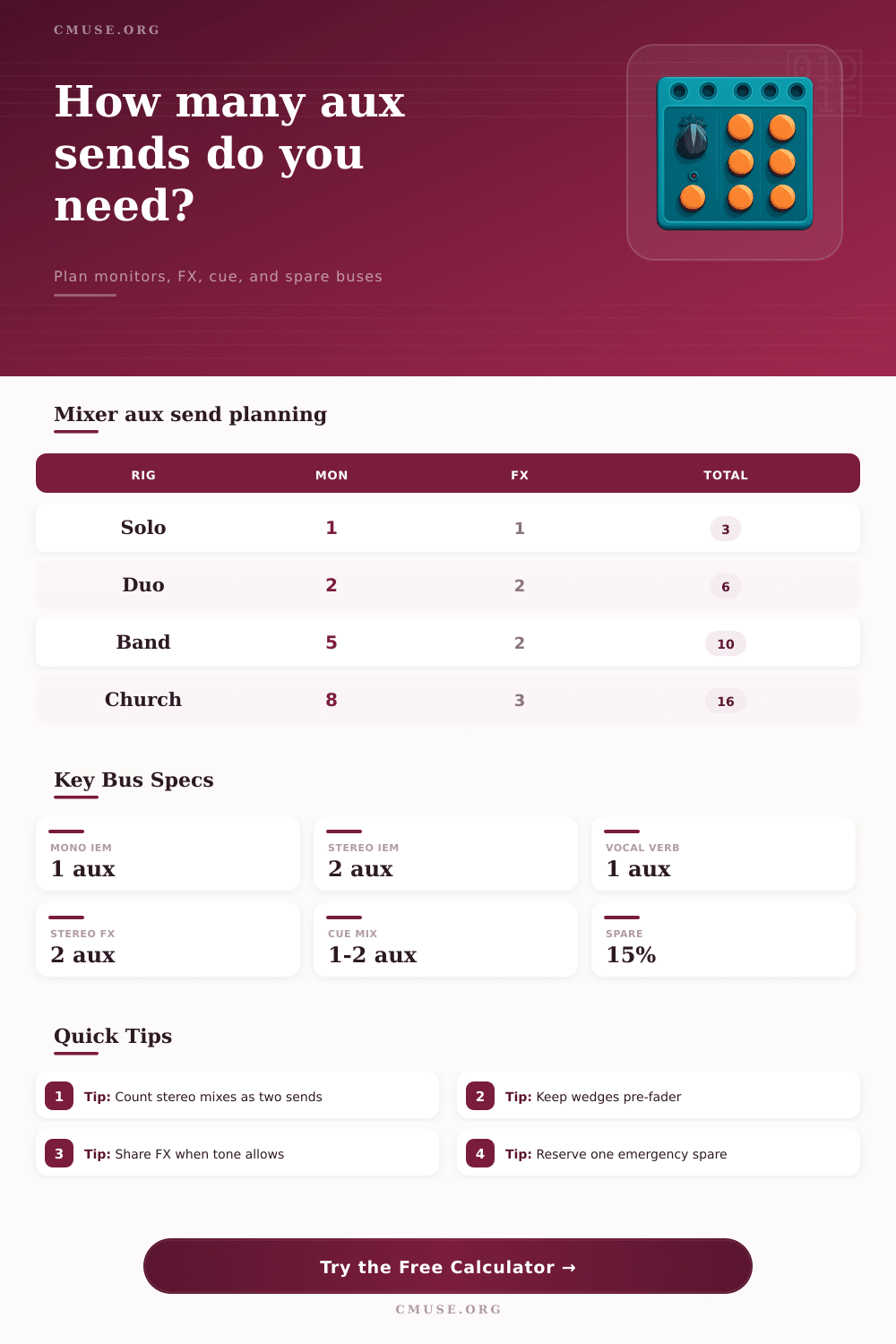
M = mono monitors + 2 × stereo monitorsEvery stereo IEM, stereo wedge pair, or headphone cue uses two independent outputs.
FX Auxes
F = mono FX + 2 × stereo FX - shared FXShared reverbs and delays reduce dedicated send needs when one effect serves several channels.
Cue And Feed Auxes
C = cue + program + stereo feed addA stereo destination is counted once as a feed, then one extra aux is added for its second side.
Recommended Total
T = base + ceil(base × buffer)The final recommendation rounds up to a mixer tier so the rig has enough usable sends.
Small analog mixer
Compact digital rig
Band plus FX tier
IEM or broadcast rig
| Mixer tier | Usable aux outputs | Typical routing | Watch point |
|---|---|---|---|
| Compact analog | 2 to 4 aux sends | One or two wedges plus one FX send | Stereo IEMs quickly consume the bus count |
| Hybrid small format | 6 to 8 aux or mix buses | Small band monitors, basic FX, simple stream feed | Confirm whether subgroups share the same outputs |
| Digital rack mixer | 10 to 16 aux or mix buses | Multiple IEMs, wedges, talkback, and two FX sends | Physical output jacks may be fewer than internal buses |
| Production console | 16 to 32 aux, matrix, or stem buses | Festivals, theater pits, broadcast splits, complex IEMs | Label pre-fader, post-fader, and matrix duties clearly |
| Monitor destination | Aux sends | Preferred mode | Planning note |
|---|---|---|---|
| Floor wedge mix | 1 aux | Pre-fader | One wedge mix can feed multiple wedges if performers accept the same balance |
| Mono in-ear mix | 1 aux | Pre-fader | Useful for limited outputs, but less spacious than stereo monitoring |
| Stereo in-ear mix | 2 aux | Linked pre-fader | Link odd-even auxes so pan and level move predictably |
| Sidefill or drum fill | 1 to 2 aux | Pre-fader | Stereo sidefills require two outputs; mono fills usually use one |
| Producer headphone cue | 1 to 2 aux | Pre-fader | Studio cues often need talkback, click, and performer-specific balances |
| Routing need | Aux sends | Common use | Can share? |
|---|---|---|---|
| Vocal reverb | 1 aux | Post-fader ambience send to a shared reverb | Yes, for similar vocal sources |
| Tap delay | 1 aux | Post-fader delay for lead vocal or solo instruments | Often, if tempo matches |
| Stereo external FX | 2 aux | True stereo processor input or dual mono effects path | Sometimes, if returns stay separate |
| Livestream feed | 1 to 2 aux | Independent broadcast balance from front-of-house mix | No, keep stream level independent |
| Lobby or recorder feed | 1 aux | Mono utility program send for overflow or capture | Yes, if delay and level needs match |
| Project | Monitor plan | FX and feeds | Likely aux count |
|---|---|---|---|
| Solo livestream | One cue mix | Reverb plus stereo stream | 4 to 6 auxes |
| Acoustic duo | Two wedges or two mono IEMs | Reverb, delay, recorder | 6 to 8 auxes |
| Five-piece club band | Four wedges plus one stereo IEM | Two FX sends and a stream feed | 10 to 12 auxes |
| Worship stage | Several stereo IEMs plus talkback | FX, lobby, recording, stream | 16 to 24 auxes |
| Theater pit | Conductor, cast, pit, and stage cues | Program, recorder, delay fills | 14 to 20 auxes |
When it comes time to set up for your performance, things get tricky. You plug cables into your snake but suddenly drummer asks you to change his mix. Now the bass player is asking for something else. And the lead singer who used to be happy with their mono in-ear monitor says they’re no longer having it. They want stereo sound instead.
Unfortunately, all of those options have left you with just two available aux sends on your four-channel analog mixer and it’s completely unaware that you are about to lose your mind. Many people don’t know how important it is to count aux sends before you rent or buy your console. It makes the difference between a smooth show and a frantic scramble to drop channels so guitarist can hear themselves think.
Why You Must Count Aux Sends
On mixers, most engineers have looked at total number of inputs and felt comfortabley. Thirty-two channels? Piece o’ cake. It’s a trap. Inputs put sound into the box. Aux sends send it out where it matters. The beauty of the calculator on this page is that it lets you deal with each destination individually by separating your “inputs” from your “aux sends.”
How many mixes do you need to run out? Stereo? Mono? What kind of effects do you want to run without using up all your busses? Aux capacity drops fast with stereo monitoring. A single stereo in-ear mix require two output channels, one for each side (left/right). These must stay locked together to be properly panned. Five musicians on stereo IEMs means ten aux sends before considering any delay or reverb.
The chart above makes you confront that math sooner then later. It assumes a stereo mix is an asset twice over, as it really is in the physical world where your patch bay lives. There’s no way to plug a stereo feed into a mono slot and expect anything but half of your picture. And then there are feeds and effects. You’d think that since multiple vocals might all go to the same send, it could save space with shared reverbs. But sometimes a good engineer knows what to share and what needs its own isolation.
Using separate feed outputs for recording, lobby mixes, or separate streams means those destinations quickly use up aux buses, just like performer monitors. You can even explicitly include these program feeds on the calculator in case you don’t want to accidentally grab your last bus and assign it to a delayed livestream nobody is watching anyway.
Experience matters in spares. On paper, you may calculate that your five-piece band require exactly twelve sends. Live sound doesn’t work that way. You might include a click track on the fly. You might add a guest artist who has monitor requirements or someone might drop a pack. Fifteen percent spare buffer isn’t much of a price to pay for peace of mind. It’s enough so that if the unexpected occurs (and it will), you’ve got breathing space. The tool automatically adds this buffer to your base count, rounding up to give you a realistic target instead of a theoretical minimum.
These numbers determine which tier mixer is appropriate. Analog desks are great for straightforward acoustic shows but struggle when faced with large IEM demands. Digital mixers has more internal buses than before, but make sure those buses actualy connect to physical output jacks. Certain consoles feature 16 internal mixes and yet only provide eight breakouts in the rear of the rack. This discrepancy can find you stuck halfway through a show with a third of your capacity unavailable due to insufficient XLR cables.
At the end of the day, planning out your aux sends means planning ahead for what you will need. And that makes a chaotic set-up a structured roadmap. Where do you pull audio from? Who gets what? You step on stage with clarity and know precisely what everyone is hearing without losing yourself in the madness. The singer feels full. The drummer hears their kit. You keep your sanity intact because you should of planned for each bus before ever playing a single note.