Augmented 6th Chord Calculator
Spell Italian, French, and German augmented sixth chords in real key context, then inspect the resolution, outer voices, enharmonic reading, and register fit.
🎼 Augmented Sixth Presets
🎹 Chord Inputs
📊 Augmented Sixth Spec Grid
🎶 Italian, French, and German Comparison
| Chord Type | Scale Degrees | C Minor Example | Functional Color |
|---|---|---|---|
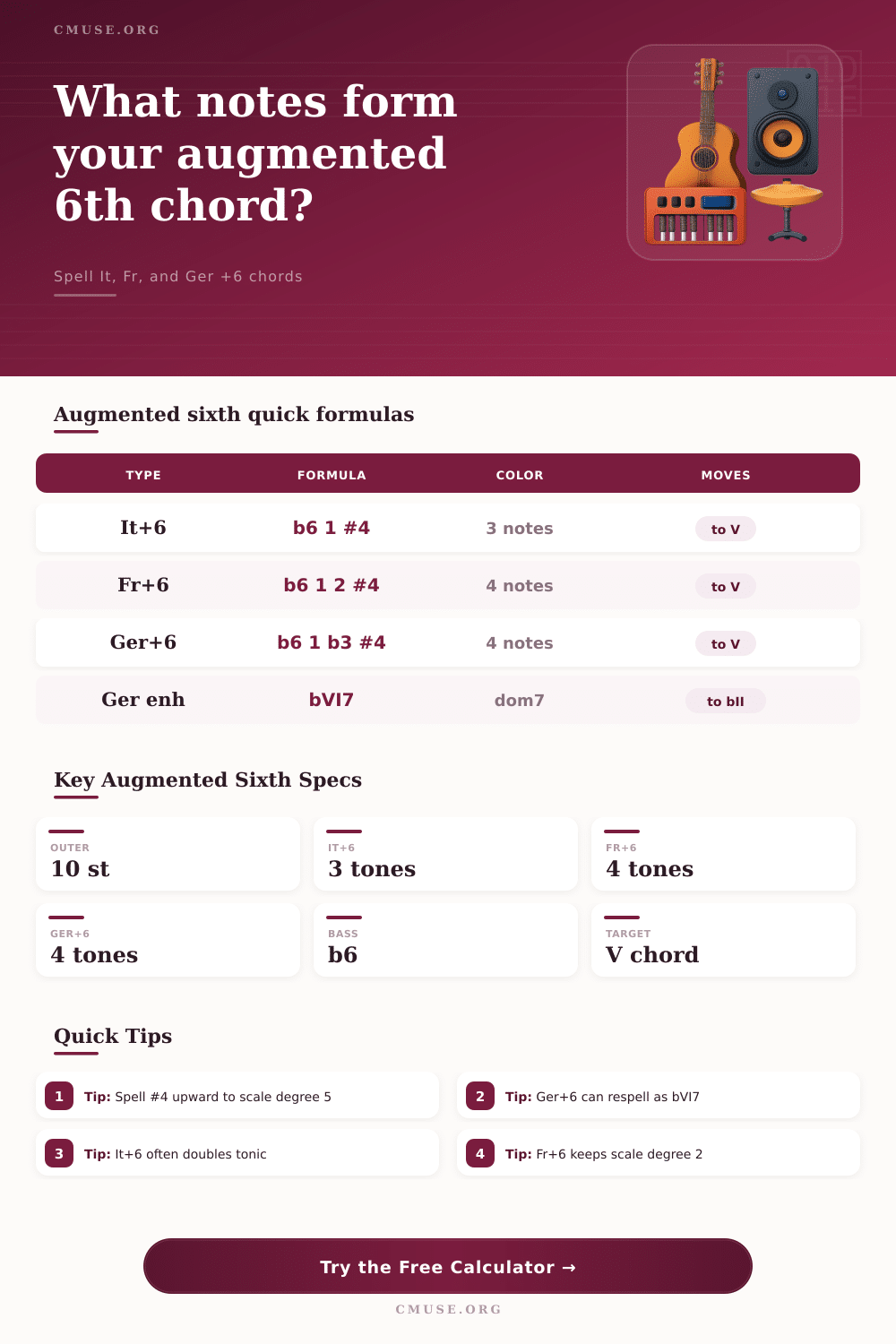
| Italian augmented sixth | b6, 1, #4 | Ab, C, F# | Lean, direct pre-dominant sonority; tonic often doubled |
| French augmented sixth | b6, 1, 2, #4 | Ab, C, D, F# | Brighter whole-tone color with scale degree 2 retained |
| German augmented sixth | b6, 1, b3, #4 | Ab, C, Eb, F# | Richer sonority, close to dominant seventh by enharmonic spelling |
| German enharmonic | bVI7 respelling | Ab, C, Eb, Gb | Can pivot toward bII or remote dominant motion |
| Resolution Detail | Typical Motion | Interval Size | Why It Matters |
|---|---|---|---|
| Lowered sixth to dominant | b6 moves down to 5 | Minor 2nd down | Creates the lower half of the expanding tendency pair |
| Raised fourth to dominant | #4 moves up to 5 | Minor 2nd up | Creates the upper half of the expanding tendency pair |
| Tonic inside the chord | 1 can stay or move to 7 | Common tone or minor 2nd | Supports smooth V or cadential 6/4 resolution |
| German fifths risk | b3 may move to 2 | Whole step down | Cadential 6/4 helps avoid direct parallel fifths |
| Enharmonic Spelling | Chord Reading | C Example | Destination |
|---|---|---|---|
| Italian +6 | Rootless II7b5 color | F#, Ab, C without D | Usually still resolves to V |
| French +6 | II7b5 in third inversion | D, F#, Ab, C | Can sound dominant-like before V |
| German +6 | bVI7 dominant seventh | Ab, C, Eb, Gb | Can move enharmonically toward Db |
| Classical spelling | Augmented sixth, not minor seventh | Ab to F# | Both outer notes resolve outward to G |
| Preset Context | Key | Chosen Form | Expected Result |
|---|---|---|---|
| Major cadence | C major | Italian +6 | Ab, C, F# resolving to G |
| Minor cadence | C minor | German +6 | Ab, C, Eb, F# often through cadential 6/4 |
| French color | F major | French +6 | Db, F, G, B before C |
| Remote pivot | Bb major | German +6 | Gb+6 respelled as Gb7 toward Cb or Db area |
| Minor borrowed tone | D major | German +6 | Bb, D, F, G# with borrowed flat third |
An augmented sixth chord are a type of chord that functions as a pre-dominant chord within a piece of music. An augmented sixth chord is used in order to create tension prior to a dominant chord. An augmented sixth chord contain both a lowered sixth scale degree within the bass of the chord, as well as a raised fourth scale degree that exist above the bass note.
These two scale create the sensation of tension within the chord, as they work in opposition to each other. There are three main types of augmented sixth chords: Italian sixths, French sixths, and German sixths. Italian sixths use three pitch within the chord, and often require the doubling of the tonic note.
What Augmented Sixth Chords Are and How the Calculator Helps
French sixths contain the second scale degree within the chord, which create a bright sound to the chord. German sixths contain the flat third scale degree within the chord, which often creates the sensation of that chord being borrow from the parallel minor key. Each of these three chords alters the possibilities of the voices that lead to the dominant chord, as well as alters the possibility that the voices will encounter parallel fifths.
The calculator display information regarding the augmented sixth chord, and the calculator obtains the information that is displayed based off the key of the chord, the mode of the chord, and the type of augmented sixth chord. The spelling of the chord in the chosen key will be displayed, as well as the chord that the augmented sixth chord targets. An enharmonic reading of the chord will also be displayed; this reading is often important in recognizing how a German sixth chord can actualy be reinterpreted as another chord to facilitate a key change.
Additionally, the calculator will perform a range check for the chord, which confirm that the chord will fit within a specific type of ensemble. German sixths are often useful within minor keys, as they often sound natively within those keys. The third of a German sixth chord often already exist within the key signature of the piece of music.
In major keys, the German sixth chord often utilizes modal mixture to indicate that the dominant chord is more significant. It is common for composers to utilize a cadential six-four chord prior to a German sixth chord. Composers utilize cadential six-four chords prior to German sixths in order to prevent the entry of parallel fifths between the flat third scale degree and the leading tone.
A person may encounter parallel fifths when resolving an augmented sixth chord to a dominant chord. A person may allow for the appearance of fifths in those situations if the musical texture of the music is thick and/or if the music is performed at a fast tempo. The calculator does not make any aesthetic decision for a composer, but instead displays the raw motion of the notes within the chord; its up to the composer to decide whether the appearance of fifths within the chord is an acceptable aspect of the chord.
A person may also choose to change which note within the chord is doubled. For Italian sixths, doubling the tonic is common. However, a composer may choose to double the raised fourth scale degree instead to make the tendency tone morely prominent.
A composer may use a process known as enharmonic reinterpretation of an augmented sixth chord. This process allow for a chord to be interpreted as a different chord in order to perform a chord progression to a remote key. A person can reinterpret German sixth chords as a dominant seventh chord that contain a flat sixth scale degree.
Reinterpreting the German sixth as a dominant seventh on the flat sixth create the opportunity to change to a key that is a tritone away from the original key. The same process can be used with a French sixth chord; it can be reinterpreted as an inverted dominant seventh chord with a lowered fifth. The calculator also includes settings that allow a person to select the chord’s spacing.
A person can choose between close position and open position for the chord. Close position mean that the voices of the chord are close to each other, fitting within an octave. Close position is often used for keyboard instrument.
Open position means that the voices of the chord are spread across two octaves; this is common for string and wind ensembles. Additionally, a person may choose the octave of the bass for the chord; this does not impact the function of the augmented sixth chord. An augmented sixth chord must be placed correctly within a phrase.
The chord must be timed correctly relative to other chords in the phrase. If placed too early in a phrase, the chord may sound like an interruption to the music; it should not appear so soon after the beginning of the phrase. However, if placed after a predominant chord, the chord can appear redundant.
The calculator does not include settings that allow a person to change the rhythm of the chord, though it does remove the difficulty of spelling and register for the chord. Finally, an augmented sixth chord will almost never be written as a minor seventh chord. It is important for a composer to write the chord correctly so that the listener can easily recognize the tendency tone and the bass note.