Audio Wavelength Calculator
Convert frequency into wavelength, quarter-wave spacing, harmonic length, and period for sound in air, water, or solids.
Air at 20C
343 m/s
1130 ft/s reference
1 kHz Tone
34.3 cm
In air at 20C
20 Hz Bass
17.2 m
Long sub wave
Quarter Wave
1/4 lambda
Boundary spacing
| Medium | Speed | Type | Notes |
|---|---|---|---|
| Air at 20C | 343 m/s | Gas | Room baseline |
| Helium | 1007 m/s | Gas | Fast sound |
| Water | 1482 m/s | Liquid | Short waves |
| Steel | 5960 m/s | Solid | Very fast |
| Freq | Wave in air | Quarter wave | Use |
|---|---|---|---|
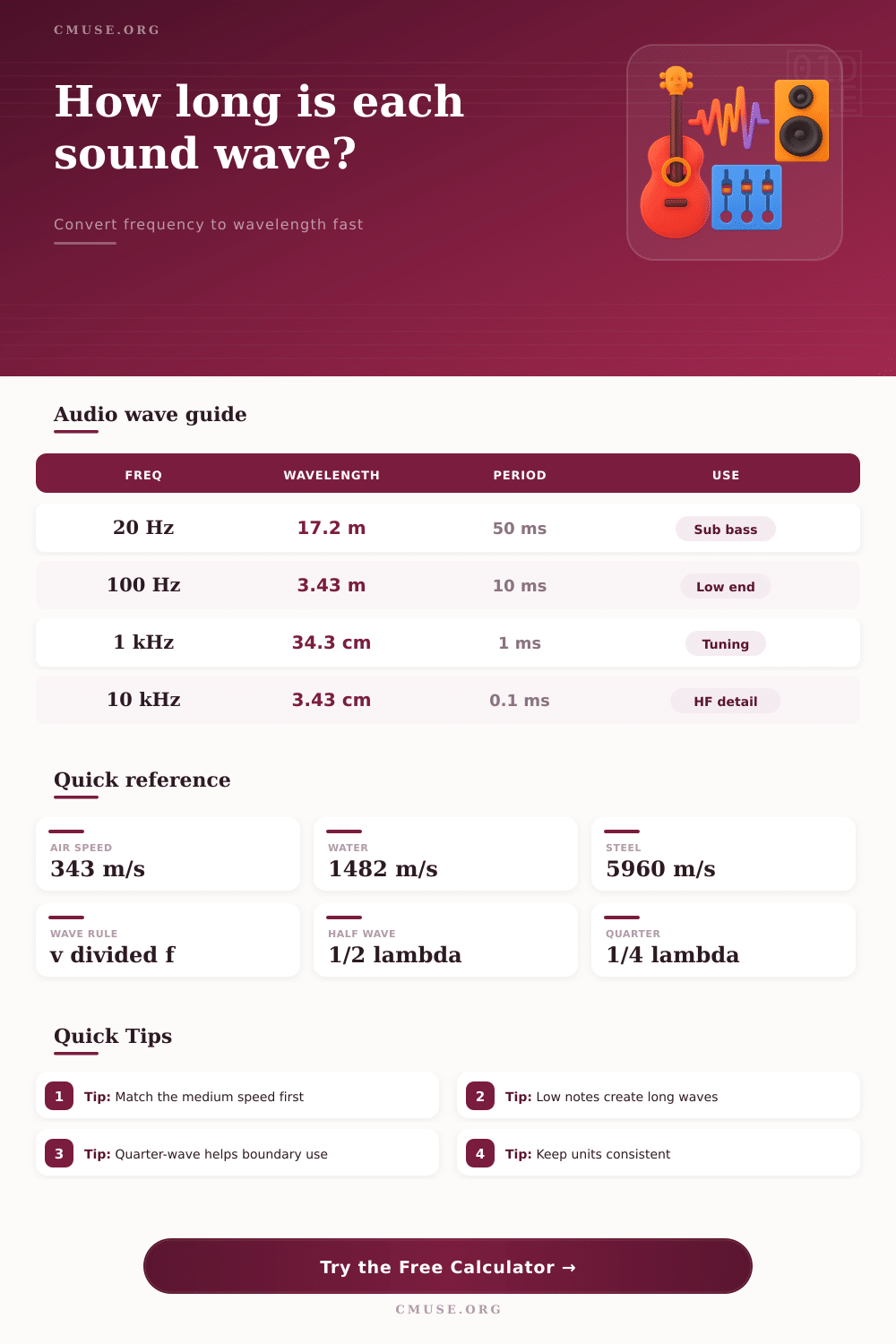
| 20 Hz | 17.2 m | 4.29 m | Sub bass |
| 100 Hz | 3.43 m | 0.86 m | Low end |
| 1 kHz | 34.3 cm | 8.6 cm | Test tone |
| 10 kHz | 3.43 cm | 8.6 mm | High detail |
| Wave point | Length | Match | Notes |
|---|---|---|---|
| Half wave | lambda / 2 | Spacing | Phase gap |
| Quarter wave | lambda / 4 | Boundary | Trap depth |
| 2nd harmonic | lambda / 2 | Octave | Twice freq |
| 4th harmonic | lambda / 4 | High band | Short span |
The wavelength of audio wave simply shows the length of one whole wave, of one peak until the next. Think about water wave as sample: the distance between two near peaks is the wavelength. When you freeze the wave, the distance between two next maxima stay the same That is the wavelength.
Using simple formula, you find the wavelength sharing the speed of sound by means of the frequency. You measure frequency in Hertz (Hz). It matters to check that the units match before the calculation.
What Is Sound Wavelength
The speed of sound depend on temperature and pressure, so the wavelength adjusts according to conditons. Also water vapor in the air alter the pace and so the wavelength.
When sound passes from one medium to another, the frequency stays same, because each compression in the first cause one in the second. The pace and wavelength alters, but frequency stays permanent. Frequency and wavelength are not proportional mutually.
Human hearing goes from around 20 Hz until around 23 000 Hz. In 20 Hz you suit 20 cycles in 340 metres, so wavelength is 17 metres. Tone of 40 Hz have wavelength in 27,4 feet.
In 30 Hz it reaches 36 feet. On the other hand, 10 kHz tone has only 0,109 feet, so a bit more than one inch. The A4-note in 440 Hz have around 0,78 metres in air.
Tone of 200 Hz require 5,65 feet for one full cycle with negative and positive pressures.
Short wavelengths in high frequencies give direction and accuracy, but they easily soak and divide. Long wavelengths in low frequencies go more far, bend around obstacles and create room resonances. That requires different engineering and acoustic solutions.
The deep range of 20 until 250 Hz bears more energy because of its long wavelengths. Hence bass requires stronger amplifiers. So you can physically feel the base in music.
The sound-pitch depends directly on the frequency. Big instruments as trombones do long sounds. The instrument-size relates to the wavelength of its sound.
Speaker with fixed length however can discharge sounds in wavelengths bigger or smaller than itself. Audio engineers use wavelengths for form and alter sound effectively in various environments. Room modes happen in half-wavelength distances equal to the room dimensions, and quarter-wavelength can cause negation or duplicationof sound.