Audio Crossover Calculator
Calculate first-order high-pass and low-pass component values from crossover frequency.
🎚 Inputs
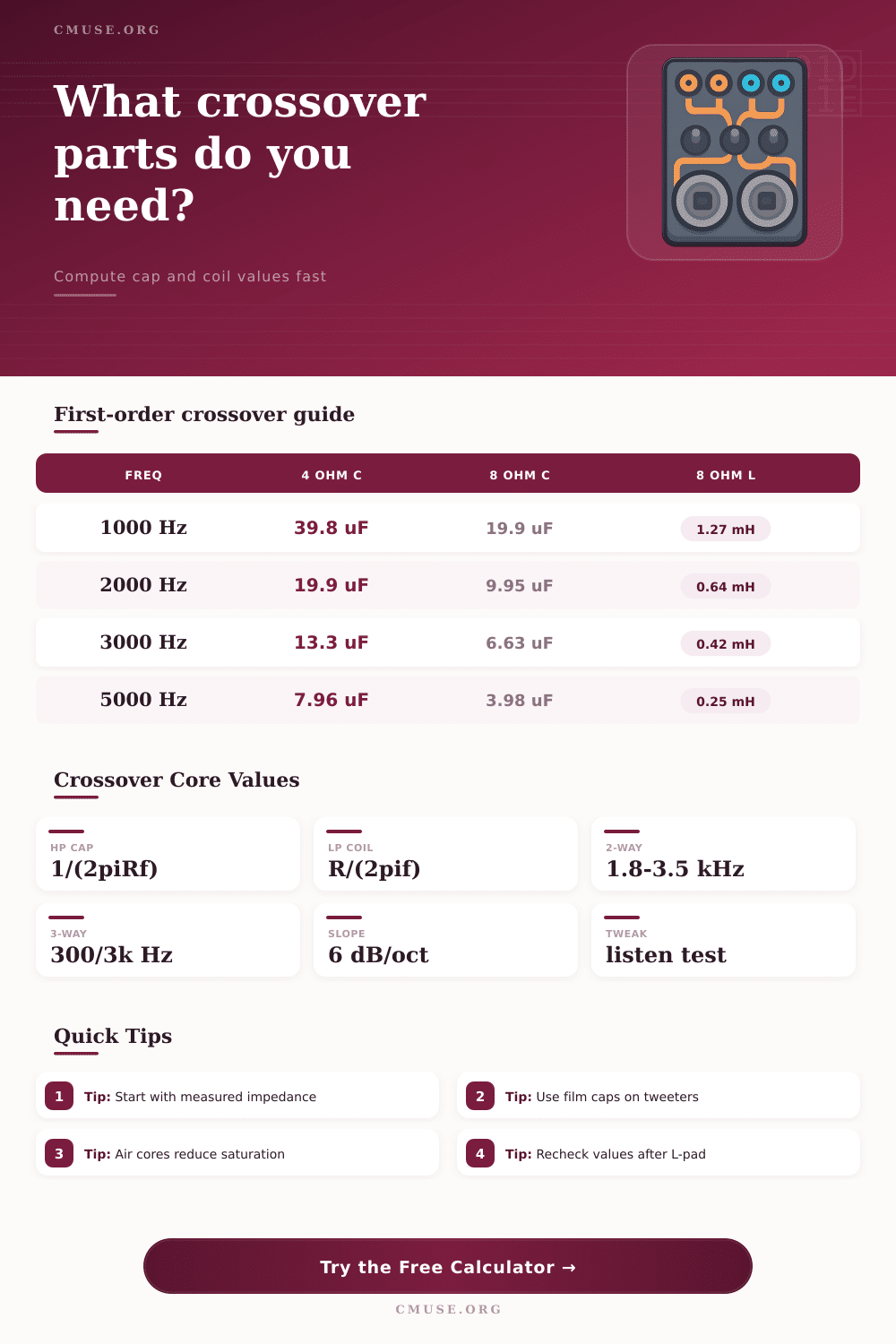
| Freq | 4 ohm cap | 8 ohm cap | 8 ohm coil |
|---|---|---|---|
| 1500 | 26.5 uF | 13.3 uF | 0.85 mH |
| 2500 | 15.9 uF | 7.96 uF | 0.51 mH |
| 3500 | 11.4 uF | 5.68 uF | 0.36 mH |
| 5000 | 7.96 uF | 3.98 uF | 0.25 mH |
When audio signal splits up and goes to various speakers, here enter the crossover frequency. Imagine it as a traffic controller who leads different sounds to the right place. Crossovers operate as filters, that decide which frequencies go to those speakers in your system.
In multi-driver systems, the tweeters care about the high sounds, while the woofers take care of the low. If you send cymbal tap to the woofer, it will damage; bass to the tweeter cause distortion. Here the filter network helps that purely splits the signal to the right ways
Crossover Frequency: What It Is and How to Set It
Here exist three main kinds of crossovers. High-pass filters allow the high frequencies to the tweeters, while it blocks the low, what stops distortion and preserves your device. The output of crossover decide what passes.
High pass blocks the low, low pass the high. The crossover frequency itself is marked in the spot where the output of the speaker falls in half, so -3 dB, and contnuously decline later.
Most arrangements use 80 Hz as crossover, and that is also the THX standard. It works as good start for almost every system. Currently the AV receivers allow you to set crossover for every channel alone, like this you can adapt it to your arrangement.
Start in 80 Hz for satellite speakers and then adapt. Subwoofer theoretically reach until 20 Hz, but the room sound and its position alters the hearable actually.
The size of your room matter more than you believe. In some rooms, move the crossover to 100 Hz give the most smooth response. Have you big front speakers?
Stay in 80 Hz, because they self reach almost 40 Hz. For little front speakers, better 120 Hz. Above 150 Hz you lose the direction, you will hear where the subwoofer come, what hampers the target.
Surround speakers work well with transition in 80 until 100 Hz. The subwoofer self usually limit to 60. 80 Hz, what gives firm quality while protect the speakers against strain. Good rule for recall: set the crossover at least 10 Hz above the lowest frequency that your speakers can handle.
Car audio setups like using crossovers for splitting the sound and attribute frequencies to various speakers. Push the subwoofer with low-pass filter above 80 Hz, and you will receive trunk rattle with weak bass. 12 dB each octave high-pass filter in 40 Hz cost 20 Hz-tone in 12 dB.
Keeping the sub-crossover in 80, 85 Hz, you preserve the stereo image nice. Like this the heavy chest-thump stay under 80 Hz, especially at 60 Hz, subwoofer handle that, and the intermediate sounds stay where they must, simply logically.