Audio Capacitor Calculator
Calculate capacitor value, cutoff frequency, reactance, and tolerance range for audio coupling caps, passive crossovers, tone circuits, and RC filters.
🎛 Quick Audio Presets
🔌 Capacitor Inputs
📊 Audio Capacitor Spec Grid
📐 Common Audio Capacitor Values
| Capacitance | Equivalent | Common Audio Use | Typical Part Type |
|---|---|---|---|
| 0.001 uF | 1 nF | Very high treble shaping and RF bleed paths | C0G ceramic or film |
| 0.01 uF | 10 nF | Bright guitar tone caps and small RC filters | Film or C0G ceramic |
| 0.022 uF | 22 nF | Common electric guitar tone capacitor | Film |
| 0.047 uF | 47 nF | Bass guitar tone and darker passive tone controls | Film |
| 0.47 uF | 470 nF | Line input coupling with high input impedance | Film or electrolytic |
| 2.2 uF | 2200 nF | DAC or preamp coupling into 10 kΩ loads | Film or electrolytic |
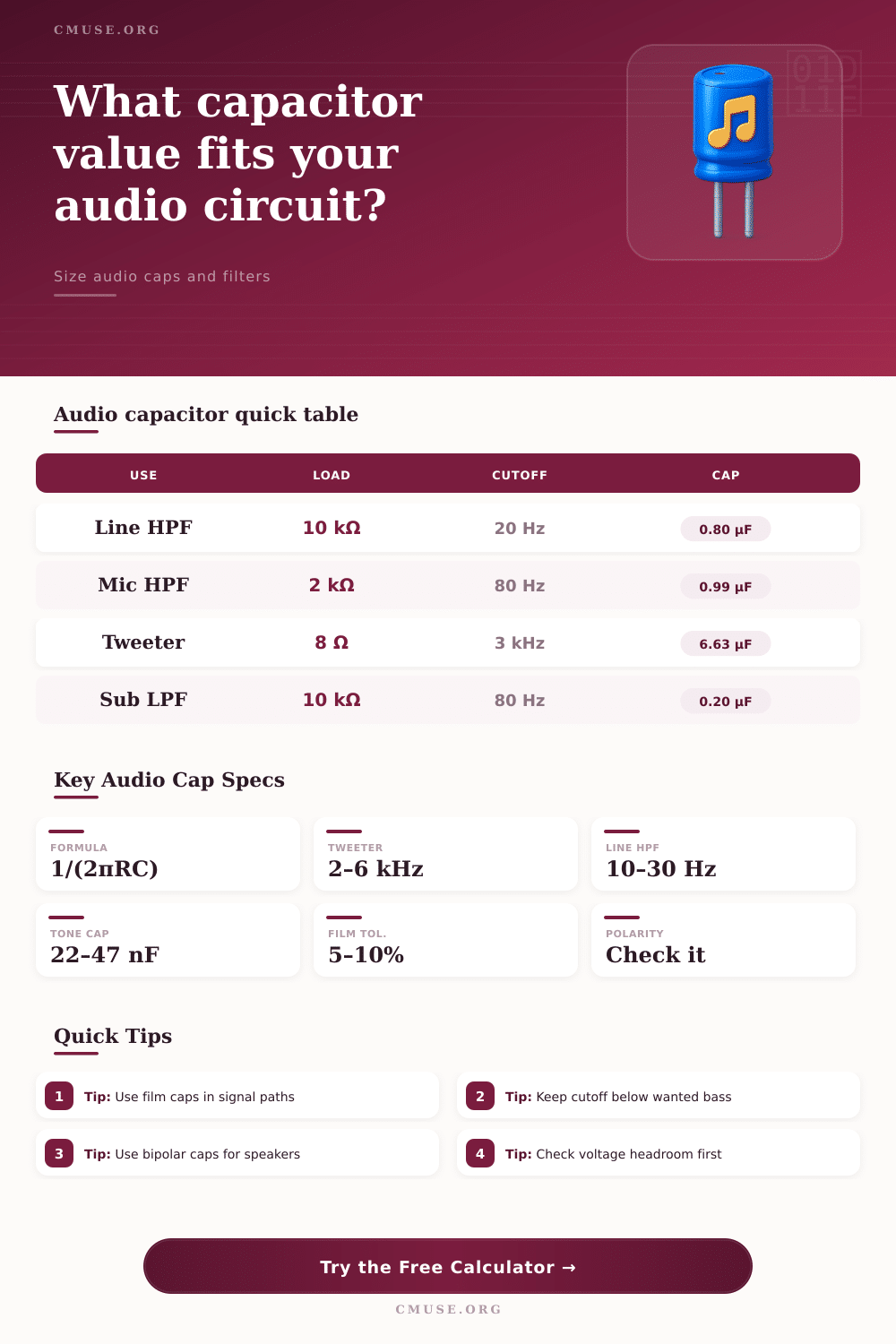
| 6.8 uF | 6800 nF | 8 Ω first-order tweeter near 2.9 kHz | Bipolar electrolytic or film |
| 220 uF | 220000 nF | Headphone coupling into low impedance loads | Polar electrolytic |
🔊 First-Order Crossover Reference
| Speaker Load | 1 kHz | 2.5 kHz | 5 kHz |
|---|---|---|---|
| 4 Ω tweeter | 39.8 uF | 15.9 uF | 8.0 uF |
| 6 Ω tweeter | 26.5 uF | 10.6 uF | 5.3 uF |
| 8 Ω tweeter | 19.9 uF | 8.0 uF | 4.0 uF |
| 16 Ω tweeter | 9.9 uF | 4.0 uF | 2.0 uF |
🎚 Line-Level RC Filter Reference
| Input Resistance | 10 Hz HPF | 20 Hz HPF | 80 Hz HPF |
|---|---|---|---|
| 2 kΩ mic/load | 7.96 uF | 3.98 uF | 0.99 uF |
| 10 kΩ line | 1.59 uF | 0.80 uF | 0.20 uF |
| 22 kΩ line | 0.72 uF | 0.36 uF | 0.09 uF |
| 47 kΩ input | 0.34 uF | 0.17 uF | 0.04 uF |
🎸 Tone Circuit Reference
| Control Load | 22 nF | 47 nF | Audio Character |
|---|---|---|---|
| 250 kΩ pot | 28.9 Hz RC corner | 13.5 Hz RC corner | Stronger treble dump as pot turns down |
| 500 kΩ pot | 14.5 Hz RC corner | 6.8 Hz RC corner | Brighter base setting with wider sweep |
| 1 MΩ input | 7.2 Hz RC corner | 3.4 Hz RC corner | High impedance keeps low-frequency loss minimal |
| 100 kΩ pedal | 72.3 Hz RC corner | 33.9 Hz RC corner | Useful for pedal voicing and tone shaping |
⚙ Capacitor Type Comparison
| Type | Strength | Watch Point | Best Audio Fit |
|---|---|---|---|
| Film | Stable, low distortion, non-polar | Large size above a few uF | Signal coupling and tone circuits |
| Polypropylene | Low loss and good crossover behavior | Physically bulky at speaker values | Higher-grade speaker crossovers |
| Bipolar electrolytic | Large uF values in compact packages | Higher tolerance and ESR | Speaker crossover series capacitors |
| Polar electrolytic | Very large values for low impedance loads | Polarity and aging matter | Headphone or supply-coupled outputs |
| C0G/NP0 ceramic | Very stable at small values | Limited practical capacitance | Small EQ, RF, and precision filters |
| Tantalum | Compact legacy part choice | Polarity and surge sensitivity | Service matching in older circuits |
📝 Spec Comparison Grid
Capacitors are electronic components used to manage the frequences within audio circuits. Capacitors act as gate for electrical signals. Each capacitor decide which frequencies will pass through the circuit and which will be removed from the circuit.
By changing the value of the capacitor, you change the tone of the audio signal. Capacitors can create warm tones or thin tones depending on the value of the component. The relationship between the capacitance and resistance in an audio circuit is known as an RC circuit.
How Capacitors Affect Sound in Audio Circuits
An RC circuit is formed by placing a capacitor and a load in series with each other. This RC circuit will create a high-pass filter or a low-pass filter. A high-pass filter will allow only high frequencies to pass through the filter.
A low-pass filter will allow only low frequencies to pass through the filter. The cutoff frequency for these filters is the value of frequency at which the audio signal begins to drop off. If you set the cutoff frequency too high for audio circuits, low frequencies such as bass sound will be removed from the audio signal.
To prevent this, you should of set the cutoff frequency to a value that is lower than the frequency of the lowest sound that you want to hear. The load resistance for a capacitor is another critical value that you should take into consideration when calculating the value of the capacitor. For speaker crossover circuit, the load resistance is the nominal impedance of the speaker.
For preamplifier circuits, the load resistance is the input impedance of the next stage of the circuit. A capacitor that will work correctly with a 10 kΩ load resistance will not work correctly with an 8 Ω load resistance. In any given circuit, you must know the impedance of the circuit to select the appropriate capacitor for the circuit.
There are various type of capacitors used in audio circuits for specific purposes. Film capacitors are used in signal paths because film capacitors are very stable and dont change the tone of the audio signal. Electrolytic capacitors are used for capacitive values that are higher than what film capacitors can provide in a small area.
However, electrolytic capacitors has higher tolerances in there values and may degrade over time. Depending on the needs of the circuit, you must choose the proper type of capacitor for the circuit. The tolerance for a capacitor is the difference between the marked value for the capacitor and the actualy value of the capacitor.
For example, a capacitor that is marked as having a value of 1 uF can have an actual value of 0.9 uF or 1.1 uF. In stereo circuits, the tolerance for each channels capacitors is a critical factor to consider. If the actual value of the capacitors differs between the left and right audio channel, the stereo image of the audio signal will shift.
You can use the tolerance of the capacitors to decide whether a precision capacitor is needed or whether a standard capacitor will fulfill the needs of the audio circuit. The voltage rating for a capacitor are a safety requirement for every capacitor. The voltage rating of the capacitor must be higher than the voltage in the circuit.
If you use a capacitor with a voltage rating of 16 V in a circuit that has 200 V of DC bias, the capacitor will fail and may produce smoke. To prevent this from happening, the voltage headroom must be higher than the peak voltage of the signal in the circuit. Designing audio filters require the use of mathematical formulas and the knowledge of the data of the components that will be manufactured.
There are various mathematical formulas that will allow you to calculate the value of the capacitor that is required to design the audio filter. Various table list the values of the most common capacitors. Based off the calculated value for the capacitor, you can select a standard capacitor value.
Using the correct value for the capacitor for the circuit will ensure that the circuit is stable and safe.