🎧 Audio Cable Length Calculator
Calculate the exact cable length you need for any audio setup — studio, stage, or home recording
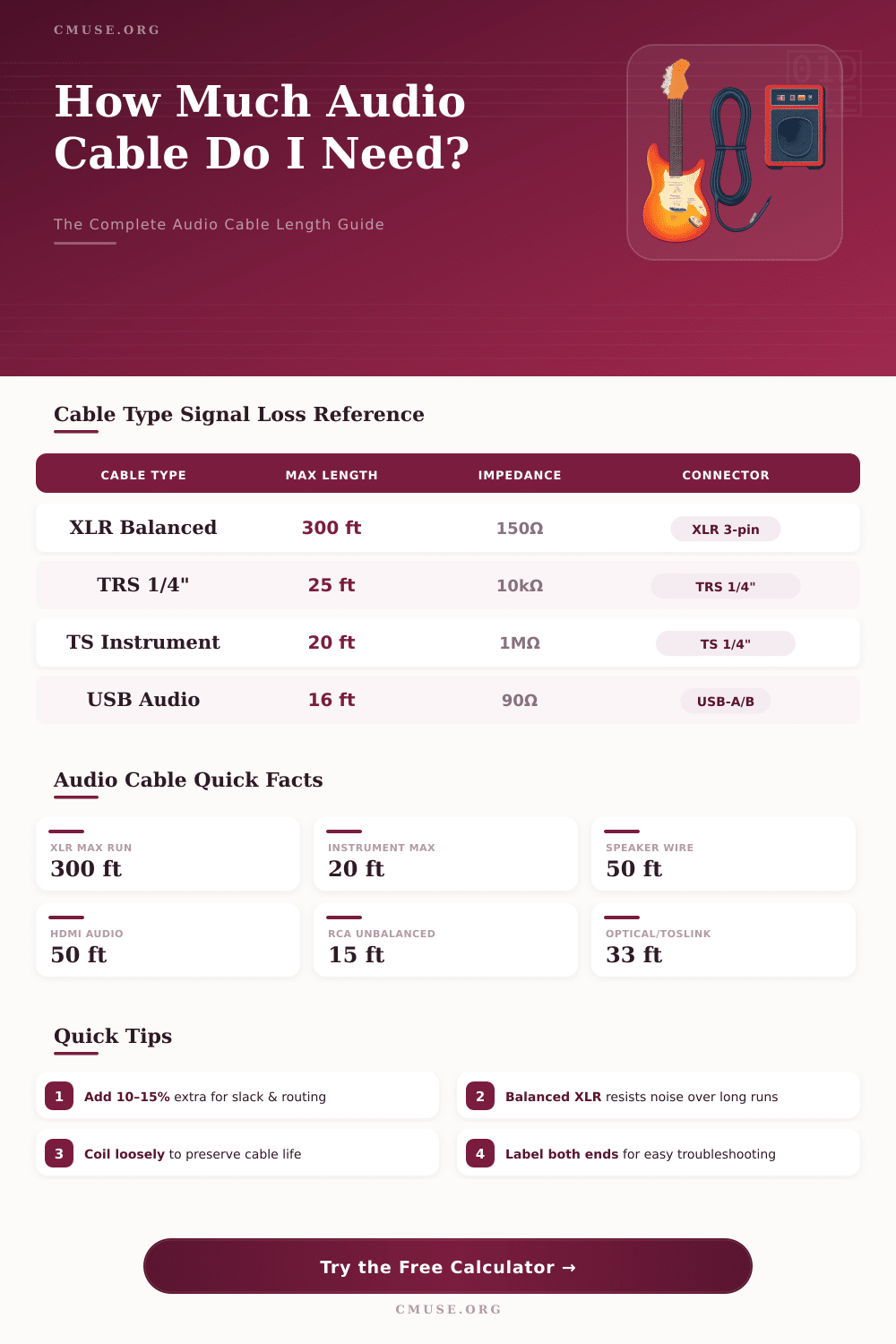
| Cable Type | Recommended Max | Hard Limit | Signal Loss Risk | Notes |
|---|---|---|---|---|
| XLR Balanced | 100 ft (30 m) | 300 ft (91 m) | Low | Balanced line, high noise rejection |
| TRS 1/4" Balanced | 25 ft (7.6 m) | 50 ft (15 m) | Low–Med | Use for line-level balanced runs |
| TS 1/4" Instrument | 15 ft (4.5 m) | 25 ft (7.6 m) | Med–High | High impedance; picks up hum easily |
| RCA / Phono | 10 ft (3 m) | 20 ft (6 m) | High | Unbalanced; for home use only |
| Speaker Wire | 30 ft (9 m) | 50 ft (15 m) | Low–Med | Thicker gauge (12–14 AWG) for long runs |
| Optical TOSLINK | 16 ft (5 m) | 33 ft (10 m) | No loss | Immune to EMI; fragile bends |
| USB Audio | 10 ft (3 m) | 16 ft (5 m) | Digital cut-off | Use USB extender for longer runs |
| CAT5/6 (AES67) | 200 ft (61 m) | 328 ft (100 m) | Very Low | Requires AES67 / Dante interface |
| Routing Style | Multiplier | Example (20 ft room) | Best For |
|---|---|---|---|
| Direct Run | 1.0x | 20 ft | Short desktop runs, patch cables |
| Along Walls & Ceiling | ~2.5x | 50 ft | Stage floor, fixed installations |
| Through Floor / Conduit | ~2.0x | 40 ft | Permanent studio wiring |
| Overhead Truss / Fly Rig | ~3.0x | 60 ft | Concert venues, theaters |
| Project | Area | Cables | Est. Total Cable | Recommended Type |
|---|---|---|---|---|
| Home Studio 10x12 | 120 sq ft | 4 | ~80 ft | XLR Balanced |
| Practice Room 8x10 | 80 sq ft | 3 | ~45 ft | TS Instrument |
| Live Stage 20x30 | 600 sq ft | 12 | ~720 ft | XLR Balanced |
| DJ Booth 6x8 | 48 sq ft | 6 | ~60 ft | RCA / TRS |
| Recording Booth 5x5 | 25 sq ft | 2 | ~30 ft | XLR Balanced |
| Church Hall 40x60 | 2400 sq ft | 20 | ~1800 ft | XLR / CAT6 |
| Home Theater 14x18 | 252 sq ft | 8 | ~320 ft | Speaker Wire |
| Podcast Desk 3x4 | 12 sq ft | 2 | ~16 ft | XLR Balanced |
The length of audio cable becomes a problem when dealing with prime sound. Almost always one chooses the shortest possible length. In audio system cables play an important role.
They care about faithful signal transfer from one spot to the another, protecting tender sound waves.
How Cable Length Affects Sound and Recommended Lengths
Although, when they are too long, it is possible to not simply match. In studio settings the signal loss shows more than in noisy pub or open space. No doubt brilliant cables are built to minimize toll at bigger distances.
Like this one must always think about the cable itself and its particular use.
RCA audio cables shorten easily until around 100 feet, if they are well made. Outside they last between 100 and 200 feet. Under 100 feet one does not notice quality loss.
With average cables it is possible to go until 300 feet, however the sound will adjust. A balun allows to extend RCA by means of ethernet cable, but only for sound, not for other signals.
Balanced cable works otherwise. It sends microphone signal during hundreds of feet without notable toll. AES digital audio well works above 1000 feet, if one uses fit 110-ohm cables.
For usual analog sound double balanced cables reach around 100 metres, simple around 150 metres, while unbalanced limit too 30 until 50 metres.
Speaker cables work specially, because they carry strong electricity at low resistance. Audio Cable Length affects chiefly through resistance and its impact on damping. Practical mode is choose thick wires for long runs.
In home setups 14-gauge wires work well. For short distances 16-gauge answer well. The longer the run, the lower the gauge number.
One advises to check distance charts according to wire gauge and speaker resistance. For instance, 12 AWG for 60 feet with 8-ohm load.
In guitar cables with passive pickups 25-foot length causes a bit of height-toll and moisture in the sound. For passive instruments safely use good quality cables under 20 feet. Active bass guitar does not suffer a lot with longer cables.
Useful is to keep the cable from guitar to volume pedal at around 3 feet, and later 10 until 15 feet until the amplifier.
Also USB cables have limits. For USB 2.0 or older the maximum standard length is 5 metres. Do not use longer, unless absolutely needed.
They will not hurt, but certainly will not improve. For HDMI 2-metre minimal length helps toescape sync problems between sound and image.