Audio Attenuator Calculator
Calculate resistor values, output level, and power handling for passive pads used on line, mic, headphone, and speaker audio signals.
🎚 Quick Presets
🎛 Attenuator Inputs
📊 Audio Pad Spec Grid
📐 Attenuator Formula Reference
| Topology | Series Resistor | Shunt Resistor | Best Use |
|---|---|---|---|
| High-Z series pad | Rload × (K - 1) | Input load acts as shunt | Line outputs into high impedance inputs |
| Speaker L-pad | Z × (K - 1) / K | Z / (K - 1) | Passive speaker or headphone level reduction |
| Matched T-pad | Z × (K - 1) / (K + 1) | 2ZK / (K² - 1) | Equal impedance unbalanced systems |
| Matched Pi-pad | Z × (K² - 1) / 2K | Z × (K + 1) / (K - 1) | Equal impedance RF-style and audio test pads |
🔌 Common Audio Impedance Reference
| Audio Use | Typical Impedance | Common Pad | Power Concern |
|---|---|---|---|
| Balanced line input | 10 kΩ to 20 kΩ | Series or Pi pad | Usually low, often under 0.25 W |
| Microphone input | 150 Ω to 2 kΩ | Balanced H-pad | Noise and matching matter more than watts |
| Headphone load | 16 Ω to 300 Ω | L-pad or series pad | Check heat for low impedance models |
| Loudspeaker load | 4 Ω, 8 Ω, or 16 Ω | High-wattage L-pad | Resistors can dissipate serious heat |
📉 dB Attenuation Ratio Table
| Attenuation | Voltage Out | Power Out | Practical Meaning |
|---|---|---|---|
| 3 dB | 70.8% | 50.1% | Small but audible trim |
| 6 dB | 50.1% | 25.1% | Half voltage, quarter power |
| 10 dB | 31.6% | 10.0% | Common line-level pad |
| 20 dB | 10.0% | 1.0% | Common microphone pad |
| 30 dB | 3.16% | 0.1% | Heavy signal reduction |
⚙ Pad Topology Comparison Grid
| Topology | Resistor Count | Impedance Behavior | Recommendation |
|---|---|---|---|
| Series high-Z pad | 1 per channel | Input impedance rises with attenuation | Use only when the load is much higher than the source |
| Speaker L-pad | 2 per channel | Keeps amplifier load near nominal Z | Use high wattage, ventilated resistors for speakers |
| Matched T-pad | 3 per channel | Maintains equal source and load impedance | Good for unbalanced 600 ohm and test setups |
| Matched Pi-pad | 3 per channel | Maintains equal source and load impedance | Good when shunt resistors are easier to place |
| Balanced H-pad | 5 per channel | Differential version of a matched T-pad | Use for balanced microphone or line pads |
🎶 Common Project Size Reference
| Scenario | Starting Level | Typical Cut | Target Result |
|---|---|---|---|
| Hot synth to line input | 5 Vrms into 10 kΩ | 12 dB | About 1.26 Vrms output |
| Mic inline pad | 0.775 Vrms across 150 Ω | 20 dB | About 77.5 mVrms output |
| Speaker level trim | 50 W into 8 Ω | 6 dB | About 12.6 W at the driver |
| Headphone level tame | 2 Vrms into 32 Ω | 9 dB | About 0.71 Vrms output |
A signal can become too hot if the signal level is too high for the input stage of an mixing console or an audio device. If the signal level is too high for the input stage of an audio device, the signal will clip at the input stage of that device. Signal clipping introduce distortion into the audio signal.
To reduce the signal level of an audio device, you can use a passive attenuator, also known as a pad. A passive attenuator is a network of resistors that reduce the signal level coming into a device. Using a passive attenuator allow you to lower the signal level of a device.
How to Use a Passive Pad to Lower an Audio Signal
Using a passive attenuator also allows you to maintain the character of the sound. Impedance is one of the primary factor to consider when designing a passive attenuator. If you simply place a random resistor into the signal path of a device, you may succeed in lowering the volume of the device.
However, you may also change the frequency response of the device or place strain on the output stage of the device. Because impedance is one of the most important factor for a passive attenuator, you must decide on a specific topology for your passive attenuator. If the signal source that you are working with has a high impedance, a series pad may be sufficient for your needs.
However, if you are working with professional 600 ohm gear, you will have to use a matched network to ensure that the impedances remains compatible with one another despite the passive attenuator dampening the signal. There are different styles of pad that can be used. One style of pad that people use is the T-pad.
A T-pad is used to maintain a steady impedance in a signal path. By using a T-pad, the tone of the signal will remain consistent. Another type of passive attenuator is the Pi-pad.
A Pi-pad is used when components has specific placement constraints. Another type of passive attenuator is the L-pad. An L-pad is used to attenuate the signal from speakers.
Speakers emit alot of power, so when using an L-pad, the impedance must remain constant and the amplifier should not have to work too hard to move the signal. If the impedance were not maintained with an L-pad, the amplifier may overheat. You must also consider the power rating of the resistors that will be used in a passive attenuator.
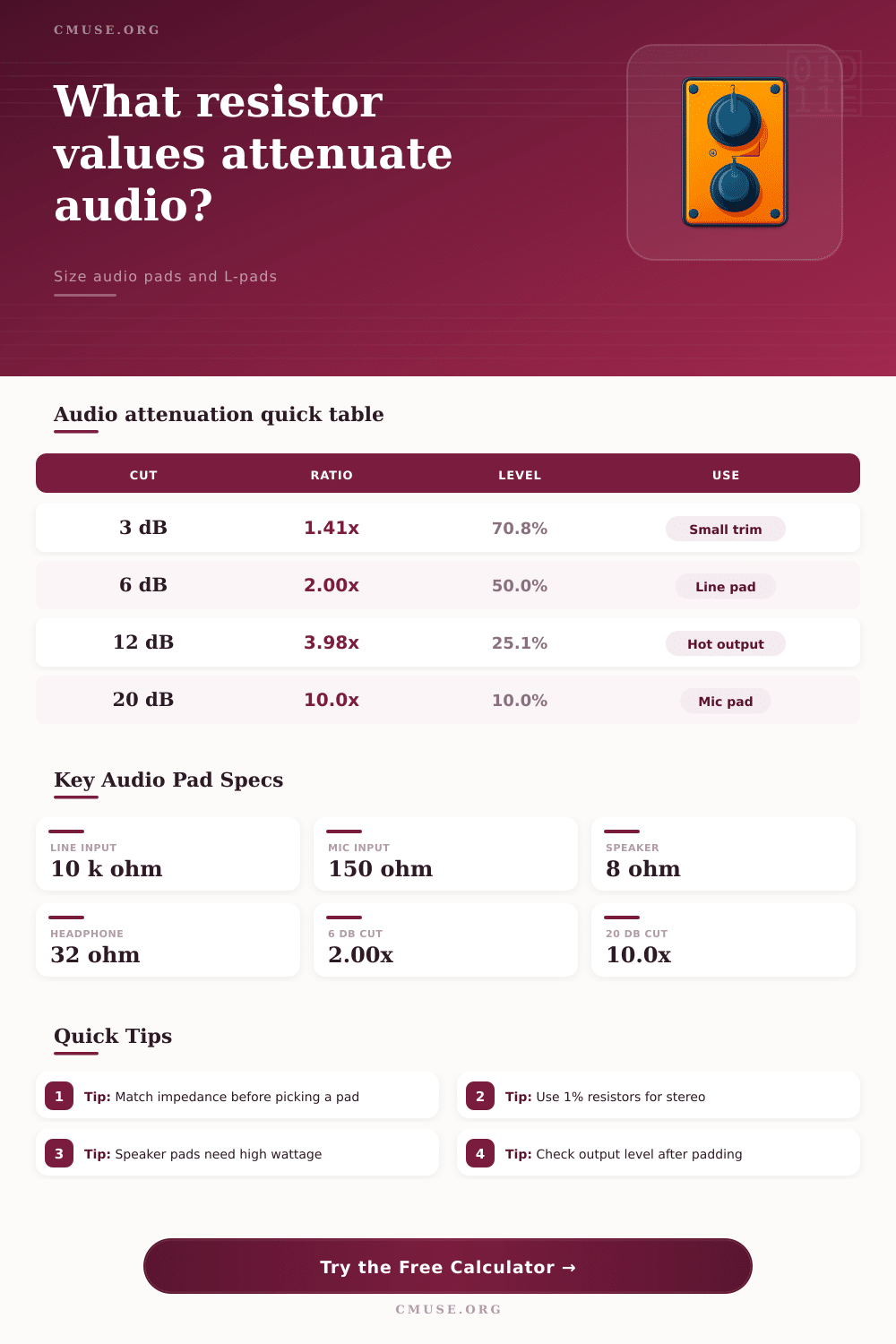
For line-level circuits, a small carbon film resistor may be sufficient. Line-level circuits only move millivolts. However, if you are building a passive attenuator to pad down a 50 watt guitar amplifier, the resistors will have to dissipate 50 watts of power.
If you use a resistor that cannot handle this much power, the resistor will burn out. You should use a resistor that is rated for twice the power that the resistor will dissipate so that the resistor will not burn out under normal use. Using a resistor with a higher power rating provides a safety factor for the passive attenuator.
When you are building a stereo pad, it is important that both the left and right channels has the same value for resistance. If you use a different value for resistance on each channel, the stereo image may become unbalance. Furthermore, the phantom center of the mix may shift with different resistance value on each side of the stereo image.
To avoid these issues, you should use 1 percent precision resistors in the construction of a stereo pad. Using 1 percent precision resistors will ensure that the attenuation of the signal is the same on each side of the stereo image. Using these types of resistors will also keep the audio signal properly centered.
The decibel ratings are used to indicate how much a passive attenuator will reduce the signal level. A 6 decibel reduction in signal level means that the voltage of the signal is halve. A 20 decibel reduction in signal level means that the signal level is reduced to ten percent of the original voltage level of the signal.
These ratings can help to indicate how much attenuation is require in your signal path. Overall, the goal of the passive attenuator is to reduce the signal level while maintaining the quality of the sound. If the impedances are properly matched and the heat requirement of the components are respected, the passive attenuator will reduce the signal level of a device without altering the sound quality.