Attenuator Loss dB Calculator
Convert amplifier watts to attenuation loss, speaker voltage, heat dissipation, SPL drop, and matched L-pad resistor values for audio attenuator checks.
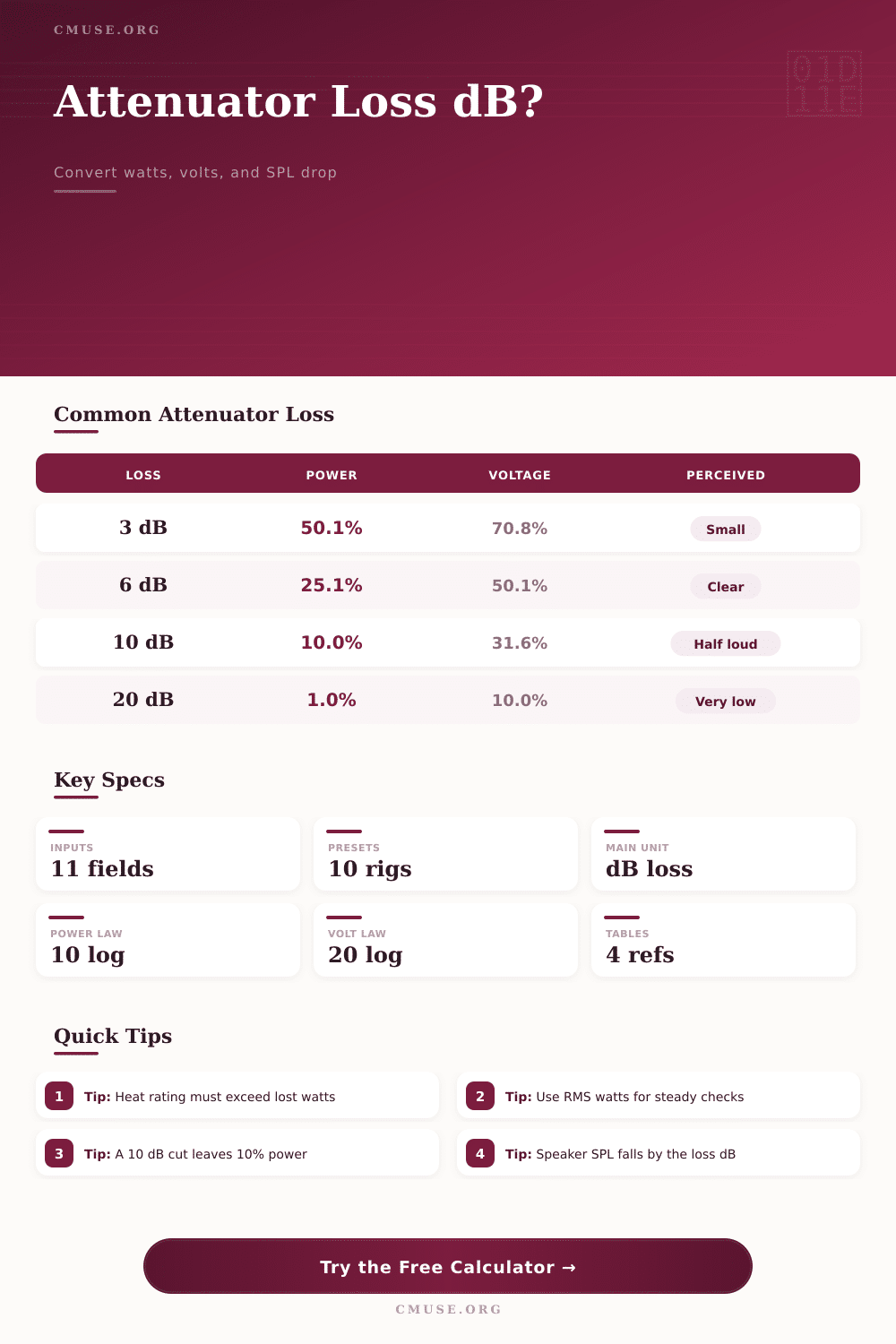
| Attenuation loss | Power delivered | Voltage delivered | Typical audio meaning |
|---|---|---|---|
| 3 dB | 50.1% of amp power | 70.8% of amp voltage | Small but obvious level reduction |
| 6 dB | 25.1% of amp power | 50.1% of amp voltage | Half voltage, useful first pad step |
| 10 dB | 10.0% of amp power | 31.6% of amp voltage | Commonly perceived near half as loud |
| 12 dB | 6.31% of amp power | 25.1% of amp voltage | Strong stage or rehearsal cut |
| 15 dB | 3.16% of amp power | 17.8% of amp voltage | Quiet-room guitar amp attenuation |
| 20 dB | 1.00% of amp power | 10.0% of amp voltage | Very deep cut, high heat in pad |
| Loss | Series resistor Rs | Shunt resistor Rp | Speaker power from 50 W amp |
|---|---|---|---|
| 3 dB | 2.34 Ω | 19.3 Ω | 25.1 W delivered |
| 6 dB | 3.99 Ω | 8.04 Ω | 12.6 W delivered |
| 10 dB | 5.47 Ω | 3.70 Ω | 5.00 W delivered |
| 12 dB | 5.99 Ω | 2.68 Ω | 3.15 W delivered |
| 15 dB | 6.58 Ω | 1.73 Ω | 1.58 W delivered |
| 20 dB | 7.20 Ω | 0.889 Ω | 0.50 W delivered |
| Original amp power | -6 dB speaker power | -12 dB speaker power | -20 dB speaker power |
|---|---|---|---|
| 5 W small tube amp | 1.26 W | 0.315 W | 0.050 W |
| 15 W combo | 3.76 W | 0.946 W | 0.150 W |
| 30 W combo | 7.54 W | 1.89 W | 0.300 W |
| 50 W head | 12.6 W | 3.15 W | 0.500 W |
| 100 W head | 25.1 W | 6.31 W | 1.00 W |
| 300 W bass amp | 75.4 W | 18.9 W | 3.00 W |
| Scenario | Input condition | Attenuation goal | Primary caution |
|---|---|---|---|
| Tube amp rehearsal | 50 W into 8 Ω | 5 W speaker power, 10 dB loss | About 45 W becomes attenuator heat |
| Small combo at home | 15 W into 8 Ω | 1.5 W speaker power, 10 dB loss | SPL may still exceed 90 dB nearby |
| Stage head trim | 100 W into 16 Ω | 12 dB loss, 6.31 W speaker | Pad needs large continuous heat margin |
| Bass cabinet trim | 300 W into 4 Ω | 75 W speaker power, 6 dB loss | Attenuator must handle high current |
| Line output trim | High impedance line input | 6 to 12 dB voltage drop | Keep source loading within spec |
The other thing to remember about turning down an amp isn’t just turning a knob, you’re dealing with actual electricity here. And if you don’t send it all to your speaker cone, where do you want that power to go? It goes to resistors that converts it to heat. That’s why understanding the thermal load on your pad is so important. If you underestimate it, you would of burnt out your high-dollar gear by the end of the night.
That’s where the calculator comes in: It helps you understand what go through your speaker and what gets burned up in the pad. Power reduction confuses most musician with perceived loudness. A three-decibel drop sounds small, yet it literal cuts the amount of power reaching your speaker cone in half. Although you may not notice a huge difference in volume, that’s still a pretty drastic mechanical change. By comparison, a ten-decibel reduction drops power down to only ten-percent of its former self; something we typically experience as being half as loud.
Why You Need an Attenuator Calculator
The catch: It’s not a linear relationship, you can’t just guesstimate that halving the power would also halve the noise; you’re going to have to use some sort of logarithmic math to close the gap between what you’re driving your amp for and what’s actualy coming out of your neighbors’ ears.
This brings us back around to a bit of hidden danger: heat, which doesn’t dissapears when you turn your fifty-watt tube amp down to five watts to sneak off to practice after dark. That still leaves those other forty-five watts, which dissipate as thermal energy in the attenuator unit. If the attenuator isn’t designed to continuously handle such a load of heat without overheating, it’s going to overheat. It will then fail somehow and either pose a fire hazard or change the value of its resistance(s).
The tool computes the heat load for you. However, you must also consider two more factors that is never included in paper ratings: the airflow and enclosure material. This is because passive components have their own limits.
Another thing pure volume sliders don’t take into account is impedance matching. If you’re not presenting the right load to the amplifier, you can damage output transformers. You can also color the tone with unwanted frequency rolls-offs. An L-pad drops the signal level going to the speaker but maintains nominal impedance seen from the amp so that the interaction between the cabinet and the tube stages is preserved. It does not flatten it out into some sterile digital silence, but maintains that breakup character.
As for volume, remember to consider other variables such as distance from the listeners and acoustics of the room. What looks like enough (a 12db cut) on paper may still result in an overwhelming sound level to someone sitting close to the cabinet. The calculator takes distance into consideration along with speaker sensitivity, providing a much more helpful picture of real-world db levels at your ear vs. Raw watts, which don’t tell whole story.
That contextualization makes theoretical electricity values meaningful in practical terms: Can I get away with moving them, or do I need to reduce them further? Effective attenuation means managing energy well instead of simply hiding it. You don’t need enough signal to blow up your equipment or your eardrums, but there must be enough left to move the speaker.
By understanding the trade-off between tone and heat, you can make calculated adjustments different than using blind trial-and-error. This ensures that the music stays clear, controlled, and safe for everyone involved. And the resistor keeps the heat in the right place.