Artificial Harmonic Pitch Calculator
Find the sounding pitch, frequency, cents offset, and physical touch point for artificial harmonics from a stopped note, string length, selected partial, tuning reference, and transposition.
Choose a realistic bowed-string, guitar, harp, mandolin, or bass starting point, then adjust the stopped position and touch partial. The calculator treats the stopped note as the new string length and multiplies it by the chosen natural-number partial.
Calculation Breakdown
2nd
Selected partial
2:1
Frequency ratio
+12 st
Pitch above stopped note
1/2
Node fraction of string
0 c
Partial tuning color
Medium
Touch reach rating
220 Hz
Open string frequency
12.9 in
Scale length input
| Partial | Common touch above stopped note | Sounding interval | Equal-tempered offset | Practical use |
|---|---|---|---|---|
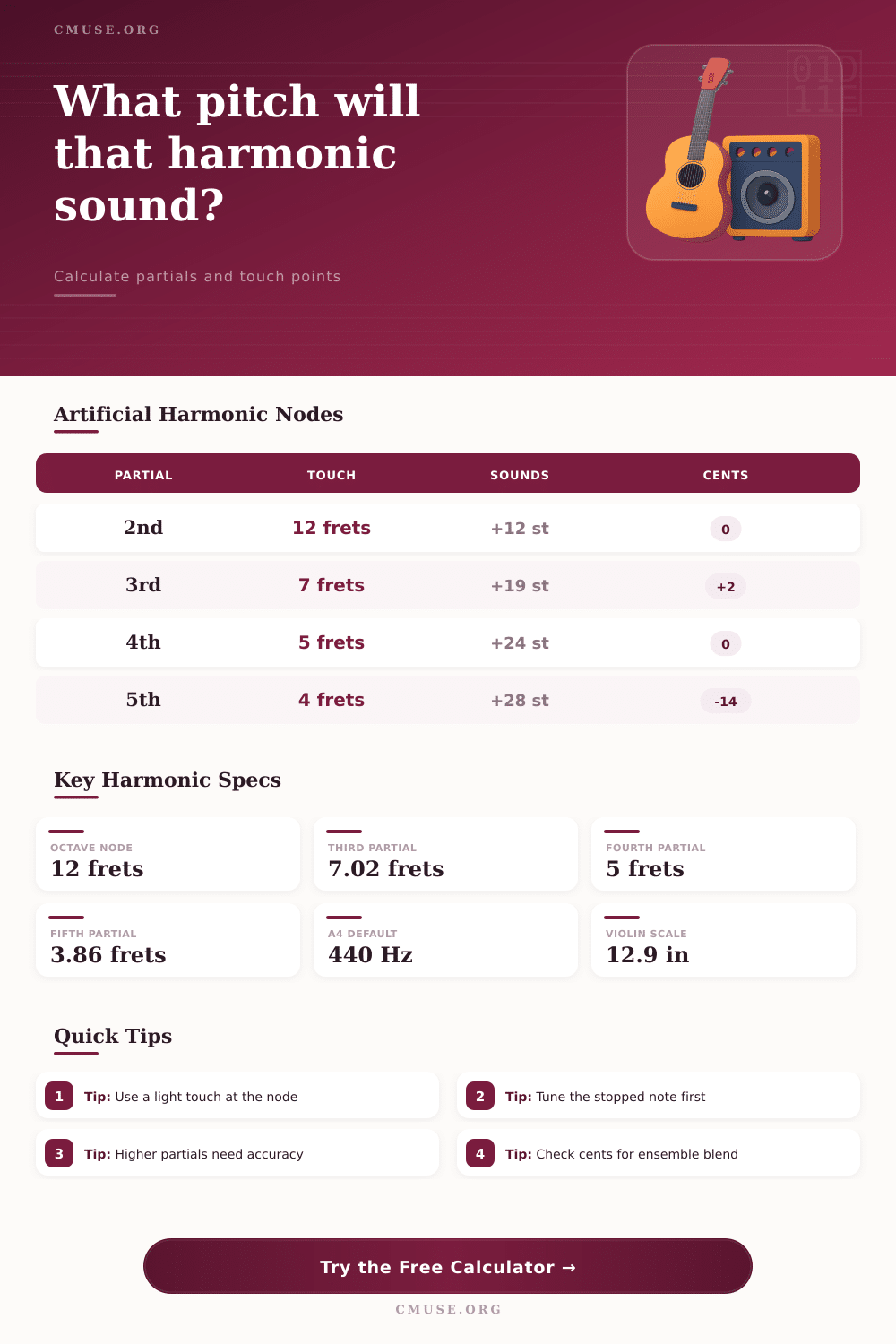
| 2nd partial | 12.00 frets, midpoint node | Octave above the stopped pitch | 0 cents | Most stable artificial harmonic for strings and guitar. |
| 3rd partial | 7.02 frets, one-third node | Octave plus perfect fifth | About +2 cents | Clear and bright when the touch point is accurate. |
| 4th partial | 4.98 frets, one-quarter node | Two octaves above the stopped pitch | 0 cents | Useful for high, pure octave effects with short reach. |
| 5th partial | 3.86 frets, one-fifth node | Two octaves plus major third | About -14 cents | Colorful but noticeably low against equal-tempered thirds. |
| 6th partial | 3.16 frets, one-sixth node | Two octaves plus perfect fifth | About +2 cents | Brilliant tone; needs a clean stop and light touch. |
| 7th partial | 2.67 frets, one-seventh node | Near two octaves plus minor seventh | About -31 cents | Special color; check carefully before blending with harmony. |
| Instrument | Typical open strings | Typical scale length | Best harmonic choices | Position note |
|---|---|---|---|---|
| Violin | G3, D4, A4, E5 | About 12.9 in / 32.8 cm | 2nd, 3rd, and 4th partials | Left-hand reach favors octave and third-partial touches. |
| Viola | C3, G3, D4, A4 | About 14.8 in / 37.6 cm | 2nd and 3rd partials | Larger spacing makes high partial accuracy more important. |
| Cello | C2, G2, D3, A3 | About 27.4 in / 69.6 cm | 2nd through 5th partials | Thumb position often handles the stopped note cleanly. |
| Double bass | E1, A1, D2, G2 | About 41.3 in / 104.9 cm | 2nd and 3rd partials | Large distances favor bridge-side reference checks. |
| Guitar | E2, A2, D3, G3, B3, E4 | About 25.5 in / 64.8 cm | 2nd, 3rd, 4th, and pinch nodes | Frets make the stopped pitch exact before touch placement. |
| Harp | Pedal-defined string pitch | Varies by string register | Mainly 2nd partial | Stopped or lightly touched octave harmonics are common. |
| Scenario | Open string | Stopped interval | Touch partial | Expected sounding result |
|---|---|---|---|---|
| Violin stopped D on A string | A3 or A4 by register | +5 semitones | 2nd partial | One octave above the stopped D. |
| Cello thumb-position octave harmonic | A3 string | +3 to +7 semitones | 2nd partial | Clear octave sparkle above the thumbed pitch. |
| Classical guitar artificial harmonic | Any fretted string | Fret number | 2nd partial | Sounding pitch is 12 frets higher than fretted note. |
| Electric guitar pinch harmonic | Picked string | Fret number | 3rd to 6th partial | Bright pitch selected by pick-hand node position. |
| Harp octave harmonic | Pedaled string | 0 semitones unless stopped | 2nd partial | Sounds one octave above the vibrating string. |
| Double bass solo harmonic color | D or G string | +5 to +12 semitones | 3rd partial | Octave plus fifth above the stopped pitch. |
| Sounding zone | Frequency band | Typical clarity | Notation caution | Blend advice |
|---|---|---|---|---|
| Middle register | 220 to 880 Hz | Stable and easy to tune | Write the stopped pitch and touch note clearly. | Works well in chamber textures and exposed lines. |
| High singing register | 880 to 1760 Hz | Bright with strong projection | Check octave displacement against the part. | Good for violin, viola, cello, guitar, and harp colors. |
| Very high register | 1760 to 3520 Hz | Brilliant but sensitive | Avoid relying on dense accidentals at speed. | Use lower partials when ensemble intonation is exposed. |
| Color partial zone | Depends on stopped pitch | Can sound low or high vs equal temperament | Mark natural partial color if exact tuning matters. | Fifth partials need special care with thirds. |
Your thumb is resting cleanly on the fingerboard and your index finger is gently touching the node while you’re stopped on a high D string. That bright shimmering tone is what you’re looking for, but there seems to be something not quite right about how it relates to the pitch of cello underneath. That’s normally down to artificial harmonics where the math are not quite as you might imagine. The above calculator take care of the physics for you. All you need to do is enter your string length and partial of choice. This spares you from making an educated guess as to where those microtonal offsets place themselves in relation to equal temperament.
This idea is very simply explained but can be quite fiddly physicaly. The basic premise is that when you play a note with your finger pressed against the string, it act like a note made by a harmonic. The stopped note become the main frequency of the vibrating string. By pressing another node higher than this finger, you effectively reduce the speaking length once more but this time by a certain fraction. Players tend to think in inches or fret numbers, but what the tool do is translate these physical positions into cents difference and actual pitch interval.
How Artificial Harmonics Work
It is useful because even though we might not all have perfect fingers for placing notes exactly right, we do have great hearing for picking up on tuning errors. As you can see, the lower partials such as the second and fourth are forgiving whereas the higher ones requires some serious accuracy. For instance, the second partial is simply an octave up, requiring no deviation in cent value from the standard tuning. It is easy and stable.
Jump up to the fifth partial however and now you’re facing a major third interval that lies about fourteen cents flat of equal temperament. If you’re performing with synthesizers or pianists that can’t adjust their pitch on the fly, that matter. The tool provides a clear reference table that lets you know if your harmonic is going to blend naturaly or clash deliberately with the rest of the section.
For guitarists, it’s somewhat different as they have the frets as fixed stopping points. For example, on a cello or violin, your left-hand must maintains a firm stop on the chosen note while your right-hand index finger go out to locate the node. Depending on which partial you choose will have a dramatic effect on the distance travelled between these two contact point. If you are working with shorter-scale instruments such as mandolins or violins then a four-fret reach is going to feel very different than a twelve-fret reach. You can see precisely in centimetres or inches what your span should of be and decide whether that particular harmonic is even physically possible for your hand size at the current neck position.
Before settling on your chosen partial, it’s also good to consider the acoustic space. Higher harmonics have a tendency to cut through a mix quite well, but overly heavy bow pressure or a room that is too dead can result in an unwanted brittleness. Ideally you want a light touch of the bow at the node. You need sufficient contact to ensure a good core for the fundamental frequency beneath the note. This applies equally to bowed string. On electric instruments such as guitars, we find similar results can be obtained by placing the pick hand to control the nodal point, where distorting amplification can exaggerate even the smallest impurity in the contact. The tool accounts for the difference by allowing you to swap instrument profiles which adjusts the default string gauge and scale length appropriately.
When you’re getting ready for close-mic recording and studio work, don’t overlook the cents offset readings. Something may sound great in a big concert hall but uncomfortably stick out in a narrow chamber music situation where all frequencies is laid bare. If you know that your seventh partial sits thirty-one cents flat, you have the option to either celebrate that color as a stylistic choice or bypass it altogether if pure intonation is called for in the passage. This is how seasoned session players stands out from those who simply hope it sounds right; it turns guesswork into informed decision making.
In conclusion, adding artificial harmonics creates a layer of ethereal texture that cannot be created by regular stopped notes alone. To perform them effectively means combining a good grasp of theory with the physical accuracy needed to produce them. It makes sense to remove one variable from this complex motor task: check the math first then take hold of the string. From there, stop thinking about ‘where’ to put your finger and focus instead on what the tone is like when passed beneath the bow or pick. Clarity arrives when you not only find the right position but also understand why that position produces the sound. This breeds confidence and allows the music to breathe without being held back by technical hesitancy.