Articulation Index Calculator
Estimate speech clarity from octave-band audibility, effective signal-to-noise ratio, room decay, distance loss, and hearing profile.
🎧 Listening Presets
🔊 Speech And Noise Inputs
📊 Band Weight Spec Grid
📝 Articulation Index Reference Tables
| Band | Speech Role | Weight | Full Audibility SNR |
|---|---|---|---|
| 250 Hz | Voicing support | 0.03 | +15 dB |
| 500 Hz | Vowel body | 0.10 | +15 dB |
| 1 kHz | Vowel identity | 0.20 | +15 dB |
| 2 kHz | Consonant edges | 0.26 | +15 dB |
| 4 kHz | Fricatives and presence | 0.21 | +15 dB |
| 6 kHz | Sibilance cues | 0.15 | +15 dB |
| 8 kHz | Fine detail | 0.05 | +15 dB |
| Noise Profile | Main Risk | Typical Use | Calculator Treatment |
|---|---|---|---|
| Studio HVAC | Broad low-mid masking | Control rooms | Near-flat band offsets |
| Music Bleed | Dense mid masking | Rehearsal spaces | Raised 500 Hz to 4 kHz |
| Audience Murmur | Low-mid crowd noise | Venues and halls | Strong 250 Hz to 1 kHz |
| Traffic Rumble | Low-frequency cover | Lobbies and street rooms | Heavy 250 Hz to 500 Hz |
| Pink Reference | Equal octave energy | System testing | Descending A-weighted offsets |
| Bright Fan Whine | High-band masking | Booths and gear racks | Raised 4 kHz to 8 kHz |
| AI Range | Speech Result | Common Reaction | Best Lever |
|---|---|---|---|
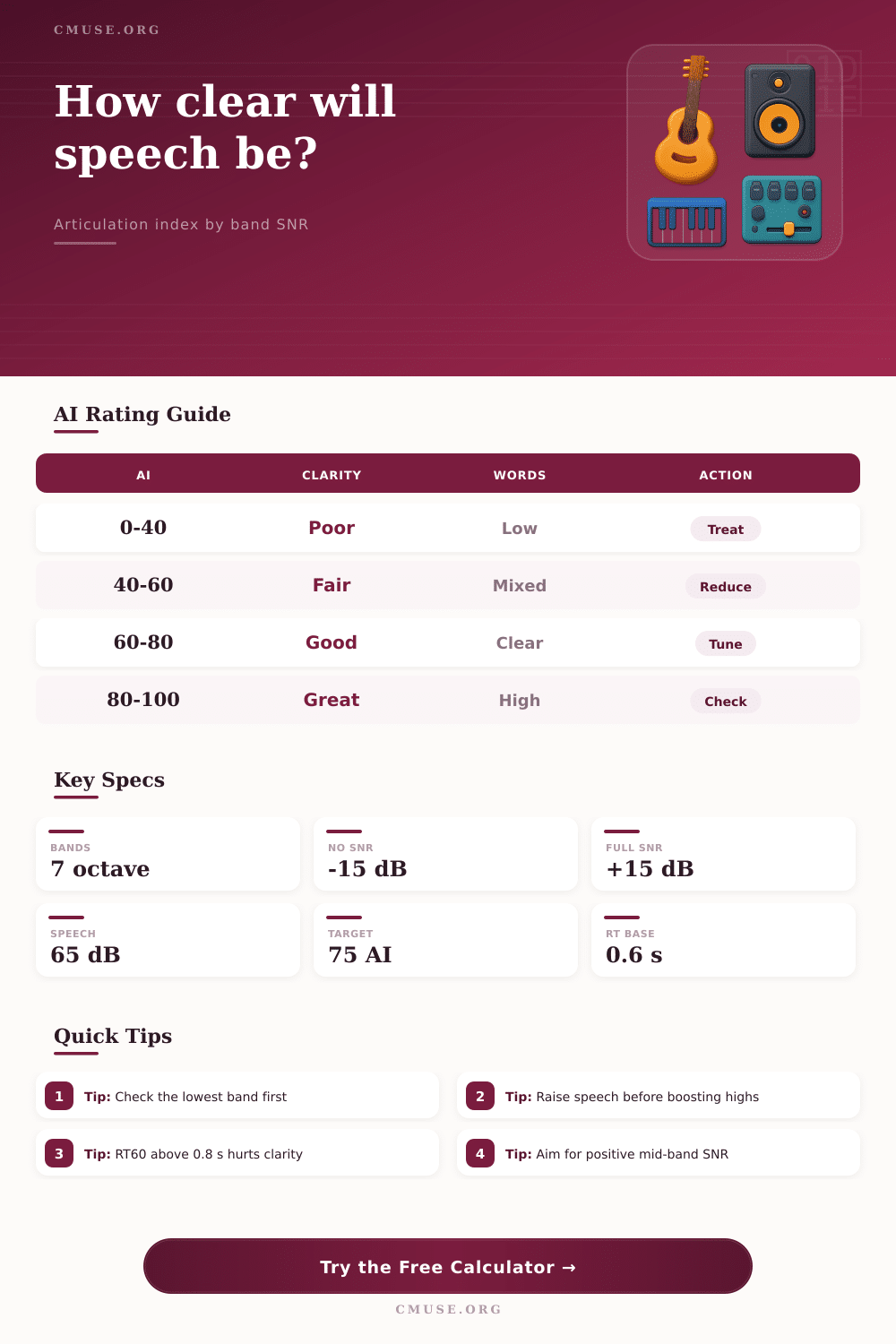
| 0-40 | Poor | Frequent repeats | Reduce noise or distance |
| 40-60 | Fair | Context helps | Add 5 to 10 dB SNR |
| 60-80 | Good | Most words clear | Protect 2 kHz to 4 kHz |
| 80-100 | Excellent | Low listening effort | Confirm with real speech |
| Scenario | Speech | Noise | Typical Target |
|---|---|---|---|
| Studio talkback | 65-75 dB | 35-45 dBA | 80 AI |
| Rehearsal coaching | 70-82 dB | 55-75 dBA | 65 AI |
| Lecture hall | 65-78 dB | 35-50 dBA | 75 AI |
| Venue announcement | 75-88 dB | 55-70 dBA | 70 AI |
💡 Practical Tips
An articulation index calculation are a calculation that helps to predict the amount of a spoken message that a listener can understand. A sound level meter is used to measure the loudness of a speaker, a noise meter is used to measure the loudness of background noises, but neither of these two measurement device will help to predict the number of words that a listener will understand. An articulation index calculation is useful in that it considers the distance between the speaker and the listener, the frequency spectrum of the spoken word, the reverberation in the space, and the hearing profile of the listener to calculate a number that will help to indicate the portion of the message that will reach the listener.
An articulation index calculation require several different inputs to determine the intelligibility of speech for a listener. One of the inputs is the level of speech at a distance of one meter from the speaker, which is used as a reference point for calculations. If a listener is located at a distance from the speaker, the articulation index calculation automatically accounts for the decrease in energy that is radiated with distance.
How the Articulation Index Works
Background noise is another of the inputs for the articulation index calculation; the level of background noise is entered into the calculation as an A-weighted value. However, different spectral shape of noise are applied to the background noise depending upon the source of that background noise. For instance, the spectral shape of background noise from an HVAC system may be different than the spectral shape of background noise from a crowd of people.
Another of the inputs for the articulation index calculation is the reverberation time of the room in which speech is occurring. If the reverberation time of a room is long, the sounds of consonants may smear together such that the listener cannot understand the word that are spoken by the speaker. Therefore, if a room has a long reverberation time, reverberation will create a penalty in the articulation index calculation.
Late reflections in a room will often compete with the direct sound of the speaker; therefore, reverberation will reduce the intelligibility of speech. The hearing profile of the listener is another of the main variable in the calculation. The hearing profile is important in that listeners often dont have perfect hearing.
For instance, listeners with high-frequency hearing loss will have a more lower articulation index calculation score than listeners with perfect hearing. Thus, an articulation index calculation may produce different score for a group of listeners who are exposed to the same speech in the same space, but who have different hearing profiles. The output of an articulation index calculation will be a score that predicts the percentage of the spoken message that will be understood by the listener.
If the score produced from the articulation index calculation is above seventy-five, most of the content word that the speaker spoke will be understood by the listener. If the score for the articulation index calculation is below sixty, the listener will have to use context to understand the words that is spoke by the speaker. If the score for the articulation index calculation is below forty, the listener will have difficulty in understanding the conversation that is occurring between two speaker.
Additionally, the articulation index calculation will also provide a value for the limiting band of the speech. The limiting band is the frequency that is reducing the articulation index score for the listener. Correcting for the limiting band will often have more benefit to the listener than increasing the volume of the speaker.
Within the articulation index calculation, different weight are applied to different bands of frequencies. For instance, the two-kilohertz band is assigned a high weight within the articulation index calculation because most of the consonants and vowels is found in the two-kilohertz band. The eight-kilohertz band is assigned a low weight within the articulation index calculation because most of the consonants and vowels are not found in the eight-kilohertz band.
If the limiting band is identified as the four-kilohertz or six-kilohertz band, it will be beneficial to reduce the noise within that frequency band. It will not be beneficial to simply increase the overall volume of the speaker. It is possible for an individual to make a mistake with the articulation index calculation.
For instance, it is possible for an individual to believe that the articulation index is a value that is related to the room in which speech is occurring. However, other variable in the articulation index calculation include the speaker, the listener, and the background noise in the environment. For instance, if the speaker changes to a microphone, the articulation index will change.
Additionally, if the listener moves to a different location within the room, the articulation index will change. Additionally, it is possible that an individual may believe that reducing the reverberation within a room is the most effective means of increasing the articulation index calculation for that room. However, if the background noise in the room is extremely high, it may first be more beneficial to reduce background noise before reducing reverberation.
Distance between the speaker and the listener impact high frequencies more than low frequencies. Additionally, air absorption of high frequencies by the air between the speaker and listener impacts high frequencies more than low frequencies. Therefore, the consonant frequency bands will be impacted more than the vowel frequency bands.
Thus, a small change in the position of the listener or a small reduction in the high frequencies of background noise may have a greater effect on the articulation index calculation than a large change in the volume of the speaker. The articulation index calculation automatically accounts for these difference in impact on high frequencies. In most case, it is not necessary for the articulation index calculation to reach a score of one hundred.
Most rooms will have some level of background noise and distance between the speaker and the listener. Thus, an articulation index score of one hundred is impossible to achieve with any speaker and any listener. If the articulation index calculation score is lower than the desired target score for intelligibility, the articulation index calculation will provide a figure that estimates the amount that the noise floor within the environment should be reduced, or the volume of the speaker should be increased, in order to reach the target score.
This figure help to determine whether treatment of the noise in the environment is necessary, whether a different microphone is needed, or whether the speaker should change the position of the speaker.