Anacrusis Length Calculator
Convert pickup notes into meter beats, tempo time, phrase duration, and the final bar completion needed to balance the pickup.
♫Real Pickup Presets
🎼Pickup, Meter, Tempo, and Phrase Entry
Enter phrase groups such as 4 + 4, 8, or 2 + 2 + 4. The calculator balances the pickup against the closing bar inside that total phrase length.
📊Current Spec Grid
📝Pickup and Final Bar Reference
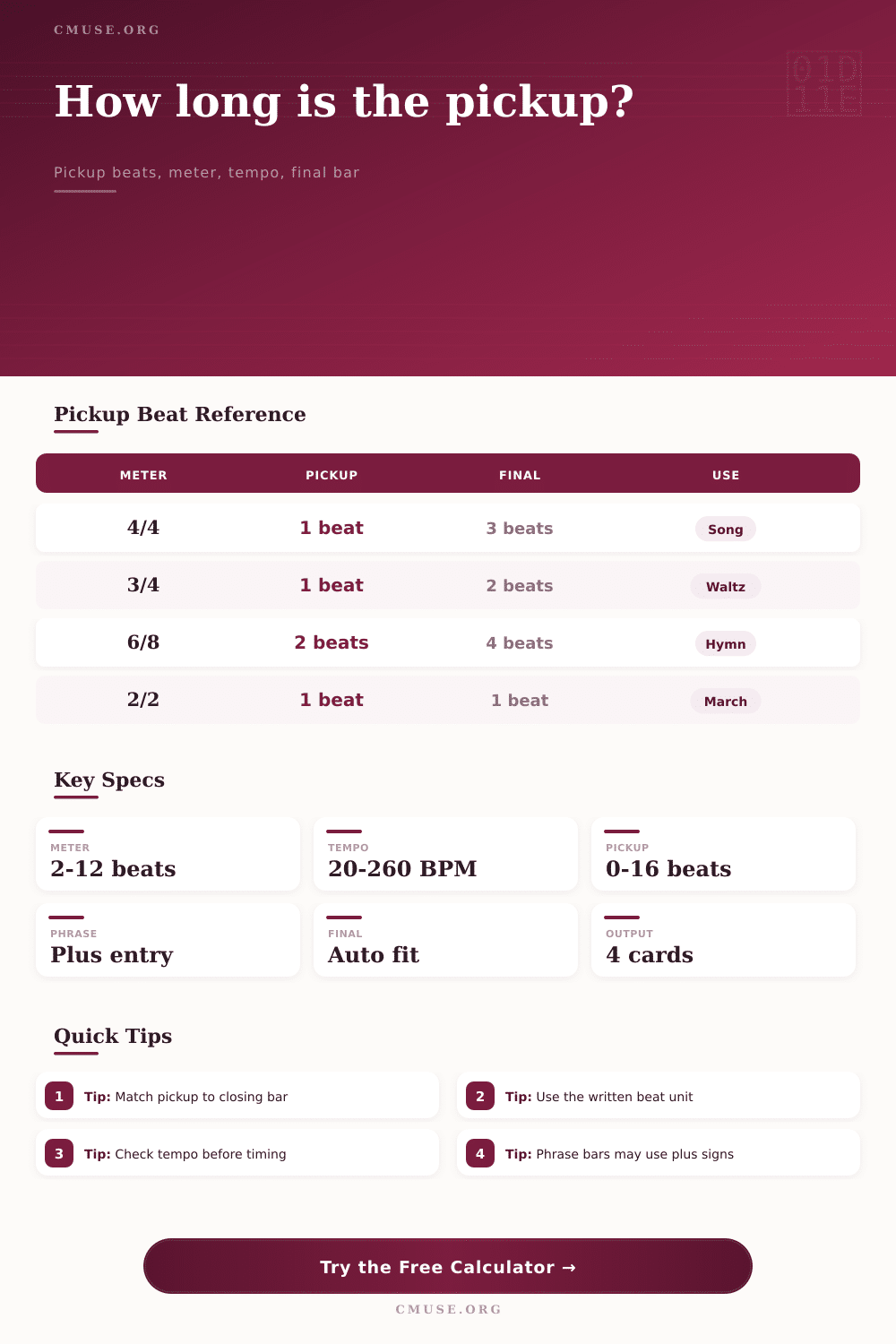
| Common Meter | Typical Anacrusis | Closing Bar Target | Practical Check |
|---|---|---|---|
| 4/4 | 1 quarter-note beat | 3 quarter-note beats | Pickup plus final bar equals 4 beats |
| 3/4 | 1 quarter-note beat | 2 quarter-note beats | Useful for waltz and hymn openings |
| 6/8 | 1 or 2 eighth-note beats | 5 or 4 eighth-note beats | Use the notated eighth-note beat unless conducting otherwise |
| 2/2 | 1 half-note beat | 1 half-note beat | A half-bar upbeat closes with a half bar |
| 5/4 | 1 to 2 quarter-note beats | 4 to 3 quarter-note beats | Keep the asymmetric bar total intact |
⏱Tempo Duration Table
| Tempo | One Beat | Four-Beat Bar | One-Beat Pickup |
|---|---|---|---|
| 60 BPM | 1.000 sec | 4.000 sec | Slow, exact one-second pickup |
| 72 BPM | 0.833 sec | 3.333 sec | Common ballad pacing |
| 96 BPM | 0.625 sec | 2.500 sec | Moderate vocal entrance |
| 120 BPM | 0.500 sec | 2.000 sec | Easy rehearsal count |
| 144 BPM | 0.417 sec | 1.667 sec | Fast pickup timing |
📐Phrase Entry Examples
| Phrase Entry | Total Bars | Use Case | Pickup Balance |
|---|---|---|---|
| 4 + 4 | 8 bars | Parallel period or regular song phrase | Pickup and final bar stay inside the 8-bar span |
| 2 + 2 + 4 | 8 bars | Question, repeat, answer layout | Closing bar completes only the initial upbeat |
| 3 + 5 | 8 bars | Uneven antecedent or transition phrase | Meter total still controls the final bar |
| 8 + 8 | 16 bars | Verse or chorus span | Balanced timing scales with tempo |
| 12 | 12 bars | Long form section or blues-adjacent count | Pickup duration does not add an extra bar |
🧮Final Bar Completion Table
| Meter | Pickup Length | Expected Final Bar | If Written Short |
|---|---|---|---|
| 4/4 | 0.5 beat | 3.5 beats | Add an eighth-note value |
| 4/4 | 2 beats | 2 beats | The bar should read as a half bar |
| 3/4 | 2 beats | 1 beat | Ending often lands on beat one |
| 6/8 | 2 eighth beats | 4 eighth beats | Check beaming against the compound pulse |
| 2/2 | 0.5 half beat | 1.5 half beats | Equivalent to three quarter notes |
✦Timing Tips
There is a slight break after which the first drum stroke sound. This opening sound is one that appears in Broadway numbers, in Rock Anthems, and in pop songs. It’s the musical equivalent to a moment when you catch your breath before saying something. We call it a pickup or anacrusis.
It is measured according to where in the phrase it falls. Get the maths wrong and it becomes lopsided and rushed sounding, the calculator above will run the numbers for you. To know what’s happening with calculation you need to look beyond the notation into heart of the measure. There’s just one golden rule: whatever you take away at the beginning has to come back at the end.
How to Count Musical Pickups Correctly
If you have a one-beat lift in a piece in 4/4 then there should be a three beat final bar. In doing so, you retain completeness of meter. The musical sentence is not cut short but feels complete. When we clap to a tune most of us intuitively grasp this. Things can get tricky when you’re reading a complex score or cueing a choir that are concentrating on both pitch and words at the same time.
That’s where the tool does the arithmetic for you, freeing your attention to think about transition without needing to divide fractions. The choice of which beat unit you use is important too. When counting in 6/8 do you want it to be a quarter plus an eighth or an eighth note followed by another? Depending off your choice will make the two beats feel differently; the former will be one hefty downbeat whilst the latter feels like bouncy two beats. With the calculator you can change this instantly to demonstrate that the very same length of pulse will change the rhythmic identity depending on how you choose to count it.
This is where many rehearsals grind to a halt as singers feel something should of been timed in thirds whereas the conductor hears it in halves. This is about clock time in real world. Tempo translates abstract beats into real-world clock time. If there’s a single beat pick-up at 60 beats per second, it lasts a whole second. Two-hundred beats per minute and it will take half as long.
This is crucial for coordination. If you’re singing over a band then knowing exactly when your voice should enter in relation to the instrumental introduction allow you to line it up exactly without any awkward overlap or gap. The table below gives you these times and shows how they stretch and shrink different than the speed of the music. Time is elastic but mathematical.
The additional complication come with phrasing. Often, an eight-bar phrase splits into two groups of four. In this case, if your pickup falls at the end of the bar, you need to make sure you still cover full bar. This ensures the following section starts cleanly. The tool breaks down these groupings for you and you can enter any pattern such as four plus four or perhaps more irregular ones such as three plus five. Then it checks whether you have included sufficient material in the final bar to close the phrase.
If not, it will flag up missing time and you can decide where to put the rest or extend a note. This stops those slight drifts where phrases merge together across a longer piece of music. Typically, common errors are around how you feel it in your body and what’s written on paper. Sometimes the lyric makes a stressed syllable on a note that would normaly be considered one beat but feels more like two beats.
The calculator simply asks you to state exactly what the note value should be. There is no guesswork at all with the notation. It doesn’t take sides or pass judgement on how you decide to groove. It asks only about the mathematics of the measure. And that is where its power lies; it becomes a neutral way to compare what you as an artist choose to do.
Timing is everything in music. However, good timing has geometric origins. Across the length of a piece, you have two mirror images: the pickup and its resolution. If we work out the exact length of each then they will be equally weighted at both ends of the piece. You return to that first breath, knowing exactly when to release it so the music starts in the right place.