Amplifier Power Supply Calculator
Estimate transformer VA, rail voltage, reservoir capacitance, and mains current for audio amplifier builds.
Transformer
25-0-25VAC
Stereo 50-100W class AB build
Bridge Rectifier
8-35A
Use PIV above rail peak
Reservoir Caps
10k-33k uF
Per rail for low ripple
Protection
125% fuse
Slow-blow mains input sizing
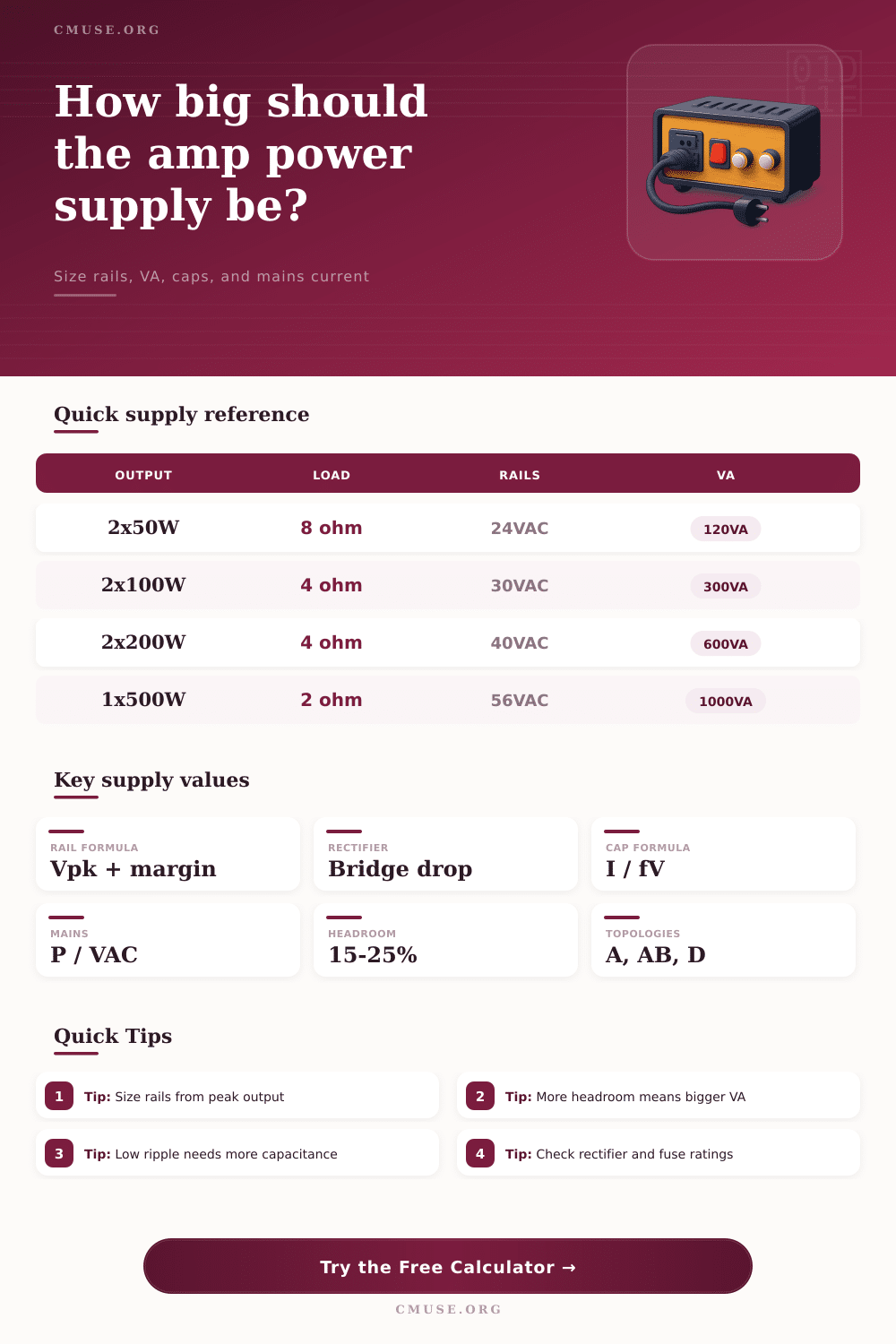
| Output | Load | Recommended rails | Transformer VA |
|---|---|---|---|
| 2x50W | 8 ohm | 24-0-24VAC | 120VA |
| 2x100W | 4 ohm | 30-0-30VAC | 300VA |
| 2x200W | 4 ohm | 40-0-40VAC | 600VA |
| 1x500W | 2 ohm | 56-0-56VAC | 1000VA |
| Topology | Efficiency | Heat | Supply note |
|---|---|---|---|
| Class A | Low | Very high | Huge idle draw |
| Class AB | Medium | Moderate | Most linear amps |
| Class D | High | Low | Smaller VA needed |
| Tube | Low | High | Bias and B+ matter |
An amplifier power supply has one main job. It converts the AC voltage of the mains into DC voltage, that the amplifier can actually use. It changes alternating current into direct and removes by means of filters the leftover noise.
In an amplifier you easily notice the power supply. Most of them in amplifiers are of the kind with “capacitor input” with big mains transformer, whether toroidal or of EI type.
How an Amplifier Power Supply Works
For a 60W amplifier you need a full load supply of ±35V, so a 25-0-25 secondary transformer works best. The circuit separates rectifiers and capacitors for every channel. Only the transformer is shared, so that ties between channels are minimised.
Double supply removes the need for coupling capacitors. In an audio power amplifier the AC signals swing around a fixed DC voltage. With a single supply those signals reach only half of the supply voltage, so that they can swing equally above and below it.
The supply voltage does not change the gain of the amplifier, but limits the swing of the output voltage. With unregulated supplies the lines can stay at 34V during peek output, climb to 36-38V without load. A regulated amplifier starts to clip at 32V, minus drops of 1.3V on transistors of driver and output stage, so 30.7V or around 59.2W into 8 Ohms.
Cleaner power gives quieter gear and better audio quality. DC filter caps are a good place to start when fixing noisy power supplies. Old caps can leak and cause buzz.
For instance, an old bass amp with heavy buzz from the output and the DI can often be traced back to leaking caps in the supply.
Many amplifiers have a microcontroller to handle the on/off switching of the mains and other housekeeping tasks. It runs usually by means of a small separate standby transformer, that stays active even when the main supply is switched off.
Cheap mass-produced switch mode power supplies with weak filtering and bad EMI/RFI rejection damaged the name of SMPS in the hi-fi audio world. But there is no good reason that SMPS cannot work for audio circuits, big or small. Anyone who has worked with high power PA systems knows, that bigger amplifiers of 600W to 1kW and above are heavy and large.
A good power amplifier needs a solid supply and good shielding, like a heavy steel chassis. The skill of the supply to follow fast transients without falling apart is among the main concerns. When an amplifier works below its maximum power, it produces more heat than output power, even ideally.
The connected load takes part of the output voltage, while theoutput section receives the rest of the supply, that becomes waste heat.