Amplifier Gain Calculator
Convert input and output voltage into dB gain, power gain, and output power for audio amp stages.
🔊 Presets
📏 Inputs
📊 Quick Reference
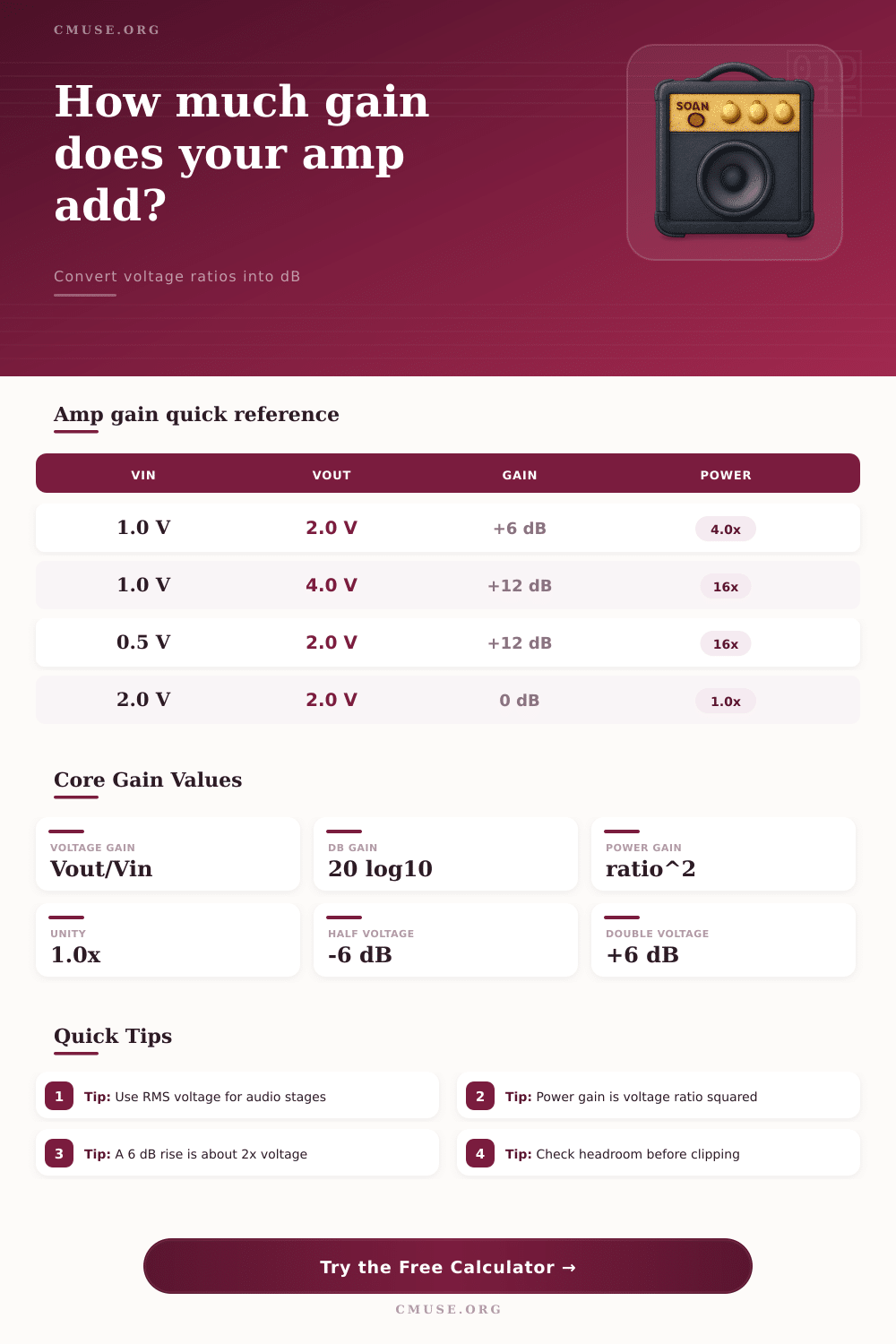
| Vin | Vout | Gain | Power |
|---|---|---|---|
| 0.5 V | 1.0 V | +6 dB | 4.0x |
| 1.0 V | 2.0 V | +6 dB | 4.0x |
| 1.0 V | 4.0 V | +12 dB | 16x |
| 2.0 V | 2.0 V | 0 dB | 1.0x |
At the heart of every amplifier, gain is one of those basic ideas that makes electronics actually work. An amplifier exists simply to take a signal and make it bigger, because of that it is the most important thing you measure to describe how an amp performs. Think about gain as a way to estimate exactly how much stronger your signal gets.
Exactly, it shows the ratio between output and input, whether you deal about amplitude or about power. Because amplifiers boost signals, their whole skill depends on that comparison between output and input. In the engineering world they call that gain.
What Is Gain in an Amplifier
So how does gain work practically? It is the output voltage divided by the input voltage, and you can express it in two ways. Sometimes it appears as a simple multiplier, for instance 3x, or in decibels, like +9 dB.
Assume an amp that receives 35 mV at the input and gives 3.5 V at the output. That is 40 dB gain, which means that the output is 100 times stronger than the input. The calculation is easy: just output voltage divided by input.
Because it is a ratio, it does not have a unit. Even so, gain can also describe the relation between output and input power by means of logarithms, and depending on context it relates to voltage or current boost.
There are several ways to measure and talk about gain. In audio work you compare signal voltage at input and output. Simply, gain measures how much boost happens.
It is the ceiling, the maximum amount that an amplifier can give to your signal. In the world of headphones you almost always deal with voltage gain. Something interesting though: boosting gain does not alter your dynamic range.
It simply makes everything louder across the whole bored.
People commonly mix “gain” with “volume”, but they are different, the difference sits in their place in the signal chain of the amp. Gain usually sits early in the path, before volume controls come later. You could think of gain as the input level in the preamp stage, although it acts more like a tone shaper than a pure volume control.
Volume is what you hear, the felt loudness coming from the system. Gain is the raw boost that the amplifier applies to the signal.
The relation between gain and volume controls gives interesting sonic results. With low gain and high volume you get clean sound without distortion. Flip that, high gain with low volume, and distortion appears already at quiet levels.
An amp with very low gain gives only clean tones without grit, but it sounds softer despite its power. Most amplifiers control gain by means of some kind of negative feedback circuit. Change something in that feedback and the gain shifts.
Funny enough, a change of gain also affects the frequency range. Common designs have too much gain built in, that you then reduce by means of adjustable negative feedback. Reduce the feedback andthe gain grows.
Even so, cranking up the gain has trade-offs. High gain can shift the output impedance and add more distortion to the signal. Input gain has a big impact on the noise floor, because it sits so early in the signal chain, everything picked up at the input gets boosted at every following stage of the whole system.