Amplifier Damping Factor Calculator
Compare speaker load, cable resistance, and amplifier output impedance to estimate real-world control.
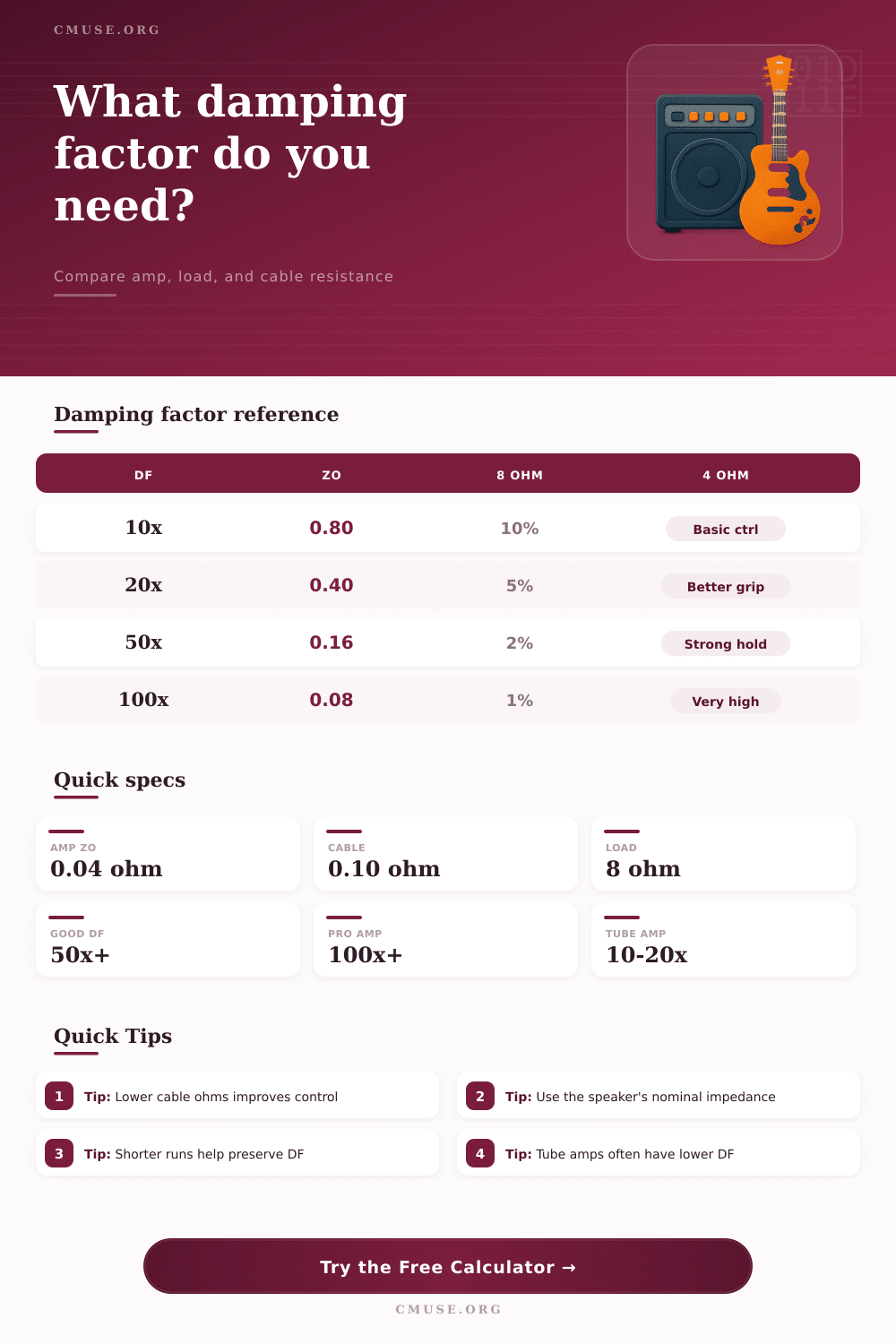
| DF | Zo at 8 ohm | Load match | Result |
|---|---|---|---|
| 10x | 0.80 ohm | 8 ohm | Basic control |
| 20x | 0.40 ohm | 8 ohm | Better grip |
| 50x | 0.16 ohm | 8 ohm | Strong control |
| 100x | 0.08 ohm | 8 ohm | Very high |
10x DF
0.80 ohm
At 8 ohm load
20x DF
0.40 ohm
At 8 ohm load
50x DF
0.16 ohm
At 8 ohm load
100x DF
0.08 ohm
At 8 ohm load
Amplifier damping factor is the ratio between the impedance of the speaker and the output impedance of the amplifier. It shows how well the amplifier can control the motion of the speaker cone. Think of it as a brake for the speaker.
When the audio signal stops the cone should right away stop moving. A high damping factor helps that happen quickly.
What Is Amplifier Damping Factor?
Every amplifier has an output impedance. Think of it as a resistor in series with the output, that represents the imperfection of that amplifier’s output stage. The damping factor depends directly on the output impedance.
Amplifiers with low output impedance can reach a high damping factor. The higher the factor, the lower the output impedance of the amplifier, and in theory the better damped the spekaer is.
You count it by dividing the load impedance by the output impedance. Makers almost always choose 8 ohms as the load, because that gives higher and more impressive numbers than 4 or 2 ohms. If an amplifier has a damping factor of 100 with an 8-ohm load, that means its output impedance is 0.08 ohms.
A factor of 3000 shows that the output impedance is tiny and the speaker would not dare to even hint at resonating.
Why does this matter? Every motion of the voice coil generates a current that the amplifier seas. If the output resistance of the amplifier is low, that current grows and the coil slows down more strongly.
A high damping factor quickly damps unwanted motions of the cone caused by mechanical resonance, acting as a brake for the voice coil motion. This reduces the unwanted vibrations of the woofer, stopping it from vibrating freely. That helps preserve the natural dynamics of the music and reach accurate sound.
An amplifier with a high damping factor able to drive reactive loads with high current, usually sounds better, and gives tighter bass. The damping factor is the ability of the amplifier to return the speaker cone to its resting position as soon as possible.
A damping factor between 10 and 50 is considered low. From 50 to 300 is commonly seen. 300 to 500 is high, and 500 to 4000 is very high.
Subwoofers need a bigger damping factor to control their heavy cones. Tube amplifiers typically have low damping factor, probably under 10, because of the series resistance of the output transformer and less global feedback compared to solid state designs.
Around 100 is a good target for damping factor, but more is better up to a point of little returns. Both 50 and 1000 are high damping factors, so thatdifference alone does not matter much when you choose an amplifier.