Amp Tube Lifespan Calculator
Estimate when preamp, power, and rectifier tubes need testing or replacement using hours, tube family, bias, cabinet heat, standby habits, transport, volume load, and gig risk.
🎸Real Amp Presets
🔌Tube Set And Use Pattern
Tube Life Estimate
📊Amp And Tube Spec Grid
🧪Reference Tables
| Tube Family | Baseline Life | Common Role | Early Warning Sign |
|---|---|---|---|
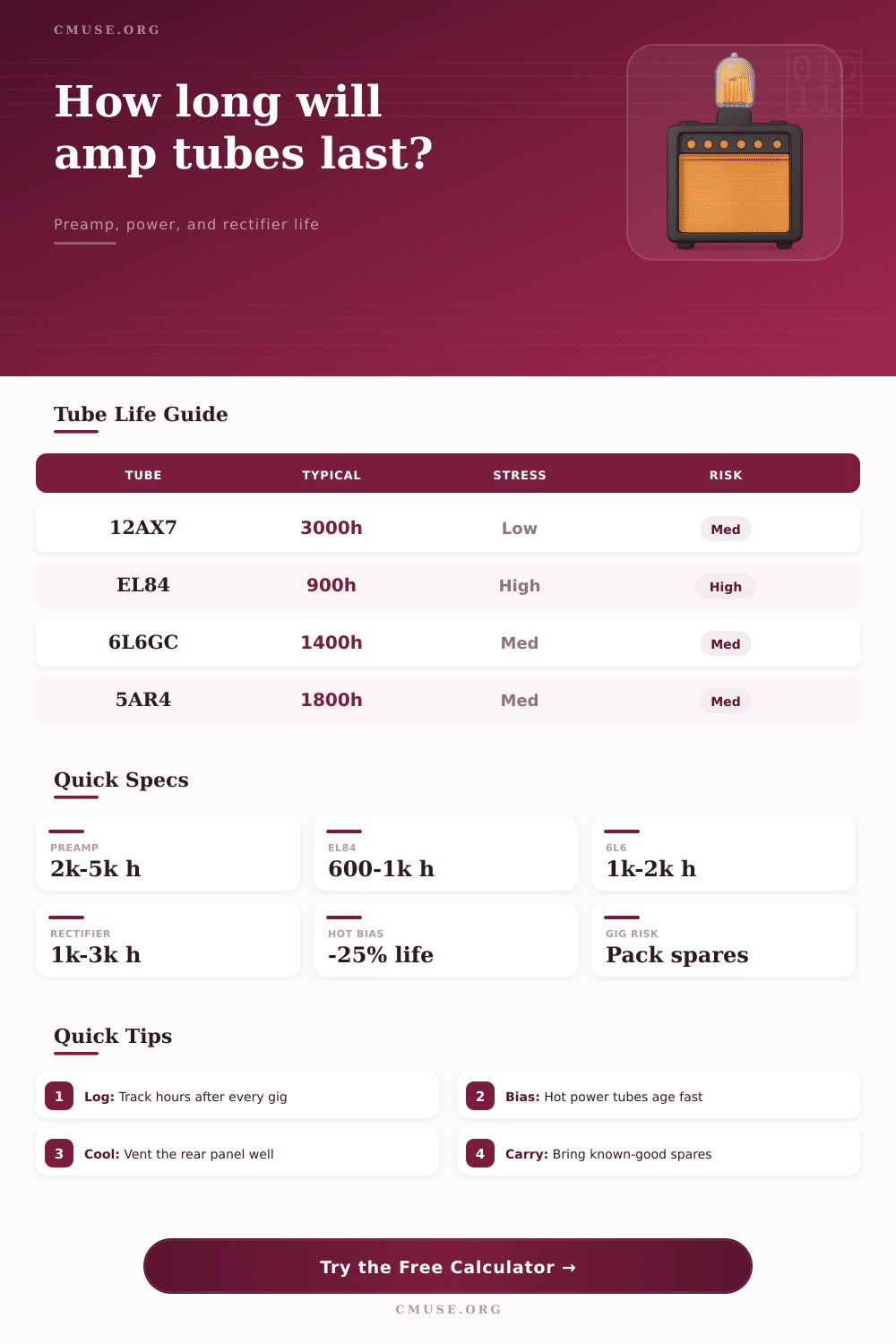
| 12AX7 / ECC83 | 3000 to 5000 hours | Gain stages and phase inverter | Noise, microphonics, dull gain |
| 12AT7 / ECC81 | 3500 to 6000 hours | Reverb driver or phase inverter | Weak reverb, brittle attack |
| EL84 / 6BQ5 | 700 to 1200 hours | Small combo power section | Rattle, loss of chime, red plating |
| 6V6GT | 1200 to 2000 hours | American combo power section | Flabby bass, early breakup shift |
| 6L6GC / 5881 | 1400 to 2400 hours | Clean headroom and high power | Thin clean tone, hum, drift |
| EL34 / 6CA7 | 1000 to 1800 hours | British midrange power section | Harsh highs, weak punch |
| 5AR4 / GZ34 | 1800 to 3000 hours | Tube rectifier with slow start | Sag increase, fuse events |
| Stress Factor | Low Impact | Moderate Impact | High Impact |
|---|---|---|---|
| Bias setting | Cool bias can extend life | Nominal bias tracks baseline | Hot bias can cut life sharply |
| Ventilation | Open back and cool room | Normal combo airflow | Closed space or hot stage |
| Transport | Home use, little vibration | Local load-ins | Touring shock and stairs |
| Volume load | Clean headroom use | Moderate stage drive | Power tubes pushed hard |
| Amp Scenario | Tube Set | Weekly Use | Service Note |
|---|---|---|---|
| 15W EL84 combo | 3 preamp, 2 power | 5 to 10 hours | Check power pair yearly if gigged |
| 30W EL84 combo | 3 preamp, 4 power | 8 to 15 hours | Heat and transport matter most |
| 22W 6V6 combo | 6 preamp, 2 power, 1 rectifier | 4 to 12 hours | Rectifier lasts longer than power pair |
| 50W EL34 head | 3 preamp, 2 power | 6 to 18 hours | Bias drift check before important shows |
| 100W 6L6 head | 5 preamp, 4 power | 8 to 20 hours | Quartet matching becomes critical |
| Result Band | Remaining Life | Gig Readiness | Suggested Action |
|---|---|---|---|
| Fresh | More than 60% | Low risk | Keep logging hours |
| Working | 35% to 60% | Moderate risk | Test before recording |
| Watch | 15% to 35% | Rising risk | Carry a tested spare set |
| Service | Under 15% | High risk | Schedule testing or replacement |
💡Tube Life Tips
Your amp sits in a corner of the room; you plug in and hear nothing but the hum of an empty space. Not a great way to begin a gig. Your tube has died, and now you stand there while the bass player glance at his wristwatch. To most players, vacuum tubes is treated as though they are lightbulbs. They will keep running right up until they simply cease to function, or until you look down and see they’re actualy broken. This forgets that their ability to emit electrons gradualy declines long before they finally give out completely.
The above calculator take into account those logged hours and adds in any other environmental stressors so that you don’t have to guess what state your equipment is in: Is it ready for this weekend’s show? Or should you take it down to the tech bench today? This is about power tube side. Power tubes put out big fat stacks of heat while running on a higher plate voltage than preamp tubes (which usually dissipate far less heat and also runs at a lower plate voltage). As a result, they get hot, work hard and tend to take the brunt off the abuse. Their performance starts to wear down over time because of build-up of wear and tear from excessive heat.
How to Keep Your Amp Tubes Alive Longer
If you bias your tubes hot, getting more early breakup and extra wattage, then you’re sacrificing longevity for tone. By doing this, you’ll likely cut your expected life expectancy by 25% or even more. But what’s nice about a good tube is if you treat it well, it will last for quite some time. Most folks don’t think about these variables till it’s too late. Tube life is silently killed by heat. If you gig in a club without AC, your tubes will cook faster then the specs say. This happens if the back of your cabinet have bad ventilation or if you use a closed-back cabinet with crappy rear ventilation.
There’s also a factor called transport shock. A tube will live ten hours at home but die in twenty minutes in a van bouncing on pothole-strewn roads. Tubes is made of delicate internal filament structures that are suspended by tiny supports. Vibration will loosen them over time. This is why the reference table on the page breaks down how the stress factors of volume load and transport combine to increase baseline degradation rates.
Preamp tubes are responsible for signal amplification and generaly last longer than power tubes or rectifiers. Rectifier tubes sits somewhere in the middle, and they often fail when the solder joints crack under thermal cycling. Rectifier tubes, Sit between power tubes and preamp tubes and handle the conversion of AC to DC. Rectifier tubes also has to deal with lots of voltage spikes at amp startup. Rectifier tubes typically outlast power tubes but not preamp tubes. When you frequently cold start the amp, it can cause significant stress to the cathode, which can lead to failure. A standby switch will allow the heaters to warm up prior to full voltage being applied which reduces this initial stress on the cathode. If you’re using a tube rectifier for that saggy vintage feel, keep close tabs on its health…particularly when cold starting the amp regularaly.
Instead of reaching a certain number of hours, it’s a little more situational: how do I sound? How am I behaving? If you find yourself noticing microphonics on your preamp stage or perhaps your power section is starting to sound a bit flabby, time’s up. From there, you’ll be able to assess your level of risk and determine if you have enough time left or if you should of brought spares to the next gig.
In order for this tool to work well, you need to log your hours accurately. Skipping practice sessions will put you flying blind. The wearing out of tubes isn’t linear; it’s progressive with an unpredictable end. Using hot bias settings hastens that rate to where a gradual downward spiral becomes a sharp fall off. Taking care of how you handle the equipment (gentle warm up practices, proper ventilation) will make your gear last much longer. You’re controlling more than just what happens to the tube.
Here is the takeaway. A tired tube won’t do anything more than it’s asked to do… But it’ll let you know when it has had enough. So don’t think twice about bringing some spares to the big gig; it’s nothing but good business practice, both for you and the band. When we know what to expect from the trade-offs of transport stress, heat, and bias, we stop fearing our equipment. Instead, we take control. This makes us confident every time we grab that mic and head up onto the stage.