Air Column Length Calculator
Calculate the physical length of an open or stopped air column from pitch, temperature, bore diameter, harmonic mode, end correction, and trimming allowance.
Preset use: Load a real wind, organ, or tube-resonator scenario, then adjust the target pitch, bore, temperature, harmonic mode, and end correction before cutting.
Calculation Breakdown
| Boundary Type | Fundamental Effective Length | Allowed Modes | Common Instrument Use |
|---|---|---|---|
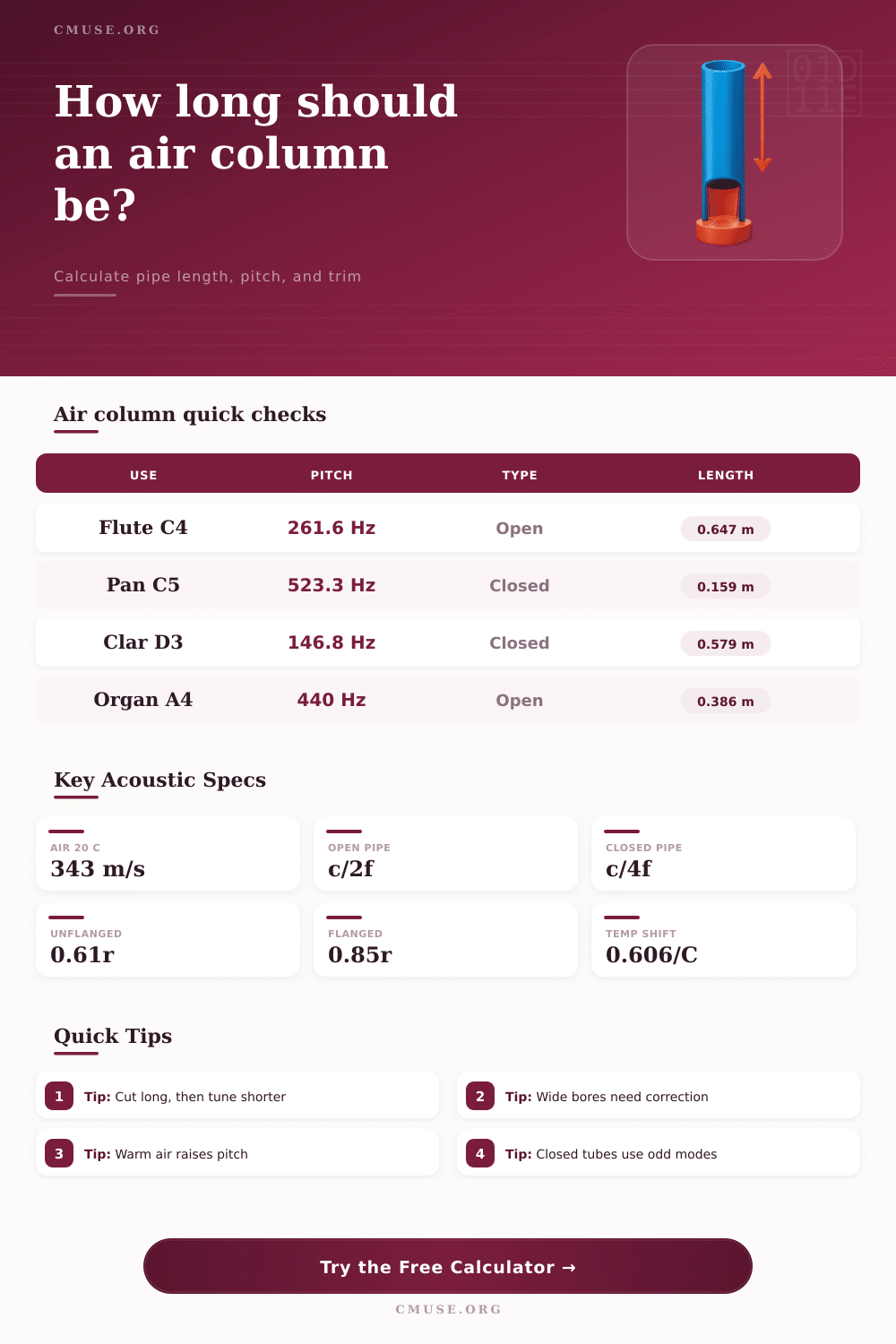
| Open-open | L = c / 2f | 1, 2, 3, 4... | Flute-like tubes, open organ pipes, recorders |
| Closed-open | L = c / 4f | 1, 3, 5... | Clarinet-like tubes, panpipes, stopped organ pipes |
| Closed-closed | L = c / 2f | 1, 2, 3, 4... | Sealed cavity approximation with pressure antinodes |
| Higher open mode | L = n x c / 2f | Any whole n | Overblown open pipes and harmonic demonstrations |
| Higher stopped mode | L = n x c / 4f | Odd n only | Stopped pipes overblowing at 3rd, 5th, 7th modes |
| Correction Model | Per Open End | Best Fit | Design Effect |
|---|---|---|---|
| None | 0 x radius | Pure classroom formula | Physical tube comes out too long for many real pipes |
| Unflanged | 0.61 x radius | Plain cut pipe end in free air | Shortens the physical cut by a modest amount |
| Flanged | 0.85 x radius | End near a broad plate or baffle | Uses a larger correction, so cut length is shorter |
| Mixed | 0.61r + 0.85r | One plain end and one baffled end | Useful for experimental organ or resonator fixtures |
| Air Temperature | Speed Of Sound | Open C4 Half-Wave | Stopped C4 Quarter-Wave |
|---|---|---|---|
| 0 C / 32 F | 331.3 m/s | 63.3 cm effective | 31.7 cm effective |
| 10 C / 50 F | 337.4 m/s | 64.5 cm effective | 32.2 cm effective |
| 20 C / 68 F | 343.4 m/s | 65.6 cm effective | 32.8 cm effective |
| 30 C / 86 F | 349.5 m/s | 66.8 cm effective | 33.4 cm effective |
| Scenario | Pitch Target | Boundary | Typical Bore Note |
|---|---|---|---|
| Open organ pipe | A4, 440 Hz | Open-open | Broad mouths need voicing checks after rough length |
| Stopped organ pipe | C4, 261.63 Hz | Closed-open | About half the length of the open pipe equivalent |
| Flute-style tube | C4 or G4 | Open-open | Embouchure and tone holes change final tuning |
| Clarinet-style bore | D3 region | Closed-open | Cylindrical stopped behavior favors odd modes |
| Bottle resonator | A3 region | Closed-open estimate | Neck and cavity geometry may require Helmholtz math |
| Design Choice | Length Impact | Tuning Sensitivity | Use When |
|---|---|---|---|
| Open-open pipe | About half a wavelength at fundamental | Moderate, two open-end corrections | You need full harmonic series behavior |
| Closed-open pipe | About one quarter wavelength at fundamental | High, one open-end correction | You need compact stopped-pipe pitch |
| Larger bore | Shorter physical cut after correction | Higher correction sensitivity | The pipe radius is large versus length |
| Warmer room | Longer calculated acoustic length | Pitch rises if the pipe is not retuned | Performance temperature differs from workshop temperature |
Calculating an length of a pipe for building a musical instrument require determining the effective length of a pipe that use sound waves. However, a person can measure the physical length of a pipe. The two lengths is not necessarily the same.
A pipe can have the correct physical length yet sound either sharp or flatter as the sound waves does not use the physical length of the pipe. An air column calculator help to find the effective length of a pipe that will make up a musical instrument. The calculator consider the target frequency of the pipe that will be built.
Finding the right length for a musical instrument pipe
The temperature at which the pipe will play will also be entered into the calculator. The speed of sound in air increase with an increase in the temperature of the air. The speed of sound at room temperature is 343 meters per second.
However, if the air are warmer, the speed of sound will be faster than 343 meters per second. The wavelength of a sound wave is the speed of sound divided by the frequency of that sound. Thus, the target temperature will impact the calculated length of the pipe.
The temperature at which the musical instrument will perform should be entered into the calculator. The diameter of the bore of the pipe will be entered into the calculator. The end correction is affected by the diameter of the bore of the pipe.
Sound waves traveling through a pipe spill out of the open end of the pipe instead of reflecting off the end of the pipe as if the end of the pipe was a hard surface. The end correction is calculated as a function of the radius of the pipe. The larger the radius of the pipe, the larger the end correction.
If an end correction is not calculate into the length of the pipe that is built, the pipe will play flat. The inside diameter of the bore will need to be entered into the calculator. The boundary conditions of the pipe will also be entered into the calculator.
The boundary conditions affect the length of the pipe. If the pipe is open at both ends, the resonant frequencies of the pipe are the lengths of half wavelength. For a pipe that is closed at one end, the resonant frequencies are lengths of quarter wavelengths.
The boundary conditions of the pipe will impact which formula the calculator use to determine the length of the pipe. A clarinet will have a different length then an open flute that produce the same frequency. The effective length of the pipe can be calculated, but there will be a trim allowance that is added to that calculated length.
A trim allowance can be used to allow for the cutting of the pipe to the correct length. It is much easier to cut a pipe than to add material to the pipe. Therefore, the pipe will be cut to be too long and then the person will trim it to the correct length.
Thus, a trim allowance is required for the pipe. These four variables is related to one another. Pipes built in cool environments to play at warm performance temperature will have different lengths.
Pipes with large bores will have a different end correction than narrow bore pipes. Pipes that are stopped at one end will have different resonant frequencies than open pipes that are open at both ends. These relationships are presented to the individual with the air column calculator so that they understands the relationships between these variables.
Due to the factors described, none of the mathematical model for calculating the length of a pipe for musical instruments will perfectly model the real life instrument. Real musical instrument have various factor that affect the length of the pipe. Tone holes, thickness of the pipe walls, and the stiffness of the reed will all impact the length of the pipe.
Using the air column calculator will allow for the determination of the length of the pipe that will minimal be required to produce the targeted sound frequency. However, the person will need to cut the pipe to the proper length by ear. Small cuts need to be made into the pipe while it is warm to the touch so that the pitch of the pipe can be corrected.
This process of cutting the pipe and listening to the sound that is create is repeated until the pipe reaches the desired pitch.