Active Crossover Calculator
Set RC values and band splits for 2-way or 3-way active speaker crossovers.
🔌 Calculator Inputs
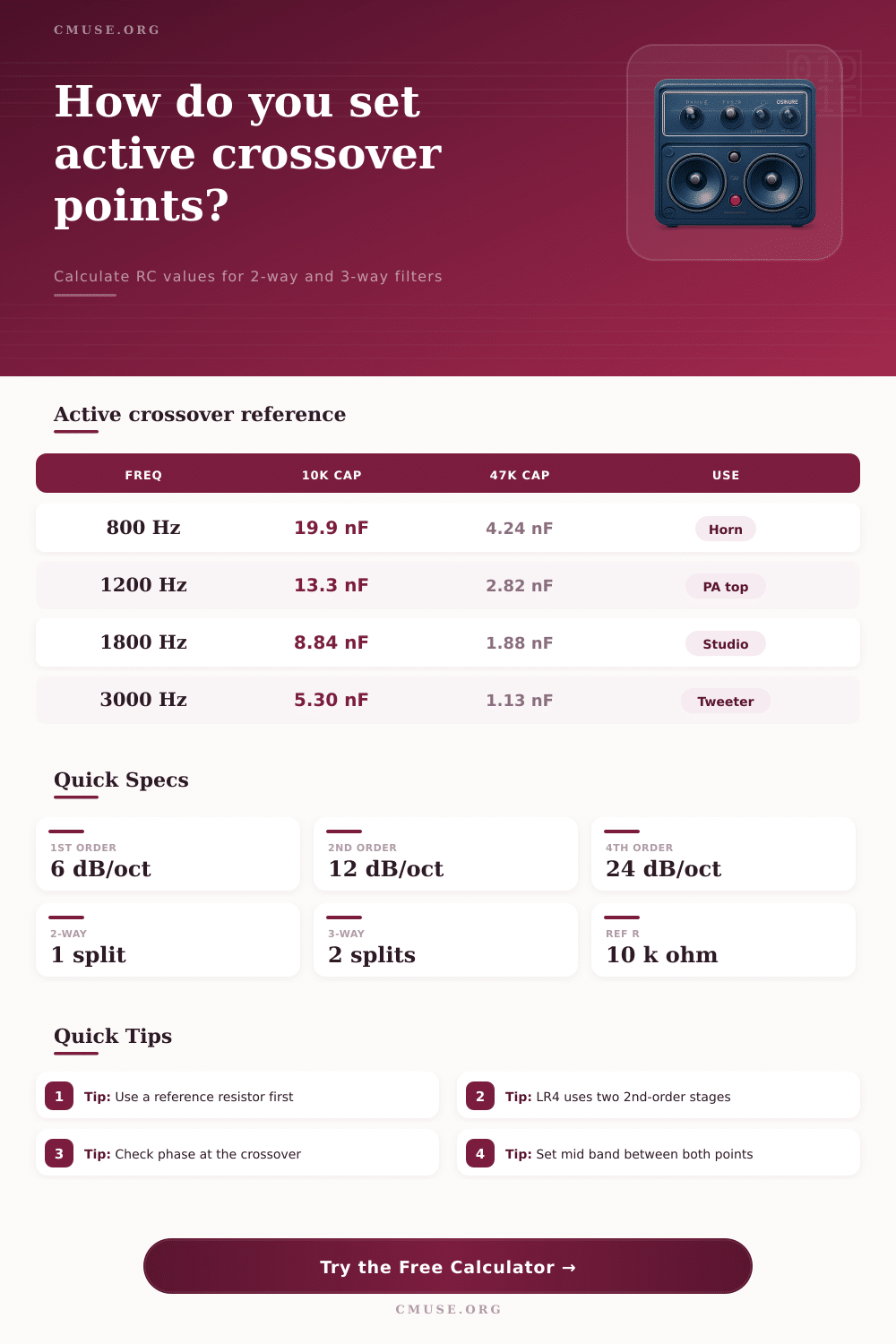
📊 Reference Table
| Freq | 10k cap | 47k cap | Use |
|---|---|---|---|
| 800 Hz | 19.9 nF | 4.24 nF | Horn |
| 1200 Hz | 13.3 nF | 2.82 nF | PA top |
| 1800 Hz | 8.84 nF | 1.88 nF | Studio |
| 3000 Hz | 5.30 nF | 1.13 nF | Tweeter |
🔧 Filter Specs
The crossover frequency is here, where audio signal divides and goes to various speakers or to subwoofer. Audio crossovers are kind of filter that rules the range of audio frequencies that goes to a given audio path or loudspeaker driver. In system with several drivers the crossover separates the frequencies so that each driver handles only his best range.
The tweeter handles the high sounds, while the woofer cares about the low. You do not want to give sharp cymbals to the woofer, nor low sounds to the tweeter. Hence you use filter net that divides the signals up and below
What Is Crossover Frequency and How to Set It for Speakers
That crossover frequency is the exact point for the system as it divides the sound and which parts of the sound range must play on which speakers. It is the frequency value, passing which the power of the signal drops in half, so -3 dB, and any more diminishes. The crossover produce signal that passes only certain freuqencies: high pass filter blocks the low, while low pass block the high.
Three types of crossovers are the mainstream. High pass filters leave only high frequencies to tweeters thus stop distortion and damage. Low pass filters answer for bass drivers, and band pass for midrange speakers.
80 Hz is the most commonly advised crossover frequency and also the standard of THX. Modern AV receivers allow you to set the spots for every channel. Start at 80 Hz for satellite speakers and adapt according to the setup is good method.
Subwoofers technically can reach until 20 Hz, but room modes and position affects the actual action. Also the room plays big role. Set to 100 Hz can give excellent frequency response in many spaces.
Higher than 150 Hz do not work, because directionality disappear when you bear such sounds by means of the subwoofer. But 120 Hz and 150 Hz commonly use for little slim speakers, and they operate as designed. Big front speakers go well with 80 Hz, because they reach almost 40 Hz.
For little front speakers 120 Hz will be better.
If you set the crossover higher than 80-85 Hz for mono subwoofer, that can inhibit the stereo image. Under 80 Hz happen satisfying bass blows, especially around 60 Hz, so leave that to the subwoofer makes sense. For surround speakers 80 until 100 Hz answer.
Generally you advise to set crossovers at least 10 Hz above the lowest nominal frequency skill of the speakers. For instance, 12 dB each octave high pass filter at 40 Hz will reduce 20 Hz tone by -12 dB at the output compared to the entry.