Action Height at Fret Calculator
Estimate string clearance at any fret from scale length, nut slot clearance, measured reference action, relief curve, and fretted-instrument setup geometry.
Load a real fretted-instrument starting point, then fine-tune the numbers from your ruler or feeler gauges. The calculator derives the saddle string line from a measured reference fret and adds a relief curve across the fingerboard.
Geometry Breakdown
Fret Position From Scale
Equal-tempered frets divide the scale by twelfth-root-of-two intervals, so each fret has a known distance from the nut.
x(n) = scale * (1 - 2^(-n / 12))
Saddle String-Line Interpolation
The open string is treated as a straight line from the nut slot baseline to the saddle witness point.
line(x) = nut + (saddle - nut) * x / scale
Relief Curve Scaling
Measured relief is scaled along the neck with a smooth sine curve anchored to the chosen relief-measurement fret.
relief(x) = reliefMeasured * sin(pi*x/scale) / sin(pi*xRelief/scale)
Final Action Height
The predicted clearance at the chosen fret is the straight string line plus the local relief contribution.
action(fret) = line(xFret) + relief(xFret)
| Instrument / Setup | 12th-Fret Treble Side | 12th-Fret Bass Side | Relief Range | Best Use |
|---|---|---|---|---|
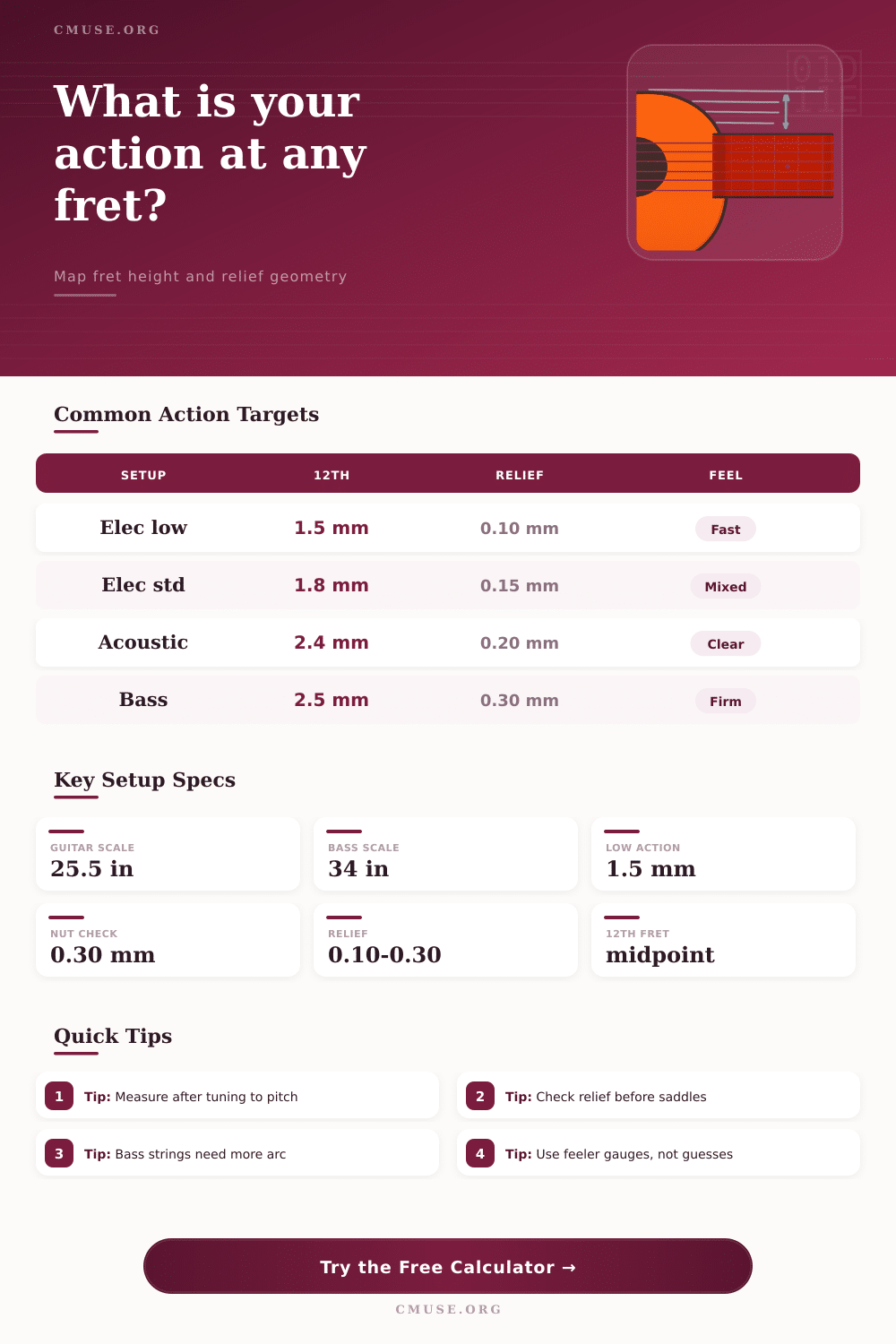
| Electric guitar, low action | 0.047-0.063 in / 1.2-1.6 mm | 0.059-0.075 in / 1.5-1.9 mm | 0.003-0.007 in / 0.08-0.18 mm | Fast lead |
| Electric guitar, balanced | 0.055-0.071 in / 1.4-1.8 mm | 0.067-0.087 in / 1.7-2.2 mm | 0.005-0.010 in / 0.13-0.25 mm | All-round |
| Steel-string acoustic | 0.071-0.094 in / 1.8-2.4 mm | 0.087-0.118 in / 2.2-3.0 mm | 0.006-0.012 in / 0.15-0.30 mm | Clean strum |
| Classical nylon guitar | 0.110-0.130 in / 2.8-3.3 mm | 0.130-0.157 in / 3.3-4.0 mm | 0.004-0.010 in / 0.10-0.25 mm | Nylon |
| Electric bass | 0.071-0.098 in / 1.8-2.5 mm | 0.087-0.118 in / 2.2-3.0 mm | 0.008-0.015 in / 0.20-0.38 mm | Finger / pick |
| Fret | Percent Of Scale From Nut | 25.5 in Scale | 24.75 in Scale | 34 in Bass Scale |
|---|---|---|---|---|
| 1 | 5.61% | 1.431 in / 36.35 mm | 1.389 in / 35.28 mm | 1.908 in / 48.46 mm |
| 5 | 25.08% | 6.394 in / 162.41 mm | 6.207 in / 157.66 mm | 8.528 in / 216.61 mm |
| 7 | 33.26% | 8.482 in / 215.45 mm | 8.233 in / 209.12 mm | 11.309 in / 287.25 mm |
| 8 | 37.00% | 9.435 in / 239.65 mm | 9.157 in / 232.59 mm | 12.580 in / 319.53 mm |
| 12 | 50.00% | 12.750 in / 323.85 mm | 12.375 in / 314.33 mm | 17.000 in / 431.80 mm |
| 17 | 62.54% | 15.947 in / 405.05 mm | 15.478 in / 393.14 mm | 21.263 in / 540.08 mm |
| 24 | 75.00% | 19.125 in / 485.78 mm | 18.563 in / 471.49 mm | 25.500 in / 647.70 mm |
| Measured Relief | Metric Equivalent | Likely Feel | Risk Zone | Useful For |
|---|---|---|---|---|
| 0.000-0.003 in | 0.00-0.08 mm | Very straight | Buzz if frets are uneven | Light touch, level frets |
| 0.004-0.007 in | 0.10-0.18 mm | Low and quick | Needs accurate nut and saddle work | Electric lead and hybrid picking |
| 0.008-0.012 in | 0.20-0.30 mm | Balanced clearance | Can feel high near middle frets | Acoustic, bass, general setup |
| 0.013-0.020 in | 0.33-0.51 mm | Big string arc | Higher intonation stretch | Heavy attack and older necks |
| Preset | Scale Length | Reference Action | Nut Clearance | Relief |
|---|---|---|---|---|
| Electric Low Action | 25.5 in / 647.7 mm | 0.055 in / 1.40 mm | 0.010 in / 0.25 mm | 0.004 in / 0.10 mm |
| Electric Balanced | 25.5 in / 647.7 mm | 0.067 in / 1.70 mm | 0.012 in / 0.30 mm | 0.006 in / 0.15 mm |
| Acoustic Fingerstyle | 25.4 in / 645.2 mm | 0.086 in / 2.18 mm | 0.014 in / 0.36 mm | 0.008 in / 0.20 mm |
| Classical Nylon | 25.6 in / 650.2 mm | 0.126 in / 3.20 mm | 0.020 in / 0.51 mm | 0.006 in / 0.15 mm |
| 4-String Bass | 34.0 in / 863.6 mm | 0.094 in / 2.39 mm | 0.016 in / 0.41 mm | 0.012 in / 0.30 mm |
How many times have you had to deal with a buzzing string on a fret? It’s not always a technique problem but more of a geometric one. Whether your guitar are difficult to play or responds well has a lot to do with how close the strings is to the frets. Since it’s all about tension, the wood flexes up and down the neck. If you can grasp how that works, what was once a problem becomes an engineering challenge, nothing random.
Most people check action on 12th fret and leave it at that. It is useful but not complete. The string doesn’t lie flat along length of the fingerboard. It curves according to the amount of neck relief, the slight bow that occurs as tension stretches out and pulls against wood grain. With perfect neck straightness you are going to end up getting buzzes in the mid-positions when the string vibrate furthest away from the fret. Too much bow to the neck and you find high frets hard to play cleanly and the intonation start suffering. You need just the right amount of forward bow to clear the tops of the frets, but not so much that they rises too high for your fingers.
Understanding Guitar String Buzz
Once you measure your relief and enter your scale length into the calculator (above), the tool does the rest. Why? Because while a long-scale guitar differ from a short-scale bass, so does its action. You enter a starting point called a reference action, typically measured on the seventh or 12th fret, as well as nut clearance. These is considered the “zero” position of string paths that will later be altered by neck bow.
Enter your measured relief into the formula. This tool then estimates how high the strings should be anywhere else on the neck, showing if your chosen saddle height will cause buzz around the fifth fret or an uncomfortably high feel in the upper register.
The first step in any good setup process is adjusting the relief, but this is often done too quickly. The truss rod need to be dialed in to achieve the desired bow before you can properly set your bridge saddles. To check your relief hold your string down at both the body joint and the nut and measure the gap between the string and the top of the fret at about the eighth position. Use a thin feeler gauge. Ideally, there should be as much space between the string and the top of the fret as a business card would of been thick (maybe less on an electric guitar). Because bass strings is thicker and use more energy when plucked, they require a little more room.
Next, you consider action height. By lowering the bridge saddles, you decrease the gap between the frets. This make chords easier and bends smoother. On the other hand, bring it down too much, and every tiny flaw on the fret level will sound like nails scratching a chalkboard. It’s always a compromise. How low can you go without buzzing? That depends based off how you play. If you strum hard with a pick, you’ll need more air underneath than a light fingerstyle player. Your playing style determine the lowest safe action setting.
This whole equation changes with string gauge too. Higher gauged strings has more tension on them, which will raise the neck without adjustment if there’s no truss rod adjustment in place. In other words, changing to higher gauge strings would require tightening the truss rod a bit so that it won’t back off your action when the heavier strings is strung up. Lighter strings create less tension and will often back the neck off a little or even straightens out the neck. Give a new set of strings a day or two to settle down before adjusting the final height. It takes some time for the wood to react to the new stress load.
Another hidden variable is depth of the nut slots. If they are too deep, the first few frets will feel low. Also, open position notes will not have good intonation. Too shallow, and the initial string feels harder to press down and higher. The nut clearance you enter into the calculator accurately models this starting point. This way it help determine whether or not a perceived buzz at the lower positions is due to a nut issue or a truss rod problem.
It does require some time getting used to and understanding these relationships, but they will reward you with playability. It’s not a fight between you and the instrument anymore. It becomes something of your own, shaped to match your hands. The set-up fades into the background like an afterthought, allowing only the music to remain.
If the geometry is correct, you won’t even think about the millimeters and inches. Just the tone.