Audio Calculator
Estimate acoustic treatment area, panel count, material weight, and absorption coverage for studios, booths, and rehearsal rooms.
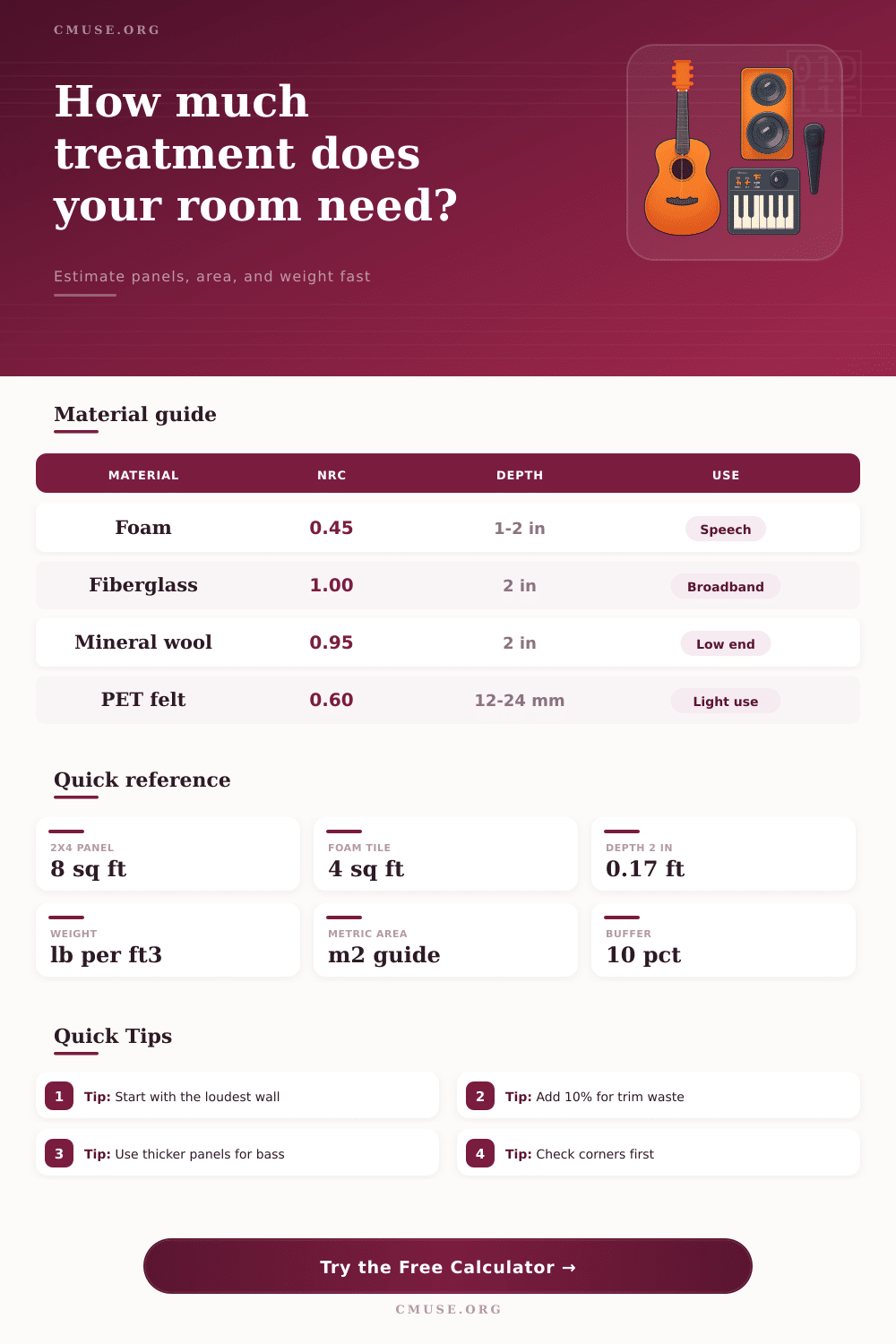
Mineral Wool
0.95 NRC
2 in broadband panel
Fiberglass
1.00 NRC
2 in control room panel
Open-Cell Foam
0.45 NRC
Speech and HF control
PET Felt
0.60 NRC
Light treatment layer
| Material | Coverage | Depth | Use |
|---|---|---|---|
| Foam tile | 4 sq ft | 1 to 2 in | Voice rooms |
| Fiberglass panel | 8 sq ft | 2 in | Mixing rooms |
| Mineral wool | 8 sq ft | 2 to 4 in | Broadband use |
| Heavy curtain | 12 sq ft | Varies | Light control |
| Type | Density | NRC | Recommendation |
|---|---|---|---|
| Open-cell foam | 1.5 pcf | 0.45 | Speech and mid band |
| Fiberglass | 3.0 pcf | 1.00 | Broadband absorption |
| Mineral wool | 8.0 pcf | 0.95 | Low end control |
| PET felt | 6.0 pcf | 0.60 | Decor-friendly panels |
| Fabric panel | 4.0 pcf | 0.85 | Balanced room treatment |
| Wood slat absorber | 18.0 pcf | 0.30 | Hybrid control surfaces |
| Heavy curtain | 0.9 pcf | 0.35 | Temporary softening |
| Project | Room size | Panels | Depth |
|---|---|---|---|
| Vocal booth | 5 x 5 ft | 4 to 6 | 2 in |
| Podcast room | 10 x 12 ft | 8 to 12 | 2 in |
| Control room | 12 x 15 ft | 10 to 16 | 4 in |
| Rehearsal room | 20 x 16 ft | 16 to 24 | 4 in |
When some mention “audio,” you usually think about sounds sent by signals. Even so that word has a wider meaning: it can relate to audio signals self, to audio frequencies or even to digital audio. Basicly it binds to acoustic, mechanical or electrical vibrations that match what human ears can hear, so in the range of 15 until 20 000 hertz
High-definition audio beats the standard quality of sounds. It gives bigger bit depth and higher frequency of samples, what gives clearer and better sound. Average audio have more modest parameters, because of what you work with fewer details in the sound.
Audio Basics and Online Music Sites
Here is how computer audio works: the signal arrives analog, you digitize it so that the computer can process it, and later it becomes analog when it leaves through the speaker. WAV file preserves precise data in any used sample frequency. CD quality, for instance, use 44.1 kHz with 16-bit size.
Bit depth shows how many bits control each sample; here decide the noise level regarding the real signal force. Do not confuse that with the sample rate, that estimates how many samples happen in a second and what defines the overall sound quality.
Audio.com works as free sharing platform for musicians and audio creators. The team of Audacity runs it, without limits for uploads, without restrictions and without ads. Audius on the other hand use his own AUDIO token for bind artists, listeners and nodes.
Artists upload their work for free listening, and the website awards them by means of lists as weekly trends.
If you search for royalty-free tracks and reliable files, here community of musicians and sound engineers globally share their work. Commonly you find formats as MP3, WAV, WMA, AAC and MIDI, that you can listen in every modern browser for free.
Audiobooks extend from gripping stories until self-help themes. Audio drama give creative outlet for various fictional stories presented by means of sounds.
Gearspace.com are one from the biggest professional audio sites, with more than 1.6 millions of visitors monthly from 218 lands. What started as side project of Jules Standen in 2002, grew to community of above 400 000 members. The forum became essential for home studio workers everywhere in the world…
Producers permanently ask here about gear and techniques. It gives open place for exchange knowledge about recording equipment and good practices. Audio engineering covers the whole process: recording, composition and sound production.
For film include dialog editing, ADR, sound effects, foley, ambience, scoring and mixing.
Audiophile is person strongly passionate, occasionally even obsessed, about high musical quality and sound reproduction. Audio communities abound, dedicated to discussions about Hi-Fi devices, about music self, about home-made speakers and amplifiers, and about gear recommendations.