Acoustic Power Calculator
Convert sound intensity, radiating area, sound pressure level, and sound power level for studio, stage, speaker, and booth measurements.
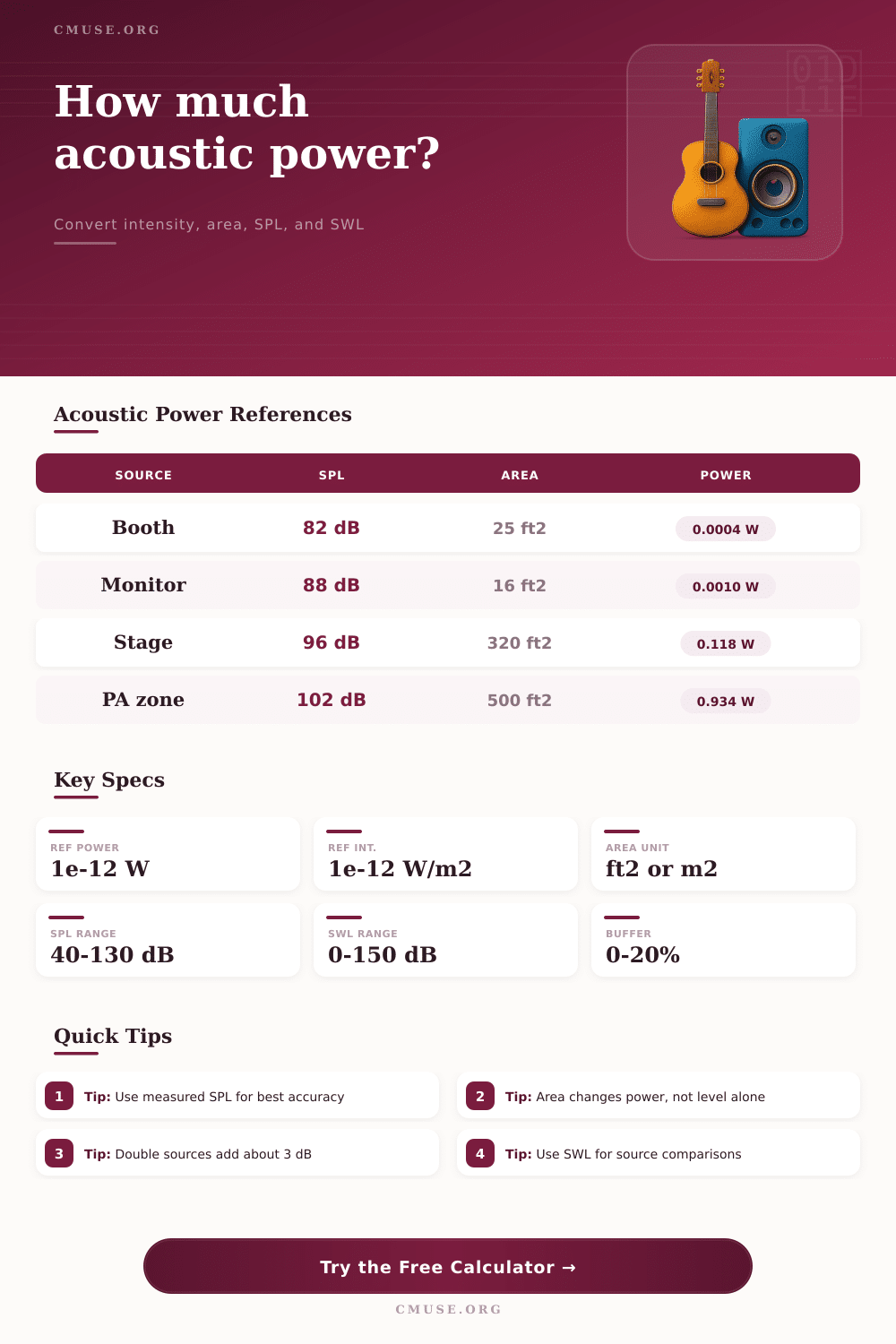
Two equal sources add 3.01 dB to SWL.
Uses I = 10^-12 × 10^(SPL/10).
Power equals intensity times area.
Uses P = 10^-12 × 10^(SWL/10).
Back-calculates intensity and levels.
| Calculation | Formula | Reference | Use Case |
|---|---|---|---|
| Power from intensity | P = I × A | A in m² | Measured surface intensity |
| Intensity from SPL | I = I0 × 10^(SPL/10) | I0 = 10^-12 W/m² | Approximate diffuse-field work |
| SWL from power | LW = 10 log10(P/P0) | P0 = 10^-12 W | Compare acoustic sources |
| Power from SWL | P = P0 × 10^(LW/10) | dB re 1 pW | Manufacturer sound power data |
| Multiple sources | LW total = LW + 10 log10(N) | N equal sources | Stacked speakers or panels |
| Zone | Typical Size | Area | Useful Basis |
|---|---|---|---|
| Vocal booth | 5 ft × 5 ft | 25 ft² / 2.32 m² | SPL or custom power |
| Practice room | 8 ft × 8 ft | 64 ft² / 5.95 m² | Measured SPL |
| Home studio | 10 ft × 12 ft | 120 ft² / 11.15 m² | SPL to intensity |
| Stage area | 20 ft × 16 ft | 320 ft² / 29.73 m² | SWL comparison |
| Small PA zone | 25 ft × 20 ft | 500 ft² / 46.45 m² | Power and coverage |
| Level | Intensity W/m² | 1 m² Power | Audio Context |
|---|---|---|---|
| 70 dB SPL | 1.00e-5 | 10 microwatts | Quiet monitor pass |
| 85 dB SPL | 3.16e-4 | 0.316 milliwatts | Long rehearsal check |
| 94 dB SPL | 2.51e-3 | 2.51 milliwatts | Calibrator reference |
| 100 dB SPL | 1.00e-2 | 10 milliwatts | Loud stage position |
| 110 dB SPL | 1.00e-1 | 0.1 watts | High-output PA zone |
| Preset | Dimensions | Primary Result | Secondary Result |
|---|---|---|---|
| Home studio | 10 ft × 12 ft | SPL to power | 120 ft² area |
| DJ booth | 6 ft × 4 ft | Intensity to power | 24 ft² area |
| Stage area | 20 ft × 16 ft | SWL total | 2 equal sources |
| Speaker baffle | 18 in circle | Power from SPL | Q factor included |
Acoustic powers and sound pressure level are two different measurement of sound. Acoustic power measure the amount of energy that a source emit into the air and is measured in watt. Sound pressure level measure how loud a sound is at a specific location and is the measurement that a person hear at a specific spot.
Acoustic power remains the same no matter where people is in the area, but sound pressure level can change with the movement of individuals in relation to the sound sources. Many people uses sound pressure level when planning audio systems for an area. However, sound pressure level is an unreliable measurement for making such plan.
Acoustic Power and Sound Pressure Level
If a user use acoustic power as the primary measurement, it is possible to determine the sound that will fill the area and how many speakers are required for a specific area. A calculator can help with the conversion from sound pressure level to acoustic power or vice versa. Additionally, the calculator can convert intensity to sound power level.
If the acoustic power or sound pressure level is select as the starting point for calculations, the calculator will provide the correct value for the other sound measurement. Another critical factor in calculating acoustic power is the area that the sound need to fill. The acoustic power of a sound source can easily be sufficient for a small area but not for a large one.
To calculate acoustic power, it is necessary to determine the area that the sound must fill. Depending on the shape of the area, such as a circle, rectangle, or triangle, the calculations will differ. The calculator also allow the user to include a percentage value that represents a buffer for the sound.
This buffer are crucial because real rooms often have irregular boundary. Directivity is another critical acoustic calculation factor. The directivity of a sound source determine how the sound disperse from the source.
For example, if a speaker is pointed into an open area, the sound will radiate in many direction. However, if the speaker is against a wall, the sound will be directed in a specific area. The directivity of the sound source can also be factor into the calculation to determine how loud the sound will be.
Without this factor, the acoustic power value for two areas may have the same acoustic power but have different sound intensities at the target area due to the directivity of the sound source. When two or more sound source are used, the acoustic power increase. If two identical sound sources are used, the acoustic power increases by three decibel.
This increased value is directly added to the acoustic power level. Using sound sources in multiples of two will not double the acoustic power but will increase it slightly to provide more even coverage of sound in the area. Many variable exist in a real room that can impact the acoustic properties of the area.
Variables such as the furnitures in the room, the presence of people in the area, and the surface of the area may impact the acoustic power of the area. Additionally, the temperature and humidity of the area can alter the acoustic power. These variables isnt included in the acoustic power calculator because these variables change so frequent within the room.
The acoustic power calculated above can be the starting point for sound system planning. However, acoustic power can be further adjusted through the use of sound measurements and sound pressure level measurements of the area to fine-tune the sound system to the area. By understanding the difference between acoustic power and sound pressure level, sound engineer and technicians can better plan out loud speaker systems.
By determining how much acoustic power is required for an area, it is possible to decide how many loudspeakers are required and where to place them in the area to maximize acoustic power. This calculation simplify the mathematical problem in planning loudspeaker systems. Engineers and technicians can focus on choosing the correct loudspeakers and the best placement of loudspeakers in the specific area that is to be sounded.