Acoustic Panel Thickness Calculator
Match panel depth, air gap, and material to the target band so your treatment reaches the frequency range you actually need.
🎧 Thickness Presets
⚙ Panel Setup
💡 Material Snapshot
📈 Frequency Guide
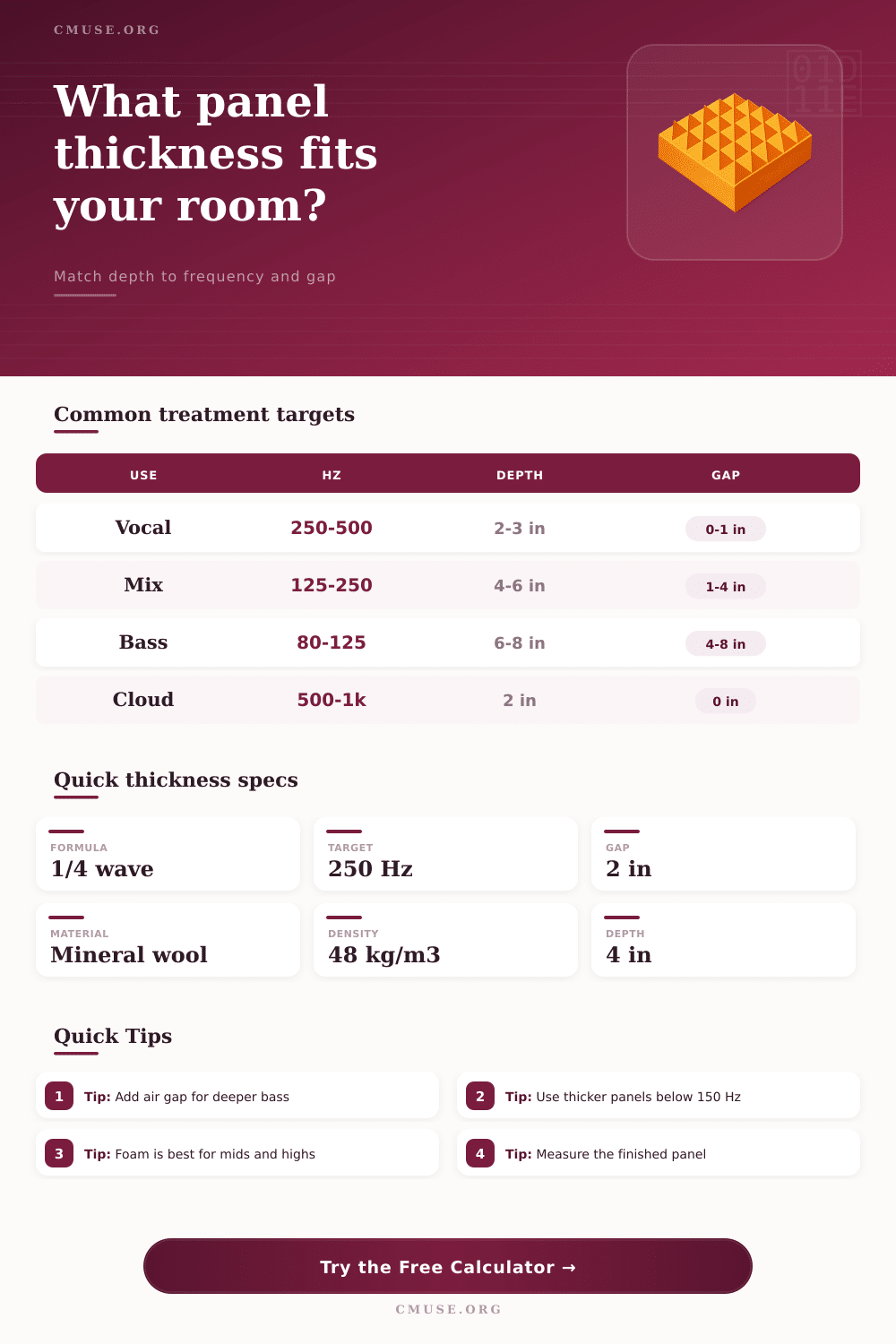
| Target band | Depth | Air gap | Typical use |
|---|---|---|---|
| 80-125 Hz | 6-8 in | 4-8 in | Corner trap |
| 125-200 Hz | 4-6 in | 2-4 in | Rear wall |
| 200-315 Hz | 3-4 in | 1-2 in | Broadband wall |
| 315-500 Hz | 2-3 in | 0-1 in | Sidewall cloud |
| 500-1000 Hz | 1-2 in | 0 in | Voice control |
📝 Material Comparison
| Material | Density | Factor | Best band |
|---|---|---|---|
| Mineral wool | 48 kg/m3 | 0.95x | 125-800 Hz |
| Mineral wool | 60 kg/m3 | 0.93x | 100-700 Hz |
| Fiberglass | 32 kg/m3 | 0.97x | 160-1k Hz |
| Fiberglass | 48 kg/m3 | 0.94x | 125-900 Hz |
| PET felt | 40 kg/m3 | 1.05x | 250-2k Hz |
| Melamine foam | 9 kg/m3 | 1.10x | 315-4k Hz |
| Cotton denim | 28 kg/m3 | 0.99x | 200-1.2k Hz |
| Wood fiber | 140 kg/m3 | 0.92x | 125-900 Hz |
To provide acoustic panel functionality, the panels must have a specific thickness. The thickness of the acoustic panel should be matched to the frequency of the sound waves that you wish to absorbing. If the acoustic panel is too thin, it will only absorb high frequency from the room and will not be able to absorb the low frequencies.
If the acoustic panel is too thick, it will take up too much space within the room and will be costly to purchase. In order to make an acoustic panel of the proper thickness, you must first determine the target frequency of the sound waves that the room will absorb. Sound waves of different frequencies requires different thickness of acoustic panels to effectively absorb those frequencies.
How to Choose the Right Thickness for Acoustic Panels
For frequencies between 80 and 125 hertz, thick acoustic panels of four to eight inches in depth are required. Adding an air gap behind the acoustic panel can enhance the acoustic performance of the panel. For instance, a four-inch acoustic acoustic panel with a two-inch air gap behind it will function similar than a six-inch acoustic panel.
For frequencies of around 200 hertz, three to four inches of acoustic panel thickness is required. For vocal frequencies of around 400 hertz, two inches of acoustic panel thickness is required. The thickness of the acoustic panel must be matched to the target frequency; if it is not, the acoustic panel will not effectively absorb the sound frequencies that the panel targets.
Another factor to consider is the material that is use in the construction of the acoustic panels. Mineral wool materials that is dense enough to have a density of 48 kilograms per cubic meter are among the best materials for acoustic panels. Additionally, the dense mineral wool will absorb the sound waves better than the lighter materials for acoustic panels.
Melamine foam is a lighter material that works well for absorbing high frequencies of sound waves at 300 hertz and above. However, melamine foam will not function as well in the absorption of low frequency. The choice of material impacts the absorption of sound waves, and the density of the material impact the energy of the sound waves that are absorbed.
The thickness specification of the acoustic panels can be applied to the areas of the room that are to be treated with sound absorption. For instance, in a vocal booth that is to absorb 350 hertz frequencies, a two-inch panel of PET felt will work without an air gap behind it. For a mixing position that is to absorb 200 hertz sound waves, four inches of mineral wool with a two-inch air gap behind the panel will work best.
Broadband acoustic panels can be used on the rear wall of the booth. For the corners of the room that are creating low frequencies of 100 hz, eight-inch thick acoustic panels with a six-inch air gap behind the panels will work as sound traps for the targeted frequencies. Calculating the total number of acoustic panels that will be needed for the room is another necessary step.
The total surface area of the walls of the room will determine the total number of acoustic panels that is needed. For instance, a wall that is ten feet wide and six feet in length has a total area of sixty square feet. If each acoustic panel covers eight square feet, then ten panels would be needed to cover that wall.
It is recommended to purchase ten percent more acoustic panels than the calculated amount to account for mistakes in cutting the panels. Additionally, it is important to consider the weight of the panels that will be used for the sound treatment. The total weight of the dense acoustic panels will be significant for the room.
Common mistakes in installing acoustic panels include using one-inch acoustic panels of foam material throughout the room. These one-inch panels will only absorb the high frequencies of sound in the room and will not absorb the low frequencies. Other common mistakes include forgetting to include an air gap behind the acoustic panels.
An air gap behind the panels will make the panels more effective at sound absorption without increasing the thickness of the panels. Another mistake is to forget to measure the depth of the acoustic panels, including the air gap behind the panels. The air gap must be measured from the wall to the back of the acoustic panel.
Sound waves will reflect off the walls and any added acoustic panel treatments. Thus, testing the room for acoustic performance with pink noise will help to determine whether or not the acoustic panels is performing their function. Air gaps behind the acoustic panels are a common treatment that increases the effectiveness of the acoustic panels.
An air gap will lower the cutoff frequency of the acoustic panel without adding more mass to the panel. For instance, a four-inch acoustic panel with a four-inch air gap behind it will absorb 125 hertz as effectively as an eight-inch acoustic panel that is placed against the wall. However, the geometry of the room limit the number of air gaps that are created behind the acoustic panels.
For instance, if acoustic panels are hung as clouds in the middle of the room, the air gaps should be modest so that the acoustic panels dont wobble in their hanging frame. In order to properly treat the sound in a given room, the thickness of the acoustic panels should be matched with the frequency that is to be absorbed in the room. Air gaps in the panels will make thinner panels more effective.
The density of the material that is use in the panels will determine the frequencies that are absorbed. By calculating the total area of the walls and buying extra acoustic panels, the acoustic treatment for the room will have enough panels to perform its desired function. By ensuring that the thickness and placement of the acoustic panels are correctly installed in the room, the sound within the room will have controlled low frequencies and clear mid-range frequencies.