Acoustic Diffuser Panel Calculator
Size QRD, skyline, or binary diffuser panels, estimate depth and band limits, and plan how many modules you need for the target surface.
🎧 Diffuser Presets
🔧 Panel Setup
💡 Material Snapshot
📈 QRD Order Guide
| Order | Step | Depth | Use |
|---|---|---|---|
| 5 | coarse | 1-2 in | Booth |
| 7 | mid | 2-4 in | Sidewall |
| 11 | fine | 3-6 in | Control |
| 13 | finer | 4-8 in | Rear wall |
| 17 | deep | 5-10 in | Live room |
📝 Build Material Guide
| Material | Density | Mass | Note |
|---|---|---|---|
| Birch ply | 680 kg/m3 | 1.00x | Balanced |
| MDF | 760 kg/m3 | 1.08x | Dense |
| HDF | 820 kg/m3 | 1.15x | Heavy |
| Pine | 520 kg/m3 | 0.82x | Lighter |
| Foam core | 60 kg/m3 | 0.18x | Very light |
| Slat hybrid | 410 kg/m3 | 0.64x | Hybrid |
📊 Frequency Guide
| Band | Depth | Pitch | Use |
|---|---|---|---|
| 250-500 Hz | 2-3 in | Wide | Voice |
| 500-800 Hz | 3-4 in | Medium | Sidewall |
| 800-1.5k Hz | 4-6 in | Fine | Control |
| 1.5k-4k Hz | 2-4 in | Tight | High spread |
A diffuser is used to control the reflections of sound within a room. When sound waves encounter a flat wall, the sound waves will reflect off of that wall and return to the room as direct sound wave that can cause problems with the frequency of the sound within that room. While a diffuser will not stop the sound waves from entering a room, the diffuser will scatter those sound waves to distribute them evenly throughout the room.
While absorption can create issues with overly quiet rooms, diffusion will allow the room to maintains it’s energy. There are several types of diffusers that can be used within a room. The first type of diffuser is the Quadratic Residue Diffuser (QRD).
How to Build and Use Sound Diffusers in a Room
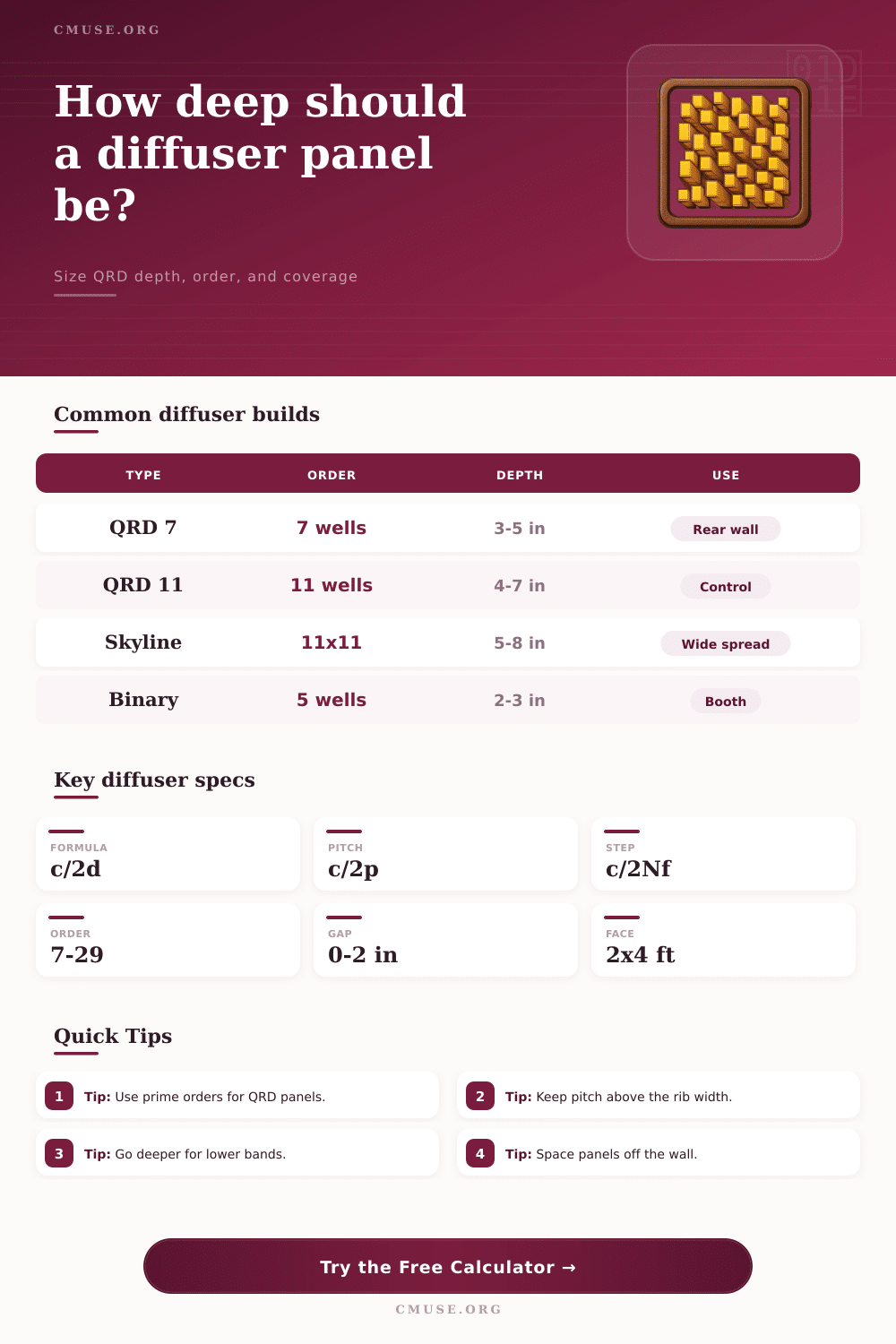
These types of diffusers uses wells of varying depths to move the phase of the sound waves. These types of diffusers are often used to break up the sound that is reflected off of the walls of a room. In order to construct such a diffuser, there are certain measurements that must be made.
For instance, the depth of the wells will impact the low frequency limits of the sound waves that are reflected off of the walls, and the pitch of the wells will impact the high frequency limits of those sound waves. If either of these measurements are incorrect, the QRD will not effective scatter the sound waves from the room. An alternative to QRDs is the use of prime numbers, such as 7, 11, and 13, to increase the strength of the reflections.
Another type of diffuser are the Skyline diffusers. These types of diffusers are constructed with a two dimensional grid of blocks that help to distribute the sound waves in multiple directions. These types of diffusers are often used for ceilings to provide omnidirectional diffusion of the reflected sound waves.
A third type are the Binary diffusers. These types of diffusers is constructed with only high and low steps for the sound waves. Because of the simplicity of constructing this type of diffuser, these types of diffusers are often considered to be lighter than other types of diffusers.
However, they may not be as precise in their scattering of the sound waves. These types can be used in different environments based off the size of the room. For instance, a Binary diffuser can be used within a small vocal booth in a room, while a Quadratic Residue Diffuser can be used within a much larger live room.
The depth at which the diffusers are constructed is another crucial measurement. If the diffusers are too shallow, the sound waves of the low-mid frequencies will remain specular. If the diffusers are too deep, however, the diffuser may be too heavy for the walls of the room, or it may not reflect the high frequencies of sound properly.
For control rooms with target frequencies of 500 to 800 Hz, depths of 3 to 6 inches will be sufficient to scatter the sound waves to 300 Hz. Another crucial measurement is the width of the ribs that are included in the construction of the sound diffusers. If the ribs are too wide, the sound waves will not be able to enter the diffuser as effectively.
If the ribs are too large, however, those ribs may cause diffraction of the sound waves. Finally, the sound diffusers can be mounted with a small gap between the sound diffuser and the wall. By mounting the diffuser with a gap, the low frequencies will be able to better reach the diffuser.
Another consideration for the construction of sound diffusers is the coverage of the sound diffusers that are to be constructed within the room. It is not necessary to cover each of the walls of the room with a sound diffuser. However, covering 20% to 30% of the area of the ceiling and rear walls of the room may be sufficient.
The size of the sound diffusers should be matched with the size of the room. Additionally, it may be a benefit to purchase extra sound diffuser material to provide an overage for the room and it’s walls. This overage will provide for error in the construction of the sound diffusers.
Finally, the type of material that is used for constructing the sound diffusers also matters. For instance, one of the most common materials is birch plywood. Birch plywood has a density of 680 kg/m³, which is a relatively even density throughout the material.
Another common material is foam core, which is relatively lightweight and easy to hang on the walls. The different frequency bands will impact the type of sound diffuser that is constructed. For instance, vocal recordings will focus upon the 250 to 500 Hz range.
Control rooms will focus upon the 800 to 1500 Hz range. For high-end live sound spaces, the sound diffusers may need to be constructed to reflect sound waves down to 300 Hz, but the structure needs to be able to support the weight of such a sound diffuser. High-Density Fiberboard has a density of 820 kg/m³.
This material is strong and adds more mass to the diffuser, but it may require more robust mounting hardware for its installation. Finally, ensuring the build quality of the sound diffusers is one last step in constructing the sound diffusers. Ensuring that the sound diffusers are constructed with clean cuts and sealed edges will prevent the sound diffusers from rattling within the walls.
The sound diffusers should also be spaced throughout the room. If too many sound diffusers is installed in one area of the room, the sound may become overloaded in that section of the room. After installing the sound diffusers into the walls of the room, it is important to test the sound within the room to ensure that the sound diffusers are performing as they should.
By following these steps, it is sure that the sound diffusers will effectively scatter the sound waves within the room.