Average Song Length Calculator
Calculate mean song length, median, shortest track, longest track, standard deviation, release runtime, gap-adjusted average, and format fit from exact track times or planned estimates.
Preset use: Load a release shape, then replace the track list with mastered timings. The music-only average stays separate from sequence time with gaps, fades, bonus tracks, and hidden audio.
Average Length Breakdown
| Track | Source | Length | Vs Mean | Statistic Note |
|---|---|---|---|---|
| Track rows load after calculation. | ||||
| Method | Calculated Length | Tracks Used | Best Use |
|---|---|---|---|
| Method rows load after calculation. | |||
| Length Band | Track Count | Share | Planning Read |
|---|---|---|---|
| Distribution rows load after calculation. | |||
| Preset | Format | Tracks | Typical Average | Use Case |
|---|---|---|---|---|
| Preset rows load automatically. | ||||
| Song Type | Common Length | Average Effect | Release Note |
|---|---|---|---|
| Short punk, skit, or interlude | 0:45 to 2:20 | Pulls the mean down quickly | Compare median so one very short cue does not hide longer core songs. |
| Compact pop or hip-hop track | 2:30 to 3:40 | Fits streaming-focused sequencing | Ten to twelve tracks often land near a lean album runtime. |
| Standard album track | 3:30 to 5:00 | Creates a classic LP average | Side length should still be checked if tracks cluster late in the sequence. |
| Longform, jazz, ambient, or prog | 5:00 to 12:00 | Raises runtime with fewer tracks | Use trimmed mean if one suite movement dominates the set. |
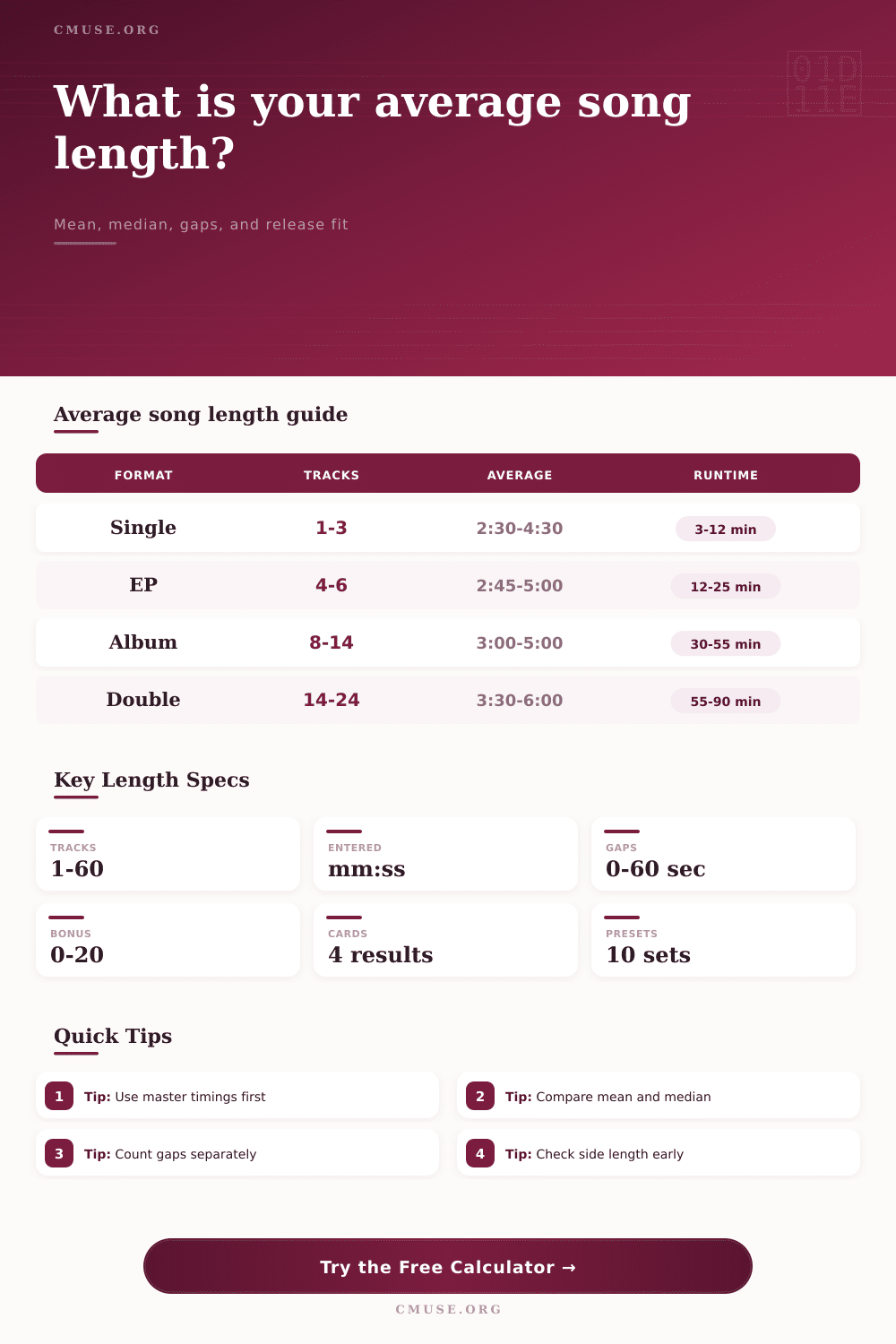
| Format | Typical Tracks | Usual Runtime Window | Average Length Check | Best Planning Use |
|---|---|---|---|---|
| Single package | 1 to 3 | 3 to 12 minutes | Average may equal the feature track | Radio edit, remix pair, or acoustic version bundle |
| EP | 4 to 6 | 12 to 25 minutes | Mean and median should stay close | Compact release with a clear center of gravity |
| Standard album | 8 to 14 | 30 to 55 minutes | Mean around 3 to 5 minutes is common | Full-length sequencing and side balance |
| Deluxe edition | 12 to 20 | 45 to 75 minutes | Bonus tracks can distort the headline average | Show core and bonus averages separately |
| Double album | 14 to 24 | 55 to 90 minutes | Side average matters more than track average | Four-side planning, disc pacing, or long suites |
Mix your album down and think it’s great. Hear it back in the context of a playlist, and you’re wondering why the pace seems sluggish. Been there? Many artist have.
Often times it’s not the songs themselves. No, it’s the structure around them. A lot of artists gets lost in the creative energy a song creates, yet fail to admit the mathematical reality of how one song follow another. They create a good song. Then they create a bad record.
Why Song Length Matters for Your Album
Knowing the average song length doesn’t limit your creative output. Instead, it helps you see that you don’t just have a pile of MP3s, but an actual program. Once you put your timings into calculator up top, it crunches the numbers for you. You do not need to guess at conversions and coefficients.
“Understanding the distinction between experience time and music time is key. Ten three-minute songs equals thirty minutes of audio. But that’s not what listeners hear. They hear the crossfades and the fade-outs. They hear the physical pauses if they are playing vinyl, and the silence between tracks. All that extra time change the rhythm of the project.
When multiplied by twelve tracks, a two-second gap doesn’t seem like much. But it adds up. It adds twenty-four seconds of dead air, which can make a side feel sluggish. It is a small thing that still counts.
For that reason alone, you should compare both the median and the mean. The arithmetic mean, which is what most people call an “average,” can quickly become skewed by outliers. Nine three-minute songs plus a single ten-minute closer, and now your average are more than four minutes long. That doesn’t accurately reflect the album any longer. It reflects a single song. The median reveals what actual center of gravity sounds like. If the mean and median is widely different, it’s typically a sign of poor sequencing. Maybe you’ve got a bunch of short songs hidden behind a couple of long ones.
This is where genre conventions come into play. Generally, pop albums gravitate towards the three- to four-minute range for radio rotation and streaming retention. Progressive rock or jazz releases might be longer, stretching past eight minutes per song. Yet, this isn’t merely a matter of style. This is also due to the format. Physical media like vinyl have a practical limit on how many minutes can fit onto each side. Audio quality begin to drop as the grooves grow too thin.
The digital realm doesn’t have a physical limit, but it does have an attention limit. People are scrolling quicker these days. If your average track-length is too long without enough variety, you run the risk of losing listeners before you reach the hook.
Also think about the audience’s attention span and your intended format: For example, what do you expect from a double album versus a single? What is a single versus an EP versus a full-length album? The chart on the page shows typical lengths of each format. A single will deliver a punch in as little time as possible (think three minutes). An EP has to have enough content to make it seem worth paying for, without being overextended. A full-length album requires dynamic pacing. You’re looking for peaks and valleys.
Even if all your songs differ sonically, they may sound like the same song. Monotonous, if they all have identical running times. Varying the running time establish a rhythmic flow in the listener’s mind; it keeps them hooked.
And don’t overlook hidden intros and bonus tracks. They’re left out of the main breakdown, yet can account for additional time. Those minutes accumulate into pressing time and manufacturing costs if it’s a physical product. Digitally, they can impact how the listener feels about value, too. Five brief bonus songs can seem more generous than two extended “filler” cuts. Perception matters almost as much as reality.
All in all, think about making it cohesive. Making sure on average it fits the narrative arc of the project.
Let’s get started. Type your mastered times into the tool. Take a look at the standard deviation and see just how consistent your tunes are. Is the spread large? Ask if this was deliberate or an accident. A large spread mean a journey. A tight spread means a uniform, focused vibe. Both are good. But only you can know what the data realy means.
When you have the numbers in front of you, then you can determine whether the pace matches your vision. And that’s how you make a record where people are compelled to play it through from beginning to end.