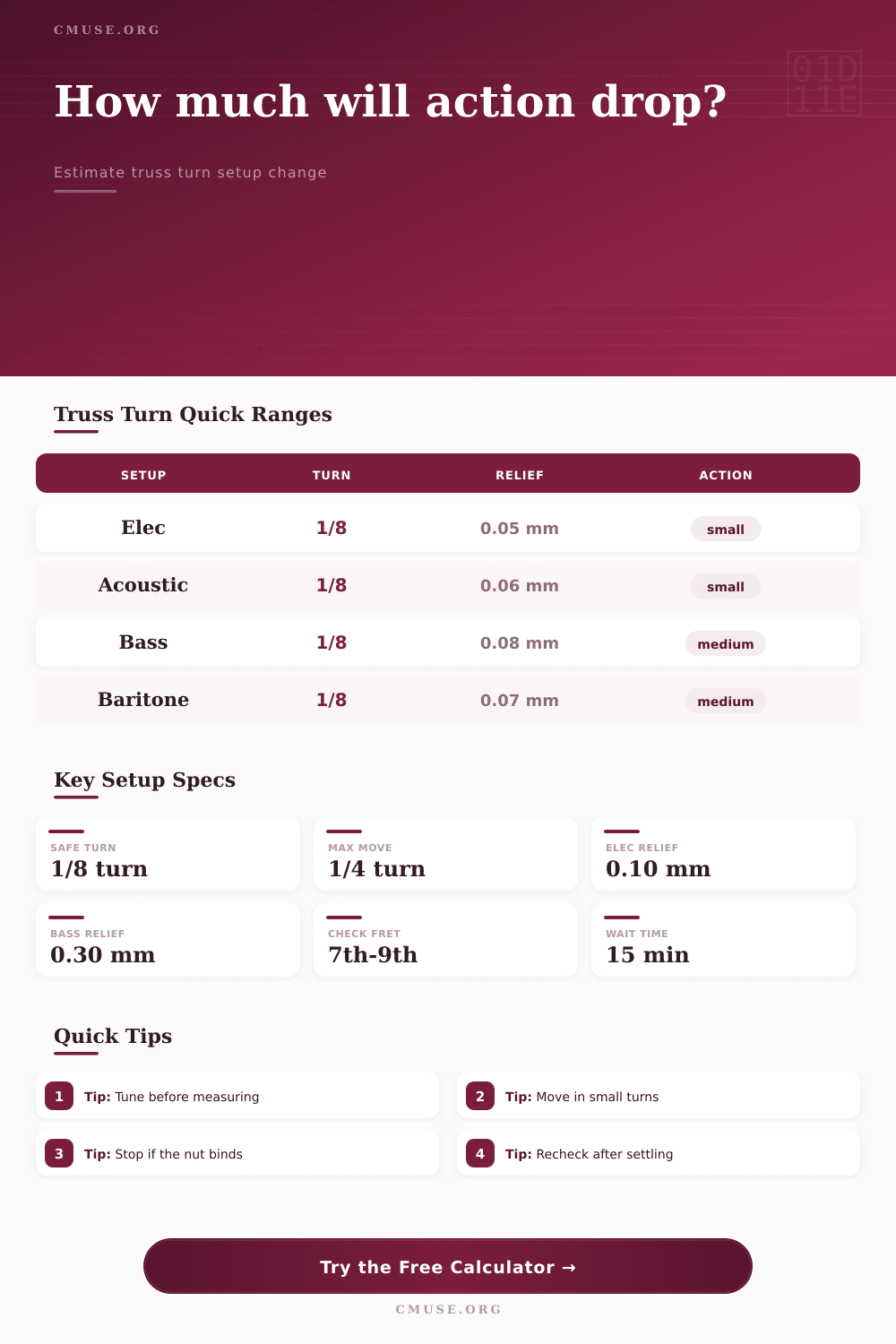
Action Drop From Truss Turn Calculator
Estimate how a truss rod turn changes measured relief and the action at a chosen fret, using scale length, fret position, rod sensitivity, neck stiffness, and string load.
🎯 Setup Presets
⚙ Truss Rod And Action Inputs
Calculation Breakdown
📏 Truss Rod Spec Cards
Small enough to remeasure without overshooting most necks.
Typical midpoint area for first-and-last-fret relief checks.
Fast action region for level frets and a light touch.
Useful clearance for longer strings and stronger attack.
🔧 Typical Turn Sensitivity Table
| Neck or rod feel | Approx relief per full turn | 1/8-turn estimate | Use in calculator |
|---|---|---|---|
| Very stiff neck or dual rod | 0.020-0.030 in / 0.51-0.76 mm | 0.003 in / 0.07 mm | 0.025 in Start low, then remeasure. |
| Average electric guitar | 0.035-0.045 in / 0.89-1.14 mm | 0.005 in / 0.13 mm | 0.040 in Good generic bench value. |
| Steel-string acoustic | 0.040-0.055 in / 1.02-1.40 mm | 0.006 in / 0.16 mm | 0.048 in Body and humidity may slow response. |
| Bass or long neck | 0.050-0.070 in / 1.27-1.78 mm | 0.008 in / 0.20 mm | 0.060 in Check again after the neck settles. |
| Small mandolin-style neck | 0.018-0.030 in / 0.46-0.76 mm | 0.003 in / 0.07 mm | 0.024 in Use especially small movements. |
🎸 Setup And Action Target Table
| Instrument setup | Typical relief | 12th-fret treble action | 12th-fret bass action |
|---|---|---|---|
| Electric guitar, very low | 0.003-0.006 in / 0.08-0.15 mm | 0.047-0.063 in / 1.2-1.6 mm | 0.059-0.075 in / 1.5-1.9 mm |
| Electric guitar, balanced | 0.005-0.010 in / 0.13-0.25 mm | 0.055-0.071 in / 1.4-1.8 mm | 0.067-0.087 in / 1.7-2.2 mm |
| Steel-string acoustic | 0.006-0.012 in / 0.15-0.30 mm | 0.071-0.094 in / 1.8-2.4 mm | 0.087-0.118 in / 2.2-3.0 mm |
| Electric bass | 0.008-0.015 in / 0.20-0.38 mm | 0.071-0.098 in / 1.8-2.5 mm | 0.087-0.118 in / 2.2-3.0 mm |
| Baritone or heavy set | 0.007-0.014 in / 0.18-0.36 mm | 0.063-0.087 in / 1.6-2.2 mm | 0.079-0.110 in / 2.0-2.8 mm |
📊 Truss Turn Planning Table
| Planned turn | Bench use | Expected action effect | When to stop |
|---|---|---|---|
| 1/16 turn | Fine correction after leveling, refret, or seasonal shift | Often barely visible at 12th, but measurable at the relief fret | If the nut feels tight or the reading moves past target. |
| 1/8 turn | Normal first adjustment for most guitars and basses | Small action drop with a clear relief change | If buzz appears in the first seven frets after retuning. |
| 1/4 turn | Maximum single planning move for many setups | Can change both feel and fret noise noticeably | If the rod resists, creaks, or the neck does not respond. |
| 1/2 turn | Only for known free-moving rods over staged checks | Large relief and action movement, easy to overshoot | Before forcing hardware or chasing saddle-height problems. |
📐 Instrument Neck Comparison Grid
| Instrument neck | Common scale | Relief check habit | Truss response note |
|---|---|---|---|
| 25.5 in electric guitar | 25.5 in / 647.7 mm | Capo 1st, hold last, read 8th | Predictable response; 1/8 turn is a useful first move. |
| 24.75 in electric guitar | 24.75 in / 628.7 mm | Read 7th or 8th fret | Shorter scale makes the same relief change feel slightly bigger. |
| Steel-string acoustic | 25.4 in / 645.2 mm | Read 6th to 8th fret | Top movement and humidity can hide part of the truss change. |
| 34 in electric bass | 34 in / 863.6 mm | Read 7th to 9th fret | Long necks often need more settling time after the turn. |
| 27-28 in baritone | 27.5 in / 698.5 mm | Read 8th or 9th fret | Heavy strings can resist the rod and keep extra relief. |
| Mandolin or small neck | 13.875 in / 352.4 mm | Read 6th or 7th fret | Small turns matter because the neck is short and compact. |
The truth is far more mechanical then magical. Think of the neck of your guitar as a continuous spring held tightly in tension by the truss rod (the counter force preventing that spring from collapsing or, if already collapsed, from trying to pop back out). Turning that rod changes not only amount of relief in center of the neck, but the entire arc of the neck from saddle to nut, which will inevitable alter the string height at the 12th fret.
Most setups goes wrong right there, where middle bow meets the end-action. If you eliminate buzz on the first couple frets, you can create a nightmare on top end with no sense of playability because you forgot about how the curve scale.
How to Adjust Your Guitar Neck
As you can see above, calculator does all the geometry for you, converting whatever turn you enter in the box into expected action drop at your selected fret. How? It works by multiplying the relief change (typically at the eighth fret) by its distance from zero on the neck’s radius at the spot where you measure action.
And since a few variables are more important then most folks realize, we’ll mention those. First is scale length. Because the leverage are different, a twenty-five-and-a-half-inch guitar neck is going to behave differently than a thirty-four-inch bass neck. If you apply the same amount of relief change halfway down the neck, the resulting action shift at the twelfth fret will not be the same.
Next, there is sensitivity of the rod itself. Some truss rods is so stiff they barely move the wood when turned a quarter-turn. Some respond sensitively, reacting violent to the slightest adjustment. Here you need to rate the strings sensitivity for yourself and then apply that to the tool. It makes you realize how unique each instrument are.
As a player, you can’t ignore this when deciding on an approach; following a general rule without thinking about how your particular neck responds is not an option here. Dampeners include neck stiffness and string load. A heavily braced acoustic or one made of roasted maple will resist the truss rod more than a flexible mahogany neck. Likewise, heavy gauge strings pulls harder on the neck than light ones, which are essentially pushing back at your adjustment. Enter the string load condition and response factor into the calculator. Those inputs help prevent you from over-rotating the rod, even though relationship is not linear.
If you ignore those variables, you make the classic overshoot error: you go a little too tight, raise the saddle chasing the new high action, and now you’ve got a dead, unresponsive instrument.
The page also lays out typical relief targets for various types of instruments in its reference tables, a crucial sanity check. For instance, electric guitars typically inhabit some sort of virtual flatland, with perhaps as little as point-zero-zero-four inches of relief. Basses requires more space between the strings due to their thickness and generally don’t fret-out when they’re allowed to vibrate freely. This means point-zero-zero-eight inches or greater is common. The tool flags any new relief calculation you input if it’s outside those comfort zones. This saves you from chasing a hypothetical ideal action that makes the frets unplayable because of intonation problems or fret buzz.
It’s all about finding the right balance: too little and you can’t play aggressively without fretting out; too much and the action is sluggish and high. There is an unwritten rule here: safety first. Do not force anything on the rod. Stop if it creaks, resists, or stops. When wood gets beyond its elastic limit it fails catastrophically. A broken neck is a very expensive lesson you should of learned earlier.
Always begin small, one-eighth, maybe a sixteenth. Then wait for the instrument to settle. Slowly does it. A minute, two, even fifteen minutes after a turn will allow all the internal stresses and humidity to equalize so you have a better read. Retune, measure again, and do it again.
It’s a slow game of milliseconds and millimeters, but once you get it right the difference is a dissapearing instrument under your fingertips instead of one fighting you every step of the way. Use the calculator as a map, but what your hands and ears tells you determines where you go. Take baby steps, let it settle, and trust in the process rather than the impulse.