Break Angle Over Nut Calculator
Calculate the string break angle over the nut from headstock pitch, tuner distance, post height, lateral string pull, tension, and friction so setup changes can be compared clearly.
🎯 Headstock And Hardware Presets
⚙ Nut Geometry And String Inputs
Calculation Breakdown
🔧 Instrument Hardware Grid
Enough hold-down for open strings without excess slot drag.
Usually no retainer needed; slot finish matters more.
Post wrap height and retainers shape the lowest strings.
Roller position creates a firm angle with low sideways pull.
📏 Break Angle Reference Table
| Measured angle | Typical feel | Likely symptom | Common correction |
|---|---|---|---|
| 0 to 3 deg | Very light downforce | Open-string buzz, weak slot seating, muted attack changes after bending. | Add wraps, lower a string tree, use staggered posts, or check the nut slot floor. |
| 3 to 8 deg | Normal flat-headstock range | Works well when slots are clean and the string has a straight path. | Keep the first hold-down point close enough to the nut for thin strings. |
| 8 to 14 deg | Firm general-purpose range | Stable seating with moderate tuning friction. | Polish slots and avoid sharp sideways pull on 3x3 layouts. |
| 15 to 20 deg | Steep hold-down | More nut pressure, more drag, and higher risk of binding on wound strings. | Raise the retainer, reduce wraps, or soften the nut slot exit angle. |
🎸 Headstock Geometry Table
| Headstock type | Typical pitch | Usual first contact | Nut-angle note |
|---|---|---|---|
| Flat 6-in-line electric | 0 deg | Post, tree, or retainer bar | Angle depends mostly on post wrap height and string tree placement. |
| Angled 3x3 electric | 13 to 17 deg | Tuning post | Headstock pitch supplies the drop; sideways tuner offset adds slot friction. |
| Slotted classical | 10 to 15 deg | Roller or tie-side string path | Usually firm over the nut with little need for extra hardware. |
| Bass guitar | 0 to 7 deg | Large post or retainer | Low strings may need retainers because the first post can sit far from the nut. |
| Locking tremolo nut | 0 to 14 deg | Clamp or retainer bar | The clamp controls seating, but the retainer still shapes string approach. |
⚖ Drop And Distance Examples
| Plan distance | 3 deg drop | 8 deg drop | 14 deg drop | Use case |
|---|---|---|---|---|
| 0.75 in / 19.1 mm | 0.039 in / 1.0 mm | 0.105 in / 2.7 mm | 0.187 in / 4.8 mm | String tree close to nut |
| 1.50 in / 38.1 mm | 0.079 in / 2.0 mm | 0.211 in / 5.4 mm | 0.374 in / 9.5 mm | Nearby tuner post |
| 2.50 in / 63.5 mm | 0.131 in / 3.3 mm | 0.351 in / 8.9 mm | 0.623 in / 15.8 mm | Distant bass or guitar post |
| 3.50 in / 88.9 mm | 0.184 in / 4.7 mm | 0.492 in / 12.5 mm | 0.872 in / 22.1 mm | Far low-string post |
🔍 Tuner And Retainer Comparison
| Hardware | What changes angle | Best measurement point | Setup caution |
|---|---|---|---|
| Vintage split post | Number of wraps and final string exit height | Center of the final wrap as it leaves the post | Too many wraps can increase angle and side drag. |
| Modern sealed tuner | Post height and wrap stack | String hole center or lowest wrap contact | Staggered posts can remove the need for extra trees. |
| String tree | Tree height and distance from nut | Underside contact where the string exits toward the tuner | A very low tree can make tuning return worse. |
| Retainer bar | Bar height across multiple strings | Front edge of the bar contact | Check that all strings have enough clearance and similar load. |
| Locking nut clamp | Clamp face and any retainer behind it | First clamp or retainer contact after the nut slot | Angle still matters before the lock is tightened. |
Here you are standing at work bench with brand new pickguard and new strings. Why does it stay in tune on one setup, yet go out the second you bend a note? More times than not, this have nothing to do with cheap hardware or bad luck. Most of the time it’s the angle at which that string pass over the nut.
This determines where the string sit in the slot and how much downward pressure it put on the bone. It also determines if it bind painfully or slips smoothy as you turn the post.
Why Your Guitar Goes Out of Tune
Once you have entered your headstock pitch and tuner distances, the calculator will figure out the rest for you, without requiring you to hold a ruler in one hand and mentally draw triangles in the other.
The underlying principle is simpler then it seems. Think of it this way: how far does the string travel horizontally from whatever holds it down at the end nearest the bridge (a string tree, for example, or the tuning post) until it reaches the nut? That’s the run. How far does it travel vertically from that contact point until it hits the nut? That’s the drop. And the angle is nothing more than the arctangent of the drop over the run. Academic-sounding stuff but really just a measure of leverage.
The other thing most players do is totally zero in on how high up off the top of the guitar the string exits. Raising the post seems to them like it will address the buzz due to increased down force. They are half correct. It’s the angle not just the straight-line height that counts. You could easily find that a tall post with extreme distance from the nut result in a shallow angle compared to one with shorter height but closer proximity to neck bridge. The tool does that too by allowing you to specifically define where first hold-down point is. In fact, if you have a string tree, that is your critical contact point. It is not the tuning post at all. The measuring line to the post would be a deceptive shallow angle that might make you falsely feel secure about how stable your tuning are.
There’s an interesting illusion regarding tension in this equation. The more tension there is in the string, whether from a lower pitch or heavier gauge strings, the greater its normal force against the nut slot. That means greater friction. But even with a smoothly cut bone nut, it can still be sticky if the string tension is high and the break angle are steep.
This calculator determines the drag caused by tuning based on the coefficient of friction you choose. Lubricating the string and polishing the slots reduces the coefficient of friction, so even at moderate angles, it slide easily along. Dry, rough slots will make that same angle a tuning nightmare.
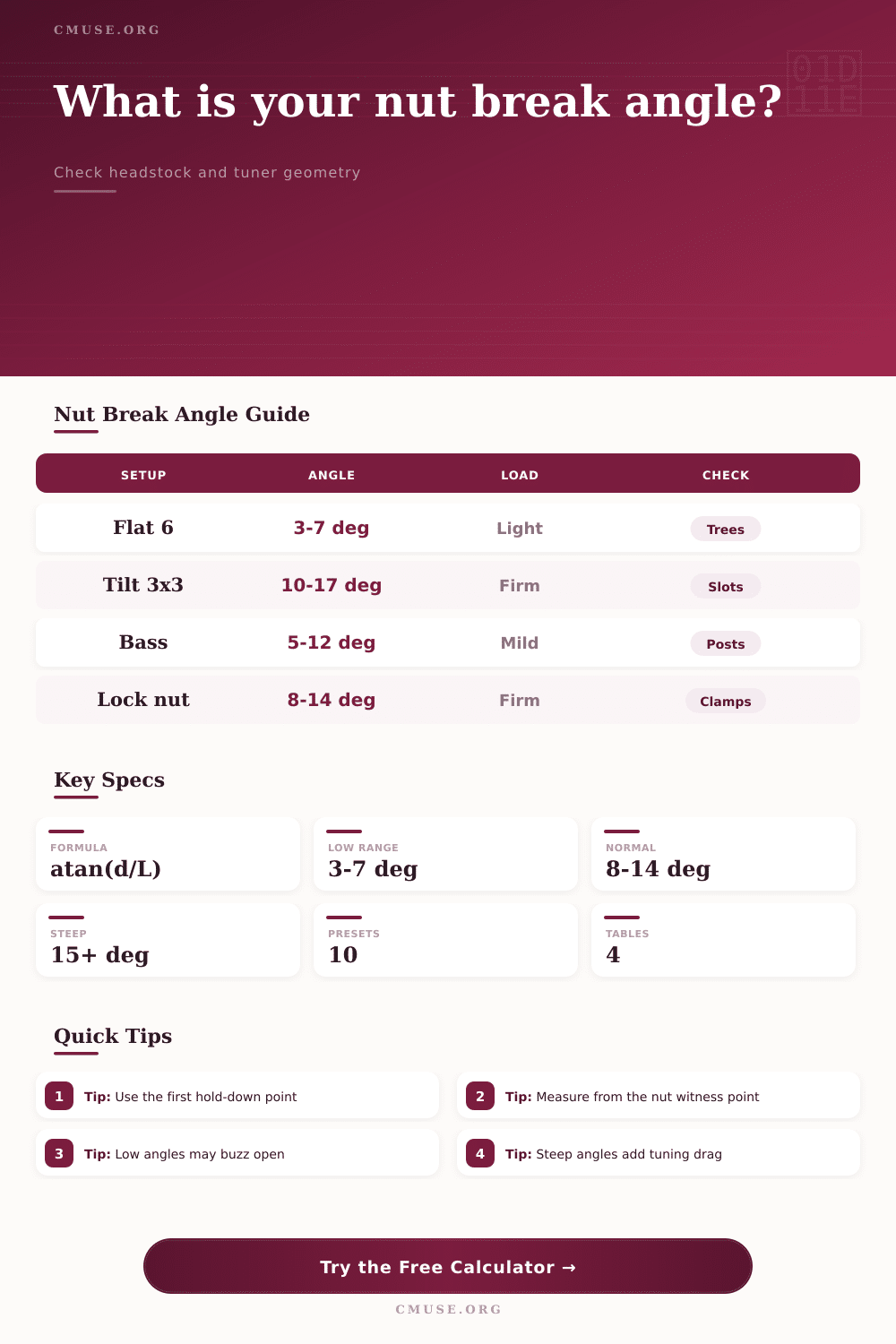
Not every instrument has one “right” angle, either. Typically a modest three to seven degrees are sufficient with a flat six-in-line headstock that might use staggered posts or string trees to accomplish this. This is just enough to seat the string without adding too much drag.
Conversely, an angled three-by-three headstock will have a steeper drop out of the box that lands somewhere in the ten to seventeen degree range. In both of these instances, the headstock’s own geometry do most of the work. Because there is a certain amount of angle inherent in the pitch, you don’t typically need additional retainers on such designs.
The bass guitar occupies an odd middle ground here. Because of its lowest string (the low E), it can sit very far away from the nut. This requires a high post or even a retainer to avoid buzzing when the string is open. However, with a thick wound string, too steep an angle can cause binding and intonashun problems when you tune up. This is well described in the reference table on the page and it shows that seating angles of less than three degrees are dangerous and more than fifteen degrees can cause friction issues.
It’s a balancing act. You need some angle to seat the string properly without too much angle that creates a choke point at the nut slot.
Set up: At the end of the day it’s all about making trades. If you want your instrument to be super easy to play, have great tone, and stay in tune, then you’re not going to get all three. There are very few things that affects everything and adjusting the break angle is one of them.
When you figure out how the drop and the distance play off each other, you’ll quit shimming and start building a set-up that works for you. It’s that little piece of geometry at the top of the neck that dictates everything from when you first pluck a string to where it will finally return to pitch. You should of checked this sooner.