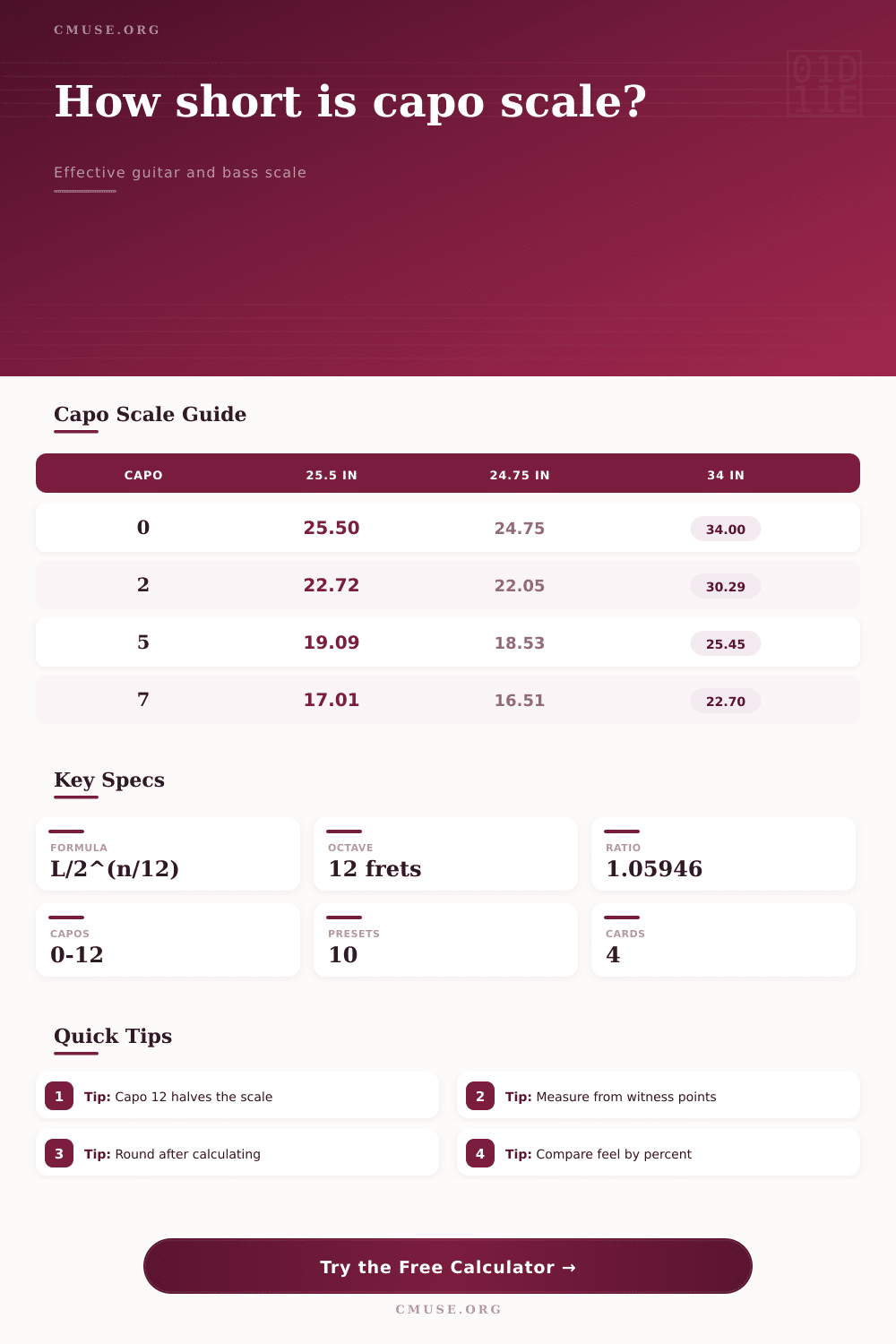
Effective Scale At Capo Calculator
Calculate the vibrating scale length created by a capo, the nut-to-capo distance, the remaining scale percentage, and guitar or bass scale comparisons using equal-tempered fret geometry.
🎯 Instrument And Capo Presets
⚙ Scale And Capo Inputs
Calculation Breakdown
🎸 Guitar And Bass Scale Grid
📏 Capo Effective Length Table
| Capo Fret | Effective Scale | Nut To Capo | Remaining | Pitch Raise |
|---|
🎼 Frets Above The Capo
| Above Capo | Distance From Capo | Remaining Length | Actual Fret | Octave Marker |
|---|
📊 Common Capo Effective Scale Table
| Capo | 24.75 in Guitar | 25.5 in Guitar | 27 in Baritone | 34 in Bass |
|---|
🔀 Ratio And Comparison Table
| Reference | Open Scale | Capo 2 | Capo 5 | Capo 7 |
|---|
💡 Scale Length Tips
When you put a capo onto say the second fret of your guitar, you’ll probably have noticed it is stiffer to play and sounds brighter too. You might assume the instrument itself has changed, but reality is simpler and more mathematical. There is no difference between position of the bridge and position of the nut. What has altered is length of string that vibrates. It’s shorter.
This in turn affect how easy instrument is to play. It changes how tight strings feel beneath your fingertips and what they will sound like. This change also help explain why a set of chords that were loose sounding in open position suddenly need to be played with greater finger accuracy.
How a Capo Changes Your Guitar
The system we use depends equally on something called equal temperament. Equal temperament divide the octave into twelve equal steps. Moving up a semitone means the next fret is raised in pitch by a certain ratio. Each fret shorten the string to match. Half the vibrating length of the string moves up an octave. That’s what happens if you put your capo on the twelfth fret.
The complicated mathematics is handled by the calculator for you to avoid having to do all this exponentiation in your head. You don’t need to worry about whether geometry is correct because it is. Your bass has a 34-inch neck but your friend’s guitar is a 25.5-inch electric; it doesn’t matter. Shortening the scale by about 19 percent at the fifth fret will give you the same proportional reduction regardless of overall size of instrument. The important number in this case is not the total inch or millimeter measurement but rather this percentage.
Two inches shorter on the bass sounds different than two inches shorter on a short-scale guitar, although it’s the exact same physical distance. It’s a matter of perceived tension based off where your hands are in relation to the starting scale. So how can you compare how an instrument ‘feels’ compared to another? Enter the percentage of the starting scale shown on the tool. If you find yourself thinking ‘my baritone guitar is feeling sluggish now when I have my capo on the third fret’, it answers why: you still have almost 90% of the starting string length vibrating. This retains a lot of the resonant nature and inherent slack of the instrument.
A little-known feature of this tool, and one most players don’t pay attention to, is the witness point adjuster, which has potential to color outcomes if your guitar isn’t set up standardly. From the perspective of the capo, it measures effective length of the scale, from the middle of the fret crown on the capo all the way down to where the saddle contacts the string. Because your saddle may be angled or worn, there could be a slight difference between theoretical figure and real-world vibrating length. With a tiny witness adjustment, the tool compensates for those physical realities. It’s one of those details that can realy make a difference when you are trying to match tone of a specific recording or tune by ear.
Measure accurately, play accurately.
It also compares size of instruments with capos on, to normal ones. This shows that if you use a capo on an electric guitar, its playable string length becomes closer to that of a classical guitar. That’s why the attack feels softer and the sustain decay faster. The sound also fades away quicker. It’s not some kind of voodoo, it’s physics. There’s less leverage from the string at the bridge and less mass of string to vibrate.
Knowing this will help adjust the dynamic of how you pick. Sometimes you may of have to pick harder as there is less energy in the shorter string.
Capos are used by many players as nothing more than a means of changing keys; no thought is given to the feel other than the key-change required. This is where it all goes wrong. There is an increase in tension that can affect note bends. Also, it may be causing intonation problems due to overly high action. Knowing the effective scale will let you predict this and plan ahead so not to break flow. You can also adjust the capo to drop one fret back, which might give you a little more playability. You could even opt for a lighter gauge string altogether.
All of these comparisons are laid out in the reference tables on the page for the most commonly used guitar and bass scales so you don’t have to run the numbers yourself. But true benefit of all of this is understanding how tension relates to position. Why does it feel like the guitar is a different instrument when you move from the second to the fifth fret? Not only is it higher but also it’s tighter because you’ve now cut the rest of the scale down by yet another large chunk. Once you understand this, the capo stops being a crutch and becomes a tonal shaping device with many uses. Instead of guessing, you’re able to intentionally design the feel of your guitar as much as the chords you’re playing.