Harmonic Fret Location Calculator
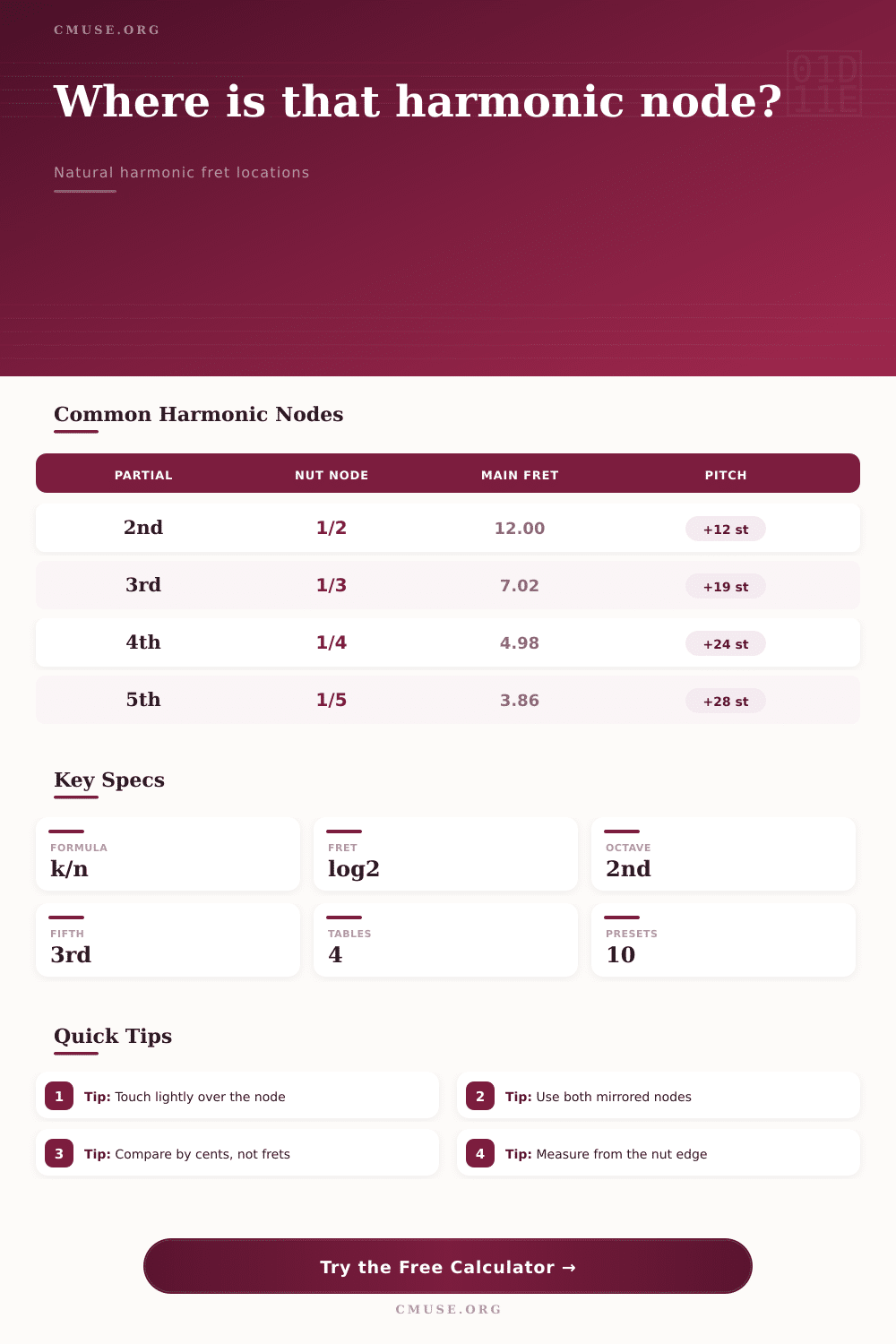
Calculate natural harmonic touch points from a string's fractional nodes, then translate each node to distance from the nut, equivalent fret position, mirrored location, and partial pitch offset.
🎯 Natural Harmonic Presets
⚙ String And Node Inputs
Calculation Breakdown
📌 Harmonic Snapshot Cards
📊 Harmonic Comparison Grid
🎚 Selected Partial Node Table
| Node | Fraction From Nut | Distance From Nut | Equivalent Fret | Mirror Point | Fingerboard Note |
|---|
🎶 Common Natural Harmonic Table
| Partial | Main Touch Node | Nearest Fret Area | Pitch Above Open | Equal-Temperament Error | Typical Use |
|---|
📐 Full Node Map Table
| Partial | Node k/n | Nut Distance | Fret Coordinate | Nearest Fret | Board Status |
|---|
🔎 Scale Length Comparison Table
| Scale | Selected Node | Mirror Node | Tolerance Zone | Same Fret Coordinate |
|---|
💡 Practical Harmonic Tips
Listen to the shimmer of a note floating over a strummed chord. That’s a natural harmonic. A sound like instrument itself is singing. But it isn’t magical. It’s physics. More specifically, it involve standing waves.
Gently place your finger lightly on a string in exactly the right fractional places. This cancels out the fundamental frequency and highlights higher harmonics. The difficulty lie in locating these positions accurately along the fretboard. The mathematics of that becomes its own job for the calculator. You just need to understand why numbers matter. Just know what numbers represent.
How Natural Harmonics Work
That middle node on the string is one of the most popular nodes. It’s just that when your finger touches here, you have an octave. Why? Because this is where your finger will line up with twelfth fret. Simple enough. Move your finger a fraction of an inch either side and your touch are gone. Your finger has become the damper. It is not a node anymore. Silence or ringing depend on how precise your finger placement is.
Things becomes more complicated with higher partials. For example, there is the third partial. What it do is create an octave plus a fifth. Where is the node? The node is one-third of the way along the string from the nut. So on a typical twenty-five inch scale that’s approximately eight and a half inches. That seems as if it should of been at the seventh fret. It isn’t. It’s a little bit up. It’s this slight mismatch that leads some players into believing harmonics is sounding sharp. And they are sharp. Why? Because the fret is a compromise for equal temperament. The harmonic node is a fixed physical point.
The calculator demonstrate where the disconnection lies. If you are a tuner of ears, this counts. A diagnostician of intonation problems? This counts too. Is a fretted note in tune with a harmonic? Maybe it’s not. Perhaps it’s the clash of the tempered scale and physics. The tool plots these spots exactly. You know where they fall as fractions of an inch, which fret is closest, and what their mirrored partner are on the opposite side of the bridge. That can help when you cannot always reach a node close to the nut. With the bridge side you have the same note but approached from another direction.
Instruments vary there needs. For example, a bass guitar has a longer scale length. Typically, this is thirty-four inches. That increase the distance between the nodes. As a result, the fret’s position becomes less accurate relative to the node. Conversely, instruments like ukuleles or mandolins reduces the size of the board. Smaller areas is the target. They are more difficult to play accurately. The scales accounts for these lengths. You choose which family of instruments to use. The distances is re-calculated. So you don’t use your gut feeling about guitars on something like a short-scale bass or violin.
Another useful feature is tolerance. It is the width of fingertip. You don’t play the string with a laser pointer. You can set a tolerance zone in the tool. Typically it’s a sixteenth of an inch. As you play higher partials such as the ninth or tenth, there isn’t much space between the nodes. They becomes crowded. The calculator will flag when a node fall outside a standard fingerboard. You don’t waste time looking for notes that aren’t present on your neck.
What this does for you is expand your vocabulary; it allow you to play things other than open strings and an octave at the twelfth fret. You can go to the seventh fret to get on the fifth. Higher partials gives you access to more complex intervals. It maps out the fretboard as a series of sound possibilities. Not a grid of notes, but a board that becomes a continuous vibration. It is a string. It is a succession of individual pitches rather than a whole.
Next time you pick up your guitar, try finding the node at the 5/12th position. Five-twelfths of the way up the string isn’t quite as neat a fraction then a third or a half. Getting it is slightly more challenging. However, once you do, that chime slices through the mix. It is a little win for physics against habit. Maintain a light touch on finger. Allow the string to breathe. You’ll be rewarded with tone.