Twelfth Root Fret Position Calculator
Use the equal-tempered twelfth root of two to turn any scale length into exact fret positions, remaining string ratios, first-position checks, and multi-scale comparison tables.
🎯 Scale Presets
⚙ Twelfth-Root Inputs
Calculation Breakdown
🔢 Twelfth-Root Constants
🎸 Scale Comparison Grid
📏 Exact Fret Position Table
| Fret | From Nut | Remaining String | Previous Gap | Adjusted Mark |
|---|
🧮 Formula Ratio Check Table
| Checkpoint | Fret | Remaining Multiplier | From-Nut Percent | Meaning |
|---|
🔧 Rule Of 17.817 Comparison Table
| Fret | Exact 12th-Root Position | Iterative Divisor Position | Difference | Use |
|---|
🎼 Common Scale Comparison Table
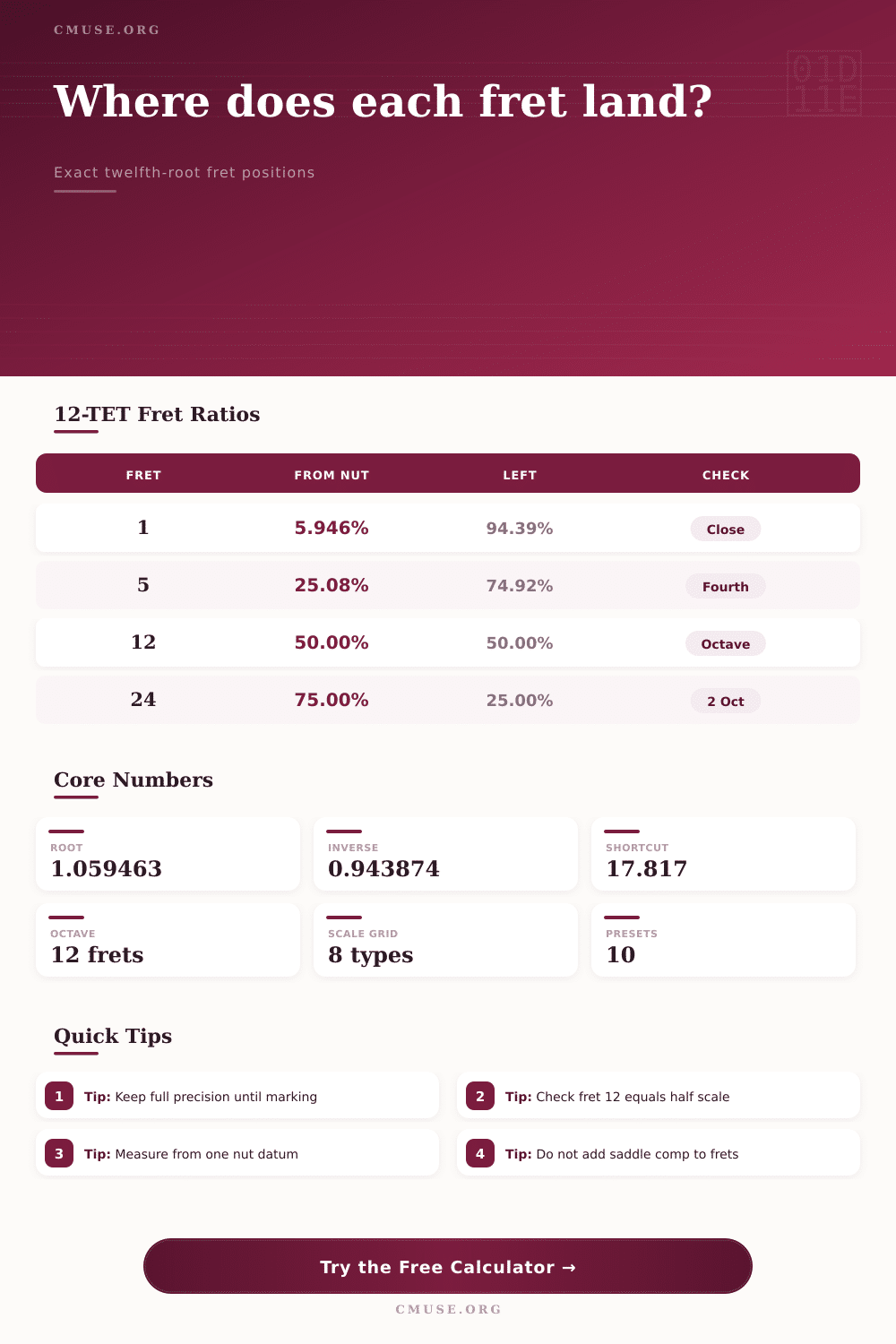
| Scale | Fret 1 | Fret 5 | Fret 12 | Fret 24 |
|---|
There is magic hiding in space between two metal wires, and precise math underneath the pitch jump. Pluck a string against one of its frets and it leap upward by exactly one semitone. Seems mechanical but the maths are uncompromising. Without this constant; without twelfth root of two, moddern music wouldn’t be possible. Why? Because this number divide the octave into twelve equally spaced intervals. Any deviation in position of a few millimetres and instrument sounds sour. This is why we need a dependable method for calculating location of these frets. Don’t try guessing.
After inputting scale length of whatever instrument you’re building, this calculator will do all of the work for you (see above). There are some common scale lengths available as presets for everything from electric guitars to basses to mandolin string. If you’re building something special, you have the option of typing in your own number and it’ll calculate away.
Why Math Is Important for Guitar Frets
From there, it provides precise distances from nut to each individual fret. It even displays what’s left of that string after every fret so you can visualy see where the ratios change as you go up the neck. That way you can catch any mistake without ruining a piece of wood.
This is rule of 17.817. You can use this easy trick to multiply your leftover string length by 17.817. Then divide by that number and there you go! The next fret position appear. That’s great if you just need something rough. But these little error add up. Before long, they’ll be big enough to impact your instrument’s intonation.
The precise formula based off the twelfth root cancels out any drift completely. It works out each fret separately starting at the nut. So placement of each note is exactly as it would be mathematically. When you’re working in cents instead than whole numbers, precision is everything.
Also, some people make mistake of measuring fret-to-fret rather than using a single starting point and then calculating all from there. Any slight discrepancy when measuring from previous fret will compound through all successive measurement. Soon enough, it will be off by quite a bit. By getting that baseline correct, it should of saved you hours of aggravation down the line.
That’s why tool on this page provides absolute positions from edge of the nut. And it allows you to compensate for nut offset should your instrument require it. For example, this would come into play for a non-standard setup or an instrument with an angled bridge. The interface include some other tolerance options that you’ll want to take note of as well.
In the real world, there’s such thing as blade width (kerf) and tool width (thickness). Without taking into account how wide your cut is, your frets will end up being just a hair too far out. You can account for these real world factors with the calculator. This means that when you mark down your fretboard, the lines you’re drawing are marking where middle of the fret wire will be, not the edge of it. It is a tiny detail but it is the difference between a playable instrument and a frustrating one.
Saddle compensation is a common point of confusion for newbies. A beginner may believe that shifting the saddle back to achieve proper intonation also alter the scale length. No! Fret placement is determined by the nominal scale length, typically defined as from the middle of the nut to the middle of the saddle prior to compensation. The calculator maintains this distinction between these elements. It provides pure fret information free of intonation adjustments. That helps you avoid the kind of misunderstanding that results in a mis-matched bridge and neck.
Whether you’re designing your own guitar, or wondering about that old guitar you inherited and it’s ever-so-slightly sharp, these are the numbers for you. Below is a table of common scales so you can get an idea of what each one sounds like in relation to another. Longer scales tend to be tighter in the lows with better clarity. Shorter scales bend easier, feel softer. It all comes down to which string length you start from. Math is still math, but the outcome depend entirely on the number you choose.
To me a good fret job is trusting. You trust the numbers so you don’t have to think about them and can get down to the work of fitting the hardware and shaping the neck. If it’s accurate it sings; if not it fights back. Let the tool count for you and you concentrate on building.
The twelfth root of two is a powerful constant. Use it properly and your music begin from a solid foundation.