Fret to Fret Distance Calculator
Calculate the distance between consecutive frets with the twelfth-root-of-two formula, then compare nut positions, range spans, upper-neck compression, and common instrument scale lengths.
🎯 Instrument Scale Presets
⚙ Fret Distance Inputs
Calculation Breakdown
📌 Live Fret Specs
📊 Instrument Scale Comparison Grid
📏 Fret-To-Fret Spacing Table
| Target Fret | Nut Position | Distance From Previous Fret | Remaining String | Formula Ratio |
|---|
🎵 First-Position Detail Table
| Fret | Nut To Fret | Gap Size | Gap Change | Layout Note |
|---|
🔍 Octave And Upper-Neck Checkpoints
| Checkpoint | Nut Position | Gap Into Fret | Remaining Length | Check |
|---|
🎸 Common Scale Comparison Table
| Instrument | Scale Length | 1st Fret Gap | 12th Fret Gap | Spacing Character |
|---|---|---|---|---|
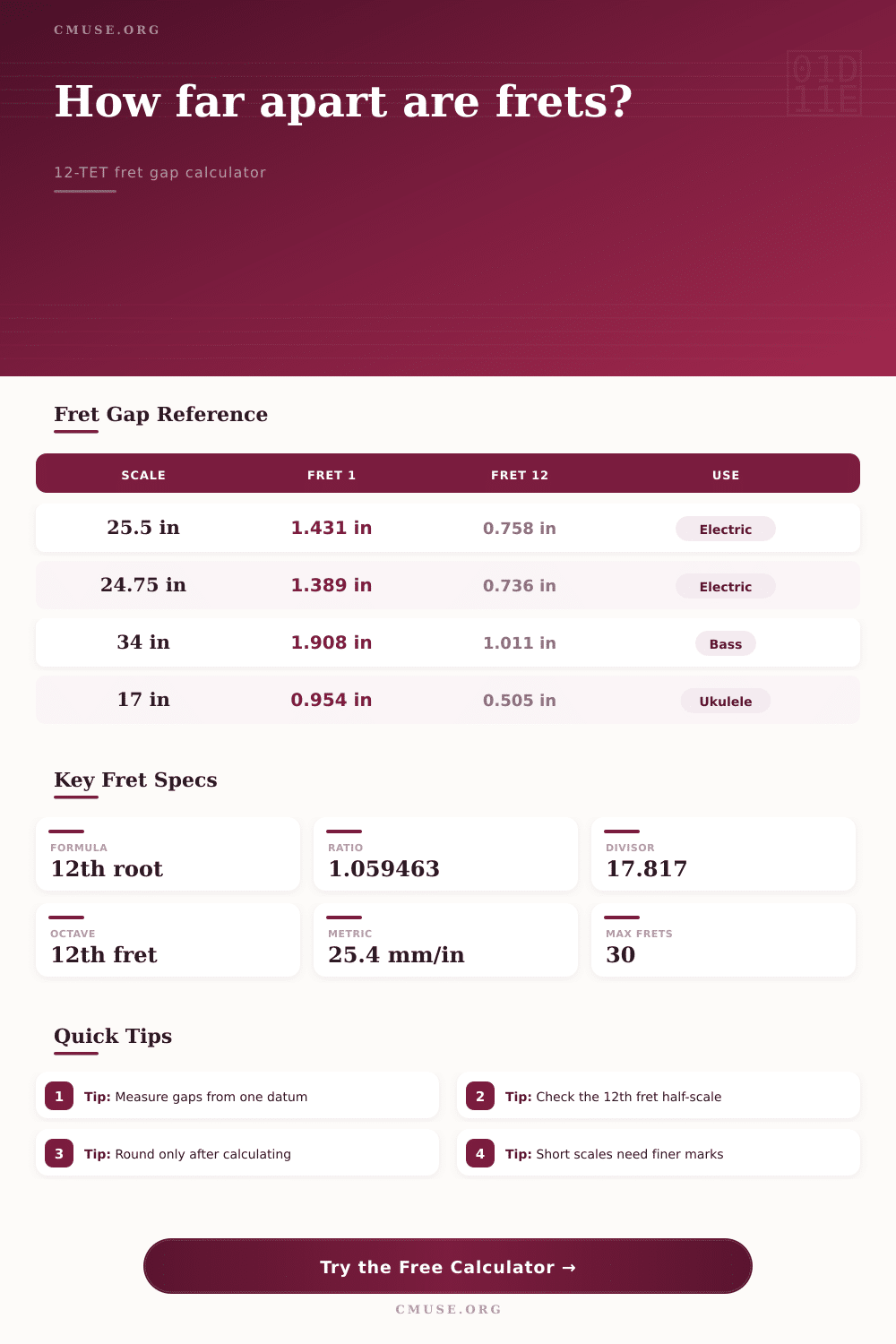
| Fender-style electric | 25.5 in / 647.7 mm | 1.431 in / 36.35 mm | 0.758 in / 19.25 mm | Long, clear spacing |
| Gibson-style electric | 24.75 in / 628.7 mm | 1.389 in / 35.28 mm | 0.736 in / 18.68 mm | Slightly tighter |
| Classical guitar | 650 mm / 25.591 in | 36.48 mm / 1.436 in | 19.32 mm / 0.761 in | Wide nylon layout |
| Long-scale bass | 34 in / 863.6 mm | 1.908 in / 48.47 mm | 1.011 in / 25.68 mm | Very open spacing |
| Mandolin | 13.875 in / 352.4 mm | 0.779 in / 19.78 mm | 0.413 in / 10.47 mm | Compact and precise |
💡 Fret Layout Tips
Measuring frets will make sense of how far apart they feel from each other. As you ascend the neck, the notes do indeed become different but the actual space between them get smaller than you might think. This goes beyond simple linear thought. Then there’s the math of twelve-tone equal temperament that kicks in.
The notes aren’t always spaced the same distance apart; instead, there is a consistent ratio between each semitone. That’s the math the calculator on this page perform for you, saving you having to struggle with exponents in your head while it translates your scale length to precise measurements. Before making permanent mark, it’s about knowing precisely where to place it.
The Math of Guitar Frets
To understand how this works it’s helpful to know that there’s one number at the heart of the system. And that number is called the twelfth root of two. It is approximately 1.05946. From here, you divides the remaining string length by that number for every fret position.
So the first fret is a big jump from the nut but then the twenty-second is barely a leap away from the twenty third. Until a player reaches the higher registers of the guitar this compression goes unnoticed but when you do reach those notes most players has no idea what has happened. Their fingers feel tight. It’s the moment in which people go awry.
They believe that frets mark a ruler but in fact frets represent a logarithmic curve. Understanding this curve makes instrument playable, rather than feeling like you’re trying to climb a wall. The biggest key to this is scale length.
On a typical Fender-type electric guitar, it’s twenty-five and a half inches. For Gibsons, that’s typically a quarter-inch shorter at twenty-four and three-quarters. That tiny change shifts every individual fret position along the board. If you’re designing something other than a guitar (such as a baritone or short-scale bass) you can input your own figure, but the calculator also features a couple of presets for those two scales.
Why does it matter? A longer scale require greater tension to produce the same note. This means it will feel different and bend differently too. The calculator takes this into consideration and adjusts all the position mapping whenever you change this single setting.
Projects often get derailed due to precision issues. If you measure every fret from previous one, your errors will add up. By the time you’re at the twelfth fret, you may be off by a millimeter. This is enough to cause an instrument to sound out of tune higher on the neck.
The calculator prevents this because it always calculates the position from the datum of the nut. So you know the actual distance from zero and it guarantees that every fret will fall exactly where the mathematics tell you it should. It’s a little thing, but it ensures intonation.
Take a look in the tool at the tolerance setting. These allow you to know just how much wiggle room you really have given your particular saw kerf. The reason why Scale Length matters in terms of play-ability is shown by comparing one instrument to another.
Consider a basic tenor ukulele (17″ scale) next to a full-sized four string bass (34″). The first fret gap on the bass is nearly two inches wide. It is less than an inch on the uke. So you can see that the frets crowd up quickly on the shorter scale.
That’s why bass players with smaller hands complain, since instruments usually have a longer scale. Ukulele players can easily make chords right along the top. The ratio is the same but the physical layout is very different based off the initial length. The comparator grid on the calculator illustrates this well.
The twelfth fret is the great checkpoint. A well-constructed guitar has its twelfth fret placed precisely halfway along the scale length. Simply measure from the nut to the saddle, then divide in half; that’s the location for the twelfth fret.
This is how it should of work and the tool will verify this midpoint as a result of your inputs. It’ll also show you the half-scale point as a sanity check. If your calculation doesn’t match the halfway mark, you have some sort of mistake in your inputs. It’s an automatic error check and it prevents you from chasing your tail later.
As soon as you get confident in the math everything else just kind of comes together for the rest of the fretboard. You quit guessing and begin to measure. Where each fret is located stops being a mystery and becomes a map to follow.