Fret Distance From Nut Calculator
Calculate cumulative fret positions from the nut, fret-to-fret spacing, remaining vibrating string length, and table layouts with the equal-tempered twelfth-root formula.
🎯 Instrument Scale Presets
⚙ Scale And Fret Inputs
Calculation Breakdown
🎸 Instrument Scale Comparison Grid
📏 Primary Fret Layout Table
| Fret | From Nut | Previous Spacing | Remaining String | Adjusted Mark |
|---|
🔢 Octave And Marker Check Table
| Checkpoint | Fret | Expected Position | Scale Fraction | Use |
|---|
🎼 Common Scale Fret Table
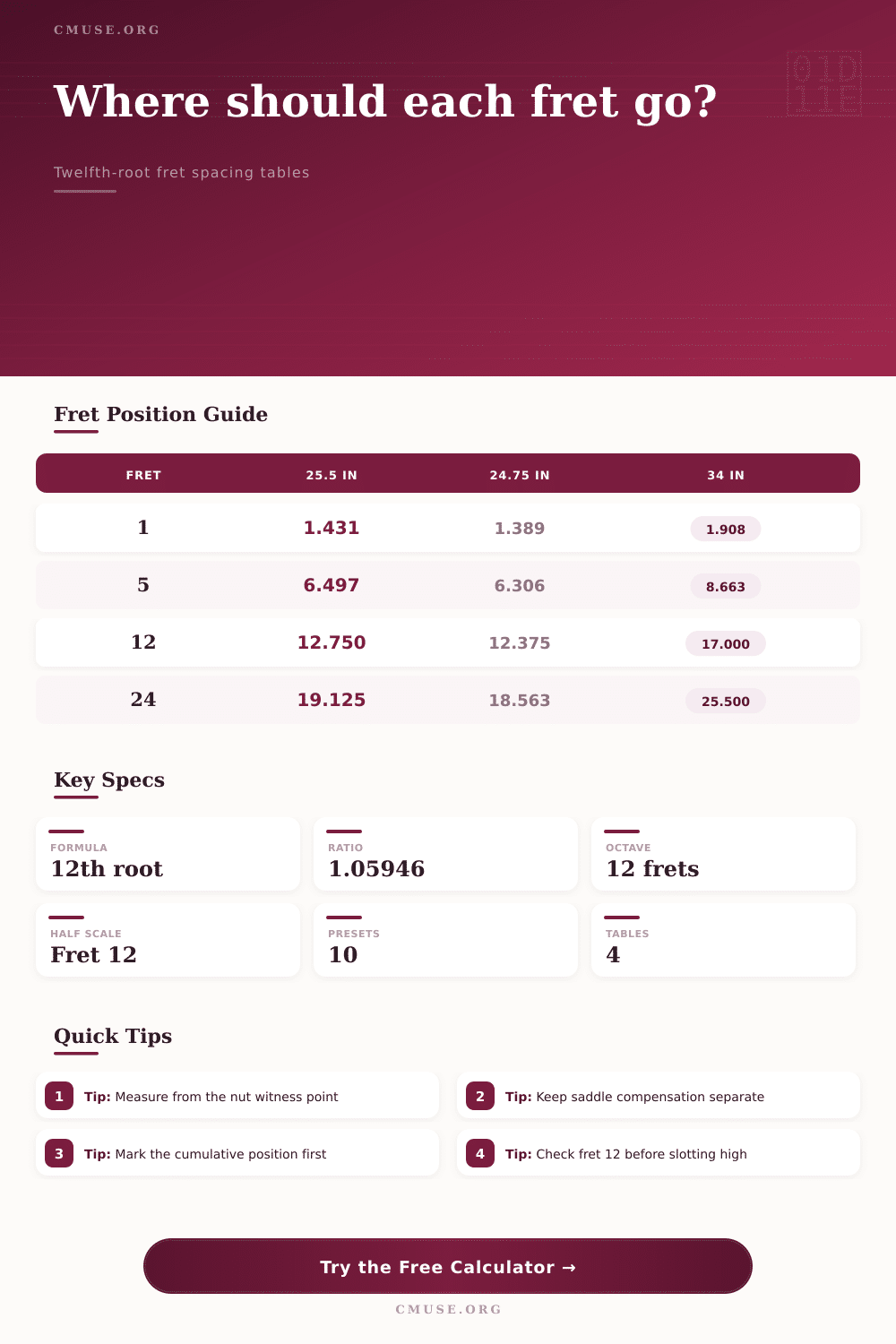
| Fret | 25.5 in Guitar | 24.75 in Guitar | 34 in Bass | 17 in Ukulele |
|---|
🔧 Slotting And Setup Reference Table
| Reference | Value | Metric | Why It Matters |
|---|
Fear: “I slipped with my tape measure by a millimeter.” (That’s a common fear among luthiers). No longer do you have a guitar you’re building; now you’ve got something you need to make work again.
Math does not rely on guesswork, and getting fret spacing correct require math. The calculator use the twelfth-root formula on your scale length. It simply mean that it takes your remaining string length and divides it into a consistent ratio. That ratio makes the pitch equal-tempered. Logarithmic spacing is difficult for human intuition to understand. That is why you need the math.
Why You Need Math for Guitar Frets
Now we have the twelfth fret as our anchor point. From this point on, it’s always half way between the nut and the saddle. This apply to long or short scales, and bass guitar or ukuleles. If your twelfth fret position is accurate then all of the others are correct. If not, none of them are correct. There is a complete table of these positions in the tool.
First make sure the half-way point is correct. If so, go ahead and put it there. If it isn’t, stop before you cut slots. The builders typically measure from incorrect side of the nut. Locate the witness point. The vibrating part of string begins here and not the outer surface of the nut itself. If the nut has a rounded crown, this point is further back than it looks. Enter in the nut offset into the calculator. It’s a minor correction. Frequently only a fraction of a millimeter. Tolerate the offset and your tuning will be off all along neck. Always measure to the assumed beginning of string.
Another point of confusion is saddle compensation. Look at input and you’ll find a field labeled compensation. That doesn’t alter the placement of the frets. The theoretical scale length determine where the frets sit. Saddle position is what is affected by compensation. It adjust for string thickness and tension. Without it the open strings fretted high play sharp. Separating these ideas is important. If you incorporate compensation into your fret placement then the open strings will be out of tune. Your frets has to be pure. Adjustments come with the saddle.
As you move closer to the body of the instrument, the frets gets closer together. The space from the first to the second fret is ample. At the beginning there’s some leeway. As you move toward the twentieth fret, the frets are very close together. One slip of just a fraction of a millimeter here is a disaster. This is where reference tables comes into play. These will show you cumulative distances so you can verify them. Then you cut away knowing you have checked your measurement against a standard beforehand. Better to check the math now than try and repair it later.
Ultimately, precision is not about being rigid; it is about being consistent. Whether you are marking by hand or using a jig, you need to be accurate. The 12th-root ratio is what’s used. Math doesn’t care if you like it; you can’t alter that equation. That said, when you accept it, the task is now mechanical. Mark, measure, check, cut. Nail that twelfth fret. Respect the nut witness point. Keep saddle compensation separate from the fret positions. Afterward, then, the music can become your focus rather than the figures.
You should of checked math first. Naturaly, it’s moddern stuff. It would of been easier if you didnt mess up the scale length. I actually think some people preferr a more relaxd approach.