Drop Tuning Pitch Shift Calculator
Compare a physical guitar or bass tuning with a target drop tuning, then calculate per-string semitone shifts, cents, frequency ratios, and the closest global pitch-shifter setting.
🎯 Drop Tuning Presets
⚙ Tuning And Pitch Shift Inputs
Calculation Breakdown
📌 Current Tuning Cards
🎸 Guitar And Bass Tuning Grid
📊 Per-String Pitch Shift Table
| String | Source Note | Target Note | Shift | Source Hz | Target Hz | Ratio | Global Error |
|---|
🎚 Pitch Shifter Reference Table
| Shift | Cents | Frequency Ratio | Octave Fraction | Pedal Reading |
|---|
📐 Drop Tuning Preset Table
| Target | String Count | Low Note | Full Tuning Low To High | Typical Source |
|---|
🔊 Frequency And String Tension Table
| Example Shift | Frequency Ratio | Physical Tension Estimate | Use Case | Tracking Note |
|---|
Many pieces of music are drop tuned, including moddern rock and metal. To achieve this you tune your lowest string down two semitones, leaving all the others at standard. The result is that your guitar sounds deep but physically it presents some problems for the instrument itself. The slackened strings tends to vibrate on the frets producing an unpleasant buzz, as well as being hard to tune.
If you want to try this, then use a pitch shift calculator first so you’re prepared when you turn tuning pegs. What’s wrong with that? Drop tunings aren’t straightforward global changes. A drop D is not achieved if you simply push a button on your pitch shifter pedal and turn all strings down two semitones. You now have D standard tuning. Every note has changed and the overall tonal character are entirely different.
Why Drop Tuning Can Be Difficult
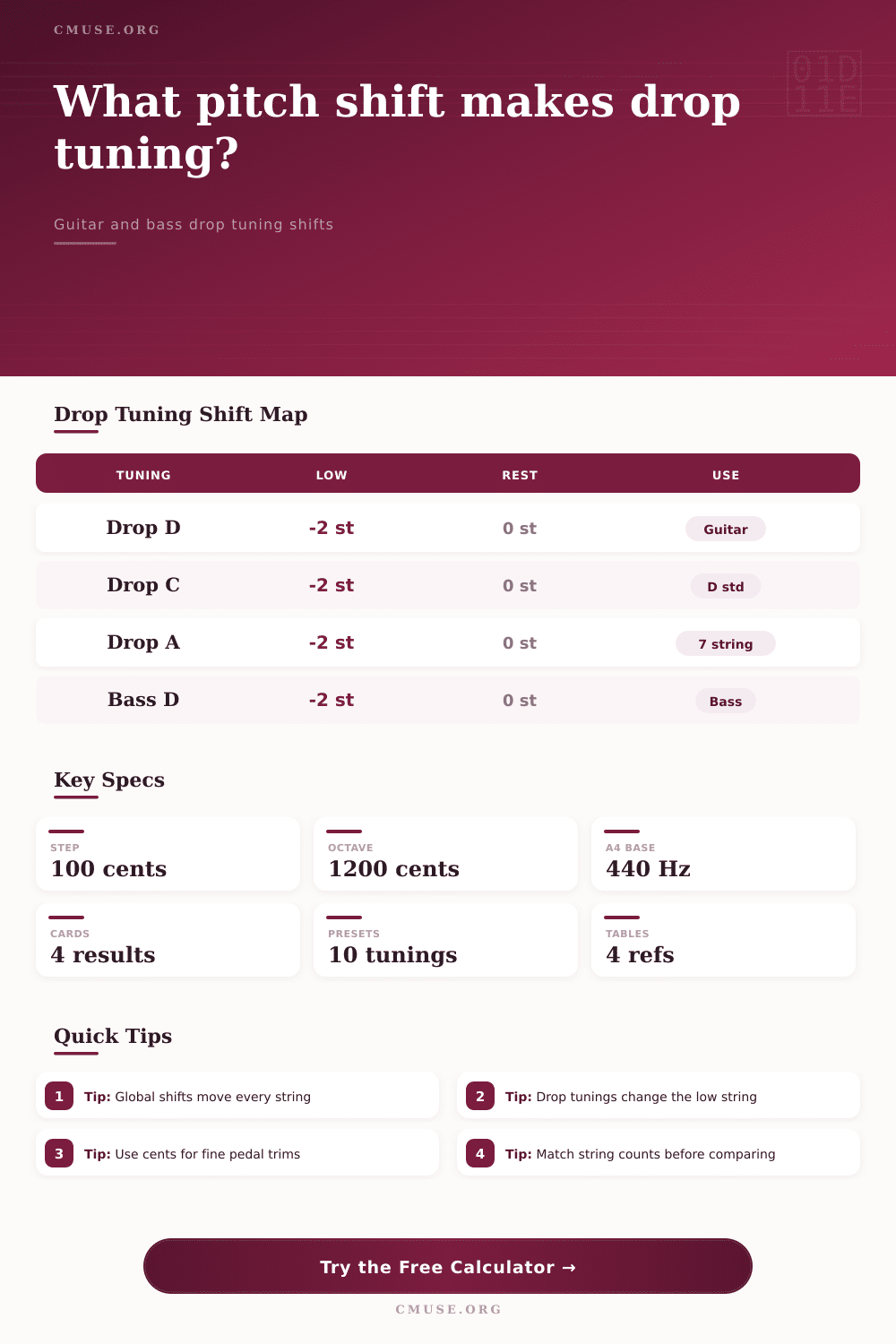
Run it through the calculator, and you see what I mean. It breaks down the change for each individual string. For drop D, you can see there’s a two-semitone shift on the low E string only, no shift on the rest. That’s why the sound created doesn’t match drop tuning at all. This highlights how a global shifter will fail to produce desired result.
This tool also offers some other interesting details on tension and frequency ratio. As you lower strings they become more slack with a corresponding change in their feel against your finger tips. If guitar action is based off regular tuning a loose D low string will have far less tension then a taut E string. This creates potential problems for fret buzz and intonation. However, the calculator give an indication of the frequency ratio.
For example, with drop D it is approximately 0.89, which indicates that the string are now vibrating at roughly 89% of its normal pitch. That’s quite a large difference, enough to be felt as a significant reduction in string tension. This is even truer when playing a bass or seven-string guitar. Already the low A or B string are under enormous tension. Lowering it even more require careful attention to scale length and string gauge. For bassists who may well drop to drop C from D standard the tool takes into account their instrument too, resetting the reference points accordingly.
The physics remain the same, but physical stress on the neck increases, as does the chance of broken strings. Presets let you run through some choices without having to commit to retuning. Wanna see what a five-string bass would sound like on drop A? Or want to hear difference between drop B and drop C? It’s kind of like a sandbox for your ears; try it out and then hear the math before you hear the guitar.
It could come into play live when you don’t have the time to retune between numbers. If the calculator shows that a global shift of minus one octave gets you close enough for a specific riff, you might opt for that quick fix instead. Drop tuning also changes the way you play the instrument. The strings is looser and the sound is heavier because it’s lower.
Measuring in semitones and cents allows for more precision. But the tension ratio help you understand it intuitively. How will the strings behave? How will the neck respond? You can predict this. This means that adjusting becomes more of a plan than a process of trial-and-error, you know exactly what you’re asking your instrument to do.
It’s not just about playing lower. It’s about playing smarter and it would of been easier if you used the tool.