Third Tuning Beat Rate Calculator
Calculate major and minor third beat rates from note, octave, temperament, partial pair, stretch, and cents trim so tuning checks can be compared by ear.
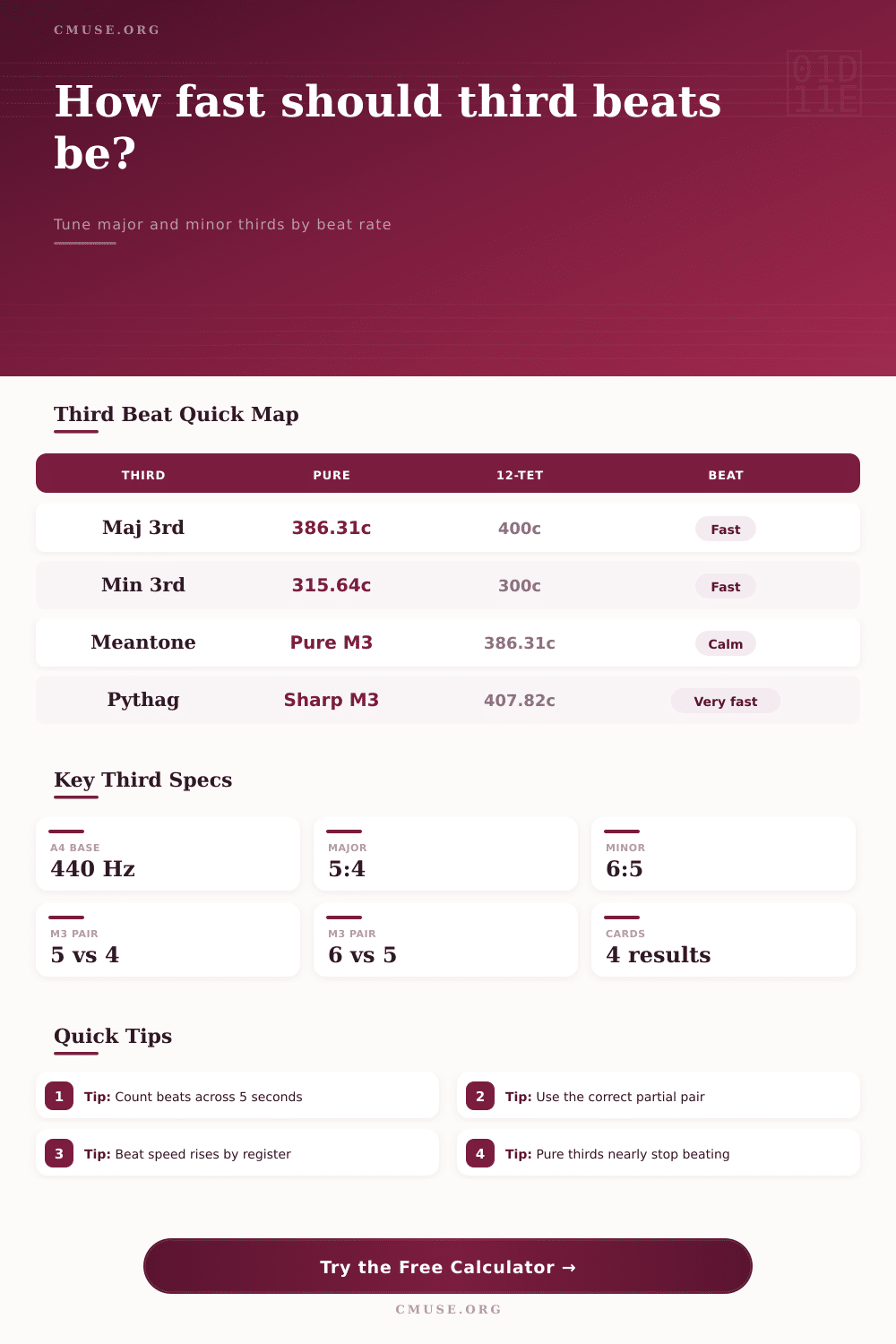
How this works: Major thirds compare the lower note 5th partial with the upper note 4th partial. Minor thirds compare the lower note 6th partial with the upper note 5th partial. The beat rate is the absolute difference between those two partial frequencies.
Calculation Breakdown
| Temperament | Major Third Size | Offset From Pure 5:4 | Typical Beat Character |
|---|---|---|---|
| 5-limit just intonation | 386.314 cents | 0.000 cents | Coincident 5:4 partials nearly stop |
| Quarter-comma meantone | 386.314 cents | 0.000 cents | Sweet major thirds, intentionally tempered fifths |
| 12-TET equal temperament | 400.000 cents | +13.686 cents | Wide and clearly beating in mid register |
| Pythagorean tuning | 407.820 cents | +21.506 cents | Very wide, bright, and fast beating |
| Temperament | Minor Third Size | Offset From Pure 6:5 | Typical Beat Character |
|---|---|---|---|
| 5-limit just intonation | 315.641 cents | 0.000 cents | Coincident 6:5 partials nearly stop |
| Quarter-comma meantone | 310.265 cents | -5.377 cents | Slightly narrow, slower than equal temperament |
| 12-TET equal temperament | 300.000 cents | -15.641 cents | Narrow and clearly beating in mid register |
| Pythagorean tuning | 294.135 cents | -21.506 cents | Very narrow, tense, and fast beating |
| Third Check | Pure Target | 12-TET Target | Approx 12-TET Beat Rate |
|---|---|---|---|
| F3 to A3 major third | 218.26 Hz | 220.00 Hz | About 6.50 beats per second |
| C4 to E4 major third | 327.03 Hz | 329.63 Hz | About 9.72 beats per second |
| A3 to C4 minor third | 264.00 Hz | 261.63 Hz | About 11.86 beats per second |
| D4 to F4 minor third | 352.39 Hz | 349.23 Hz | About 15.81 beats per second |
| C5 to E5 major third | 654.06 Hz | 659.26 Hz | About 19.43 beats per second |
| Third Type | Pure Ratio | Coincident Partials | Beat Formula |
|---|---|---|---|
| Major third | 5:4 | Lower 5th against upper 4th | Absolute value of 4 x upper Hz minus 5 x lower Hz |
| Minor third | 6:5 | Lower 6th against upper 5th | Absolute value of 5 x upper Hz minus 6 x lower Hz |
| Low register thirds | Same ratios | Same partial numbers | Slower because the base frequencies are lower |
| High register thirds | Same ratios | Same partial numbers | Faster because the base frequencies are higher |
When we talk about tuning a keyboard instrument it means controlling these interference patterns created by frequencies. When you listen to a third, you’re not simply hearing two notes. What you’re hearing is interaction of their overtones. In the case of the major third, this is the fourth partial of the upper note matching the fifth partial of the lower note.
If they match perfectly then there’s no problem and the sound is smooth. If they miss each other then you hear a beat. Using the calculator above, the maths is done for you. It converts abstract cents into pulse rates that you can actualy hear. That way you know what to expect as soon as you turn a pin.
How to Tune Keyboard Instruments
Silence can also be the name of the game when considering beat rates. When using just intonation we find that the ratio of five to four defines a major third. At this exact interval, the coincident partials matches exactly. The beat rate reduces almost to zero. This is referred to as a pure third by musicians. It’s stable and sounds calm.
Unfortunately in moddern music, pure thirds are few and far between as they don’t stack harmonically across different keys. If you tune each third to be pure then the fifths connecting the thirds becomes unreliable. The circle of fifths doesn’t close. What you’re left with is a bunch of intervals called wolf intervals; these are harsh sounding in some keys but pleasant in others.
The solution to this is equal temperament, which compromises all intervals equally. It spreads error evenly. In equal temperament, the major third is forty cents wide. It is thirteen cents wider than a pure interval. That tiny difference result in a beat.
How quickly the beat occurs depends on the pitch. Low notes beats slowly. High notes beat fast. This is why tuning a piano sounds different in the treble compared to the bass. The same number of cents error will result in a fast flutter in the high register and a slow swell in the low register. You can’t use the same ear for each without adjusting your expectations.
This is where the tool comes into play allowing you to specify what octave and reference pitch to use. It also lets you set a stretch value. A real instrument isn’t linear. Strings are stiff, air columns has an end correction. An octave tuned in theory should of be a little wider than a two-to-one relationship to be in tune to your ears.
That stretch affects how the partials interact during a third check. What happens if you don’t consider it? Then you get thirds sounding sharp in the treble and flat in the bass. And yes, this happens even though cents say the thirds are correct. The calculator lets you enter a stretch amount so that the beat rate is calculated based off the reality of the instrument.
A similar principle apply for minor thirds but with a different ratio. The ratio for the minor third is six to five. In terms of just intonation, the minor third is narrower then in equal temperament. The higher pitch is below its pure aim. This beat has its own unique character. Often, it is referred to as narrow and tense.
This tension is used by pianists to test the temperament’s integrity. If the minor third beats too quickly in equal temperament, then the thirds are too narrow. If the minor third beats too slowly in equal temperament, the thirds is too wide. Here is the exercise in balancing one interval against another until middle ground is found.
Alternatively, we have the other option of Meantone temperament. Here the fifths takes second place to major thirds which remain pure. In terms of beat rate, this is almost nothing. However, minor thirds become very narrow in quarter-comma meantone. What you get is a noticeable beat characteristic that indicates your meantone temperament are functioning correctly.
Why does all of this matter? Many of these older keyboards were not manufactured with equal temperament in mind. If you know what the beat rate should be for the temperament you wish to play in, you won’t over-compensate. Over-compensating can lead to thinking a third is sharp when it is actualy pure. The reverse can equally apply.
These differences are neatly laid out on the page under the reference table. Here you see the way the temperament alters the offset of the cents from pure. While tables may be static, your ears are dynamic. The beat count window feature bridges this gap. By setting a time window (for example five seconds), you can set the time and begin counting the beats in real time. Then you can compare with the predicted number. It makes the abstract become a tactile task.
You no longer have to guess if an interval is in tune; instead, you test an idea using measured results. Tuning is a conversation between your ear and physics of sound. That’s tuning. The calculator adds vocabulary. It informs you about the rate at which the beats occur. That has everything to do with temperament, the octave, and the pitch. It takes the guesswork out of the math of the partials.
But then again, it never replaces the ear. It hones it. You still have to listen for character of the beat, and determine whether or not the resulting chord sounds balanced in the context of the music. The math identifies the target. The music provides the direction.
When you learn thirds, you’re learning how to hear what’s between the notes. You’re hearing that pulsating interference called harmony. Once you understand that pulse, you no longer chase frequency; you shape the sound itself.