Fifth Tuning Beat Rate Calculator
Estimate the beat rate of a tuned fifth by comparing the lower note's 3rd partial with the upper note's 2nd partial, including temperament width, stretch, and inharmonicity trim.
🎯 Fifth tuning presets
⚙ Beat-rate inputs
Calculation Breakdown
📊 Tuning comparison grid
Lower fundamental
Starting note before the fifth is placed above it.
Pure upper target
The exact 3:2 upper frequency for the same lower note.
Listening band
The partial region where the fifth beat is heard.
Beat feel
Practical counting category for the selected fifth.
🎵 Fifth temperament table
| Temperament target | Fifth width | Difference from pure 3:2 | Beat character |
|---|---|---|---|
| Pure 3:2 or Pythagorean fifth | 701.955 cents | 0.000 cents | Partials align before inharmonicity or stretch |
| 12-TET equal temperament | 700.000 cents | −1.955 cents | Slow narrow fifth beat, faster in high registers |
| Sixth-comma meantone model | 698.371 cents | −3.584 cents | Noticeably narrower than equal temperament |
| Quarter-comma meantone | 696.578 cents | −5.377 cents | Strongly tempered fifth supporting sweeter thirds |
| Mild well temperament model | 698.500 cents | −3.455 cents | Useful for a deliberately colored fifth |
| Open well fifth model | 701.000 cents | −0.955 cents | Nearly pure, with a very slow residual beat |
🎚 Example fifth beat-rate table
| Fifth check | Lower frequency | 12-TET upper frequency | Approx 3:2 beat |
|---|---|---|---|
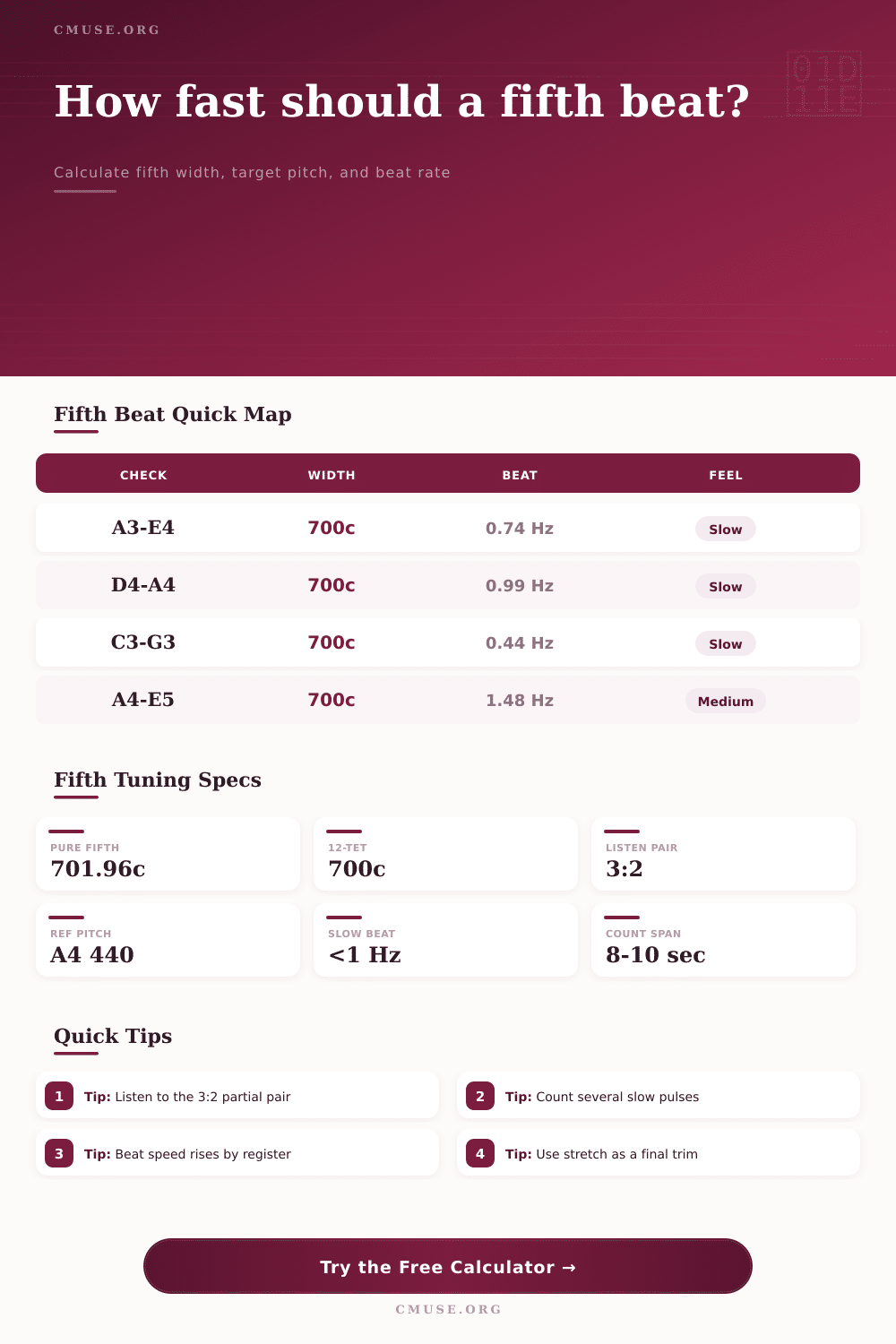
| A3 to E4 | 220.00 Hz | 329.63 Hz | About 0.735 Hz, or 1.36 seconds per beat |
| D4 to A4 | 293.66 Hz | 440.00 Hz | About 0.981 Hz, or 1.02 seconds per beat |
| C3 to G3 | 130.81 Hz | 196.00 Hz | About 0.437 Hz, or 2.29 seconds per beat |
| F3 to C4 | 174.61 Hz | 261.63 Hz | About 0.583 Hz, or 1.71 seconds per beat |
| A4 to E5 | 440.00 Hz | 659.26 Hz | About 1.469 Hz, or 0.68 seconds per beat |
🧮 Fifth beat formula table
| Step | Formula | What it means | Calculator field |
|---|---|---|---|
| Lower pitch | A4 x 2^((midi - 69) / 12) | Converts the lower note to frequency | Reference pitch, note, octave |
| Fifth target | lower Hz x 2^(width cents / 1200) | Places the upper note at the selected fifth width | Temperament, custom width, trim |
| Partial frequency | fundamental x partial x sqrt(1 + B x partial^2) | Models ideal or inharmonic partials | Partial numbers, B values |
| Beat rate | absolute lower partial minus upper partial | Audible pulses per second between the two partials | Result card and breakdown |
⏱ Beat-feel reference table
| Beat rate | Beat period | Counting method | Practical reading |
|---|---|---|---|
| 0 to 0.25 Hz | 4 seconds or slower | Listen over a long held tone | Nearly pure or very low-register fifth |
| 0.25 to 1 Hz | 1 to 4 seconds | Count 3 to 8 pulses and divide by time | Normal slow fifth territory in the middle register |
| 1 to 2 Hz | 0.5 to 1 second | Count a short 5-second sample | Upper register fifth or a more tempered width |
| 2 to 4 Hz | 0.25 to 0.5 second | Compare against nearby checks | Fast fifth color or high treble partial band |
| 4 Hz and above | Under 0.25 second | Use relative roughness more than counting | Likely very high, very narrow, or wrong partial pair |
🔍 Partial-pair table for fifths
| Pair | Pure alignment | Use case | Watch for |
|---|---|---|---|
| 3 against 2 | Standard 3:2 fifth | Main piano and ensemble fifth check | Best default for this calculator |
| 6 against 4 | Same ratio one octave higher | Higher color check when fundamentals are unclear | Inharmonicity can exaggerate the beat |
| 9 against 6 | Third harmonic line again | Bright treble inspection | Small cent changes produce faster pulses |
| 1 against 1 | Not a fifth alignment | Frequency distance only | Do not use as a fifth beat reference |
People often say that tuning a piano is more of an art than science but actualy it’s very much about negotiating with physics. It is not simply about getting one note to sound in tune with another note. It is about dealing with the acoustic fact that when these strings are pulled taut, they does not want to be mathematical sine waves.
The key element here is the fifth. This link the octave together and forms the harmonic lattice. Get the fifths incorrect and the entire instrument becomes unsteady.
Why the Fifth Interval Matters
The calculator above shows exactly how fast those beats should pulse for each interval so you don’t have to rely on a vague memory of what you think is correct. It makes the rather abstract idea of temperament into something real and measurable by frequency.
Understanding the fifth means understanding the beat. Listen: if you understand the fifth then you understand the beat. A fifth in just intonation is what we call a pure interval. However, when tuned on an instrument using equal temperament, the interval becomes slightly narrower than a pure just fifth. This results in a slight beat or slow pulse created by the second partial of the top note aligning with the third partial of the bottom note. That’s what you’re hearing. The volume undulates gently.
Most people think they are listening to the fundamental tones, but the alignment actualy happens in the higher partials. If all you listen to is the fundamentals, you’ll never ever hear the beat of the fifth. You have to tune your ear up into the overtone series. When tuning, the tool assumes you are checking the standard 3:2 partial pair. This is the industry standard because it gives the cleanest signal with the least amount of interference from other harmonics.
As you travel upwards on the keyboard, the speed of that beat change quite a lot. At the bottom end in the bass, the pulses feel spaced out and slow. Maybe once a second; maybe twice, maybe three times. By contrast, up in the treble region, the pulses has become much quicker. Although the cent width of the intervals is constant (in this example), the absolute frequency separation of the partials becomes increasingly greater with increasing pitch. For instance, a 700-cent fifth will pulse much more rapidly at A4-E5 different than C3-G3.
The calculator takes care of all of this automatically. There’s no need to try to mentally adjust how fast you should of be counting. All you have to know is that the speed of the pulsing changes, and why that is. That avoids the trap of forcing the sounds of the treble to mimic those in the bass. It simply doesn’t happen. What happens instead is the ear adjusts to the register, but the math remain strictly exact.
The other variable that gives amateur tuner trouble is inharmonicity. Strings in a piano are stiff. They create overtones which is sharper than those predicted by the theoretical harmonic series. This means that even when you create a pure fifth on a piano, it won’t really sound pure because the string’s own stiffness causes its partials to be naturaly out of alignment. You need to stretch the tuning to compensate. The inharmonicity inputs let you model this reality. Without them, you’re tuning for some idealized instrument that doesn’t exist. Set a realistic B value for strings and what happens? Your target frequencies matches the physical behavior of the instrument you’re holding. It bridges the gap between theoretical cents and practical cents.
You may not know that today’s piano does not rely on temperament as much as you would imagine, but it still has its own character. Equal temperament divides up the error equally. If we go back further, there are mean tone temperaments where thirds becomes sweeter. This results in narrower fifths and a quicker beat. You can see from the tool just how close or far apart they was tuned and how their characteristic sound differed.
Today, 12-tone equal temperament is used by most as the default system; the fifth is set precisely to 700 cents. This is 1.955 cents narrow of being ‘pure’. That very small difference produce the beat. It is a little thing but an important one. Without it, the piano would be nothing more than a terribel instrument to play in every key. However, that is not quite true because that small amount of dissonance is also what allows the piano to play in all keys without sounding terrible in any.
Choose a pitch to tune from (this is called a reference pitch) and work outward. As you do so, use the calculator to check the rate at which you are beating. Trust what the math tells you if it contradicts what your ears report: sometimes the acoustics of the room and other sympathetic vibrations can trick our ears. If your ears say a fifth is wide but the math says it should be slow, trust the math. Not so: the numbers don’t lie. They exactly indicate how the partials line up.
If you beat at 0.7 Hz in the middle register, for example, you’ll begin to hear the pulse and the space between them equally and develop a feel for time that works in your favor. That’s the key to quickly and accurately tuning. It’s not about chasing after a dead silence; it’s about finding a consistent, distinct rhythm. The calculator will give you tempo and your ears will add the music.