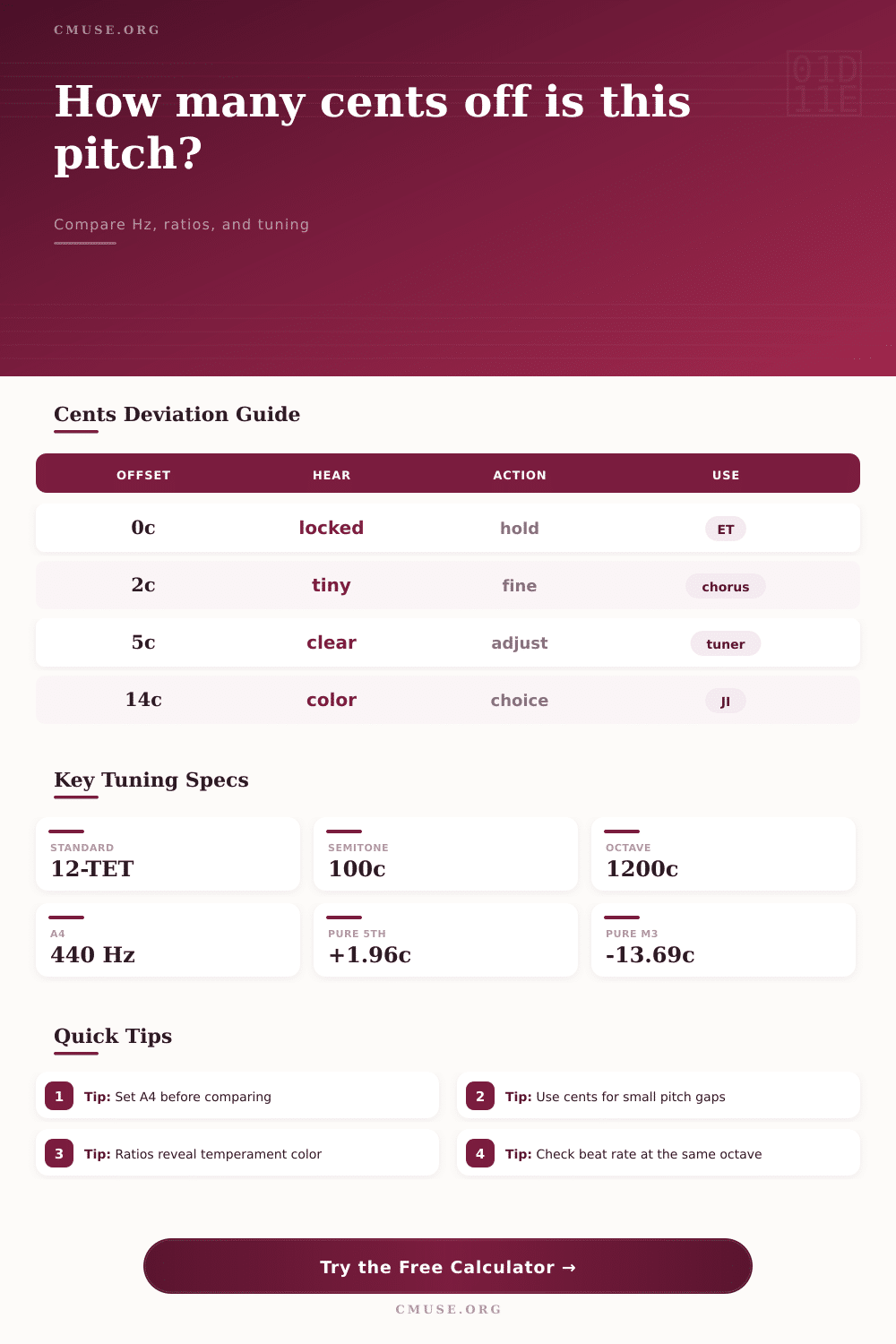
Cents Off From Equal Temperament Calculator
Compare a measured pitch, just ratio, Pythagorean interval, meantone flavor, or custom temperament against the 12-tone equal-tempered frequency for the same note.
🎯 Tuning Deviation Presets
⚙ Pitch And Temperament Inputs
Calculation Breakdown
📌 Current Deviation Cards
Positive is sharp and negative is flat against equal temperament.
The actual pitch divided by the equal-tempered target.
The direct frequency gap between both pitches.
Action is based on the selected in-tune threshold.
🎼 Temperament Comparison Grid
📊 Cents And Frequency Tables
| Deviation | Frequency Ratio | At A4 | Typical Reading |
|---|---|---|---|
| +1 cent | 1.000578 | +0.25 Hz | Tiny fine-tuning change |
| +5 cents | 1.002892 | +1.27 Hz | Clearly visible on tuner |
| +10 cents | 1.005793 | +2.55 Hz | Noticeably sharp in exposed unison |
| +25 cents | 1.014545 | +6.40 Hz | Quarter-semitone color |
| +100 cents | 1.059463 | +26.16 Hz | One equal-tempered semitone |
| Equal-Tempered Note | Hz at A4 440 | +5 c Hz | -5 c Hz |
|---|
| Temperament Interval | Ratio or Size | Cents From ET | Where It Matters |
|---|---|---|---|
| Pure perfect fifth | 3:2 | +1.955 c | Strings, voices, drones |
| Pure major third | 5:4 | -13.686 c | Just major triads |
| Pure minor third | 6:5 | +15.641 c | Just minor triads |
| Harmonic seventh | 7:4 | -31.174 c | Barbershop, brass color |
| Pythagorean major third | 81:64 | +7.820 c | Fifth-built tuning |
| Quarter-comma fifth | 696.578 c | -3.422 c | Meantone keyboards |
| Tuner Reading | Meaning | Frequency Move | Practical Choice |
|---|---|---|---|
| Within 2 c | Very close | Small trim | Usually leave for ensemble |
| 3 to 5 c | Audible in unison | Fine adjust | Tune if exposed or sustained |
| 6 to 12 c | Obvious color | Correct or choose | Decide if temperament is intended |
| Over 15 c | Strongly altered | Large correction | Useful for pure thirds and sevenths |
💡 Tuning Tips
In a recording session you might hear that a vocal track doesn’t sound quite right in combination with a piano. It’s not a timing problem and it’s not a poor performance. By all accounts on a digital tuner it is a technicaly correct note, but it produces a slight, grating unpleasantness as it clashes with the instrument. That is the ‘friction point’ between equal temperament and the physical nature of sound waves.
Using the cents off from equal temperament calculator allow you to pinpoint exactly how many cents away from true equality the pitch are moving. It turns what had been a vague sense of ‘not right’ into something specific: a number.
What Are Cents in Music Tuning
The octave has been divided equally into twelve perfectly equal half steps called equal temperament. This is a great compromise, meaning we can now perform music in any key without needing to retune our instrument. What we lose as a result is purity.
If you sustain a perfect fifth, which comes from the simple frequency relationship of harmonic series (3:2), then you’ll notice that it’s ever so slightly sharper than an equal-tempered fifth on your piano. It’s only about two cents apart, but that difference are enough to cause beats if the note is held.
Run calculations through the calculator above and it will compare your selected temperament, or frequency that you have measured against the strict grid of 12-TET to expose these underlying differences. Understanding what the figures represent is more important than just seeing them.
A cent equals one-hundredth of a semitone. In isolation, you would struggle to hear if there was a variation of two cents. If, however, you had two instrument playing the same note together then even a variation of five cents sound distinctly noticeable as a beat or waver.
The reason for including a threshold is because you can set it yourself to decide how much ‘out-of-tune’ is tolerable given your situation. For example, the human voice in a choir may tolerate a ten-cent variation without losing its sense of warmth in harmony. In contrast, a single violinist performing a solo may need to be precise within a variation of only two cents.
You can play around with different ideas of tuning, without having to get out a physics degree. For example, you can choose a pure major third (and you’ll instantly discover that it’s around fourteen cents flat from the equivalent on the piano). That accounts for how just intonation has been described as sweet in static chords, yet painful if you modulate into another key. The calculator demonstrates this in real time.
If you’re exploring some of the historical tunings, like quarter-comma meantone, then the option to insert your own ratio allow you to experiment. Here, the tool becomes a theoretical sandbox.
Before starting to perform a particular tuning system, check first if it suits your composition. Every note is right when played in context. Every note has its place and is determined by the music’s time period, the acoustic environment, and the instruments available. Performing baroque music on a harpsichord could well mean setting a lower pitch standard that alters the whole reference grid.
You can set the A4 reference to anywhere between 415 Hz and 442 Hz in the calculator. That alters the target frequencies for all other notes so your cent values are based off the actualy standard in use. This is easy to miss. However, comparing a piece performed using 415 Hz against a 440 Hz grid is going to give huge errors that bear no relation to anyone’s intonation ability.
Tuning isn’t so much a matter of achieving perfect notes but more one of relationships between those notes. It’s about ensuring that the important notes sounds good with as little unwanted beat as possible, while allowing for more freedom in others.
Whether you’re studying an elaborate orchestral texture, tuning your guitar by ear or intoning a drone string, a knowledge of how far out each note deviates in cents provides you with a common language through which you can discuss pitch. It takes away the guesswork from what was once something we intuitively knew. Now you know what you’re hearing, you can measure that roughness in numbers and then determine whether it’s a colour to embrace or an error to correct. And this is where having gone through all of this really should of pays off.