Frequency Of Note At Octave Calculator
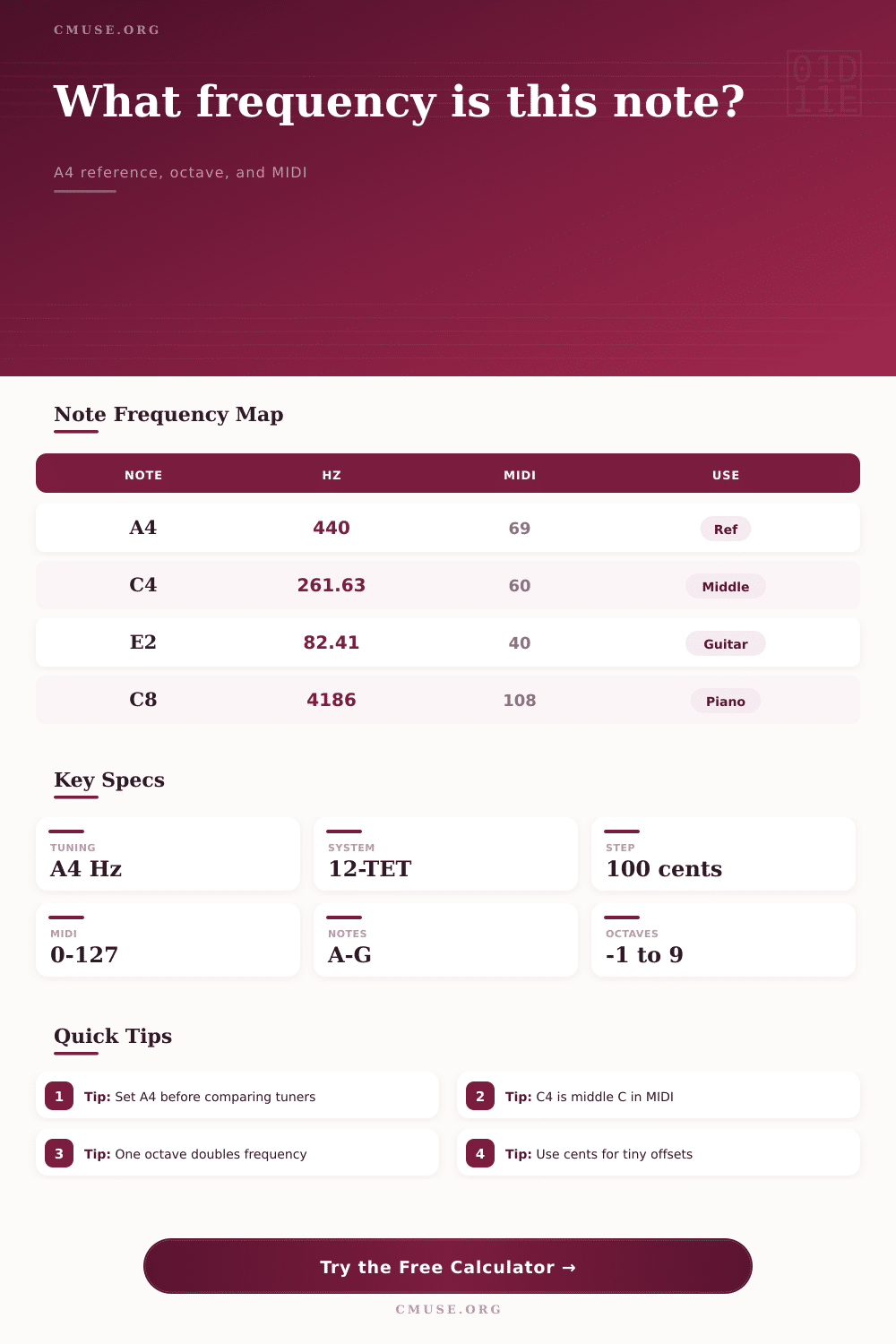
Choose a written note, octave, A4 tuning reference, and cents offset to calculate frequency, MIDI number, pitch class, wavelength, and equal-tempered octave relationships.
🎯 Note Frequency Presets
⚙ Note, Octave, And Tuning Inputs
Calculation Breakdown
📌 Current Pitch Cards
Use presets or inputs to calculate a different octave and tuning reference.
Equal-tempered frequency relative to the chosen A4 pitch.
MIDI note numbers place C4 at 60 and A4 at 69.
Pitch class repeats every octave while frequency doubles.
🎼 Tuning Comparison Grid
📊 Frequency Table For Selected Octave
| Note | Frequency | MIDI | Pitch Class | Distance From A4 |
|---|
📋 Same Note Across Octaves
| Octave | Note Name | Frequency | MIDI | Relationship |
|---|
🎛 MIDI And Octave Anchor Table
| Anchor | MIDI | 440 Hz Frequency | Role |
|---|---|---|---|
| C-1 | 0 | 8.18 Hz | Lowest standard MIDI note |
| C0 | 12 | 16.35 Hz | Sub-bass octave anchor |
| C1 | 24 | 32.70 Hz | Low piano/bass range |
| C2 | 36 | 65.41 Hz | Bass register anchor |
| C3 | 48 | 130.81 Hz | Lower midrange anchor |
| C4 | 60 | 261.63 Hz | Middle C in MIDI/SPN |
| A4 | 69 | 440.00 Hz | Reference pitch |
| C5 | 72 | 523.25 Hz | One octave above C4 |
| C8 | 108 | 4186.01 Hz | Top C on piano |
📘 A4 Reference Comparison Table
| A4 Reference | A4 Change Vs 440 | Typical Context | What Changes |
|---|---|---|---|
| 415.30 Hz | -100 cents | Baroque pitch near one semitone low | All notes scale downward equally. |
| 432.00 Hz | -31.77 cents | Alternative tuning reference | Every equal-tempered note is lower than 440 pitch. |
| 440.00 Hz | 0 cents | Common modern concert reference | A4 equals MIDI note 69 at 440 Hz. |
| 441.00 Hz | +3.93 cents | Small ensemble lift | Notes are slightly higher than 440 pitch. |
| 442.00 Hz | +7.85 cents | Bright orchestral reference | All notes rise by the same cents amount. |
| 466.16 Hz | +100 cents | One semitone above A440 | A4 frequency matches A#4/Bb4 at 440 pitch. |
If you have ever played in an ensemble where one instrument is just slightly out-of-tune with another, you’ll know how it can make the whole recording sound muddled. Maybe your piano plugin drifts slightly sharp and clashes with your synth set to 440 Hertz. It’s not something you could put your finger on, but as humans, we can feel there’s something wrong. The solution involves understanding some physics behind the concept of musical pitch.
Whether your ensemble sounds cohesive or chaotic depends on frequency, which is simply the rate of vibration. Set your reference points here and let the tool above do the complicated maths for you. That way you don’t have to guess at what causes transposing instrument to fight with those of fixed pitch.
Understanding Musical Pitch and Tuning
A4 at 440 Hertz is something most musicians know from their early days of learning music. That is current agreed Concert Pitch for both instrument makers and for performance by Orchestras alike. But it’s rarely that straightforward when it comes to producing sound.
Consider if you play pieces from the Baroque era on a Harpsichord then maybe your reference needs to be set lower at 415 Hertz. What does this mean? Simply put: Every note will be lowered by a single semi-tone. Alternatively, perhaps you’re trying out some different tuning theories such as A4 = 432 Hertz. You can shift the reference immediately using the calculator.
As soon as you alter the A4 reference, all the pitches moves together. It’s not simply about the note A. It’s about the relationship that every pitch has to this anchor point. Unfortunately, many do not grasp this. They believe that tuning involves each note in isolation. Actualy, it’s about the relationship between notes.
Simple enough on paper: input the accidental and then the octave. However, it’s here where beginners confuse MIDI numbers with what is called “scientific” pitch notation. Scientifically speaking, middle C is C4. In MIDI terms, middle C is note 60. The difference between them becomes easy to understand when the interface presents you with both the frequency and the MIDI number, too.
If you’re working in a digital audio workstation or synthesizer, then you’ll be able to see how a MIDI number isn’t a frequency but instead an index or a location. The actual physical reality is the frequency. Another part of the context is the output of wavelength. Longer wavelengths equate to lower notes, as we know, sub bass frequencies have the potential to physically vibrate your floorboards or even a car radio! Shorter wavelengths are higher notes and are easier to pinpoint directionally. Knowing this makes the challenge of managing low end in a mix easierer to understand.
The secret weapon is cents. A cent is a subdivision of a semi-tone. There are 100 cents in a semitone. In this way, we can describe a note as being somewhere between natural and sharped by 15 cents, let’s say. That kind of accuracy matters when playing by ear and getting your instrument to match intonation. It also matters when setting sample libraries to match the temperature of the room you want to listen in.
By default, the calculator sets the speed of sound at 343 meters per second. This figure is standard for dry air at 20 degrees Celsius. The speed of sound decreases if you’re working in a cold hall on acoustic instruments. Since frequency is defined by the sound’s source, it does not change. What alters are the wavelength. The reason for this difference is slight but important for acoustic design.
What the tool does then is generate tables for an entire octave at a time. As you can see every octave up, the frequency doubles. This is the basis for equal temperament and it means that instruments can be played in any key, without being out of tune, although there is no single perfect key. Equal temperament has been a compromise which help harmony. As you change the key of a part, these relationships move around the frequency spectrum. What the calculator does is show you the resulting target frequencies immediately.
There’s no need to remember them; all you have to know is that the pitch changes but the relationship between notes stays the same. That’s how instrumental transposition works. A Bb clarinet sounds a major second below the written note. Before you even look at the score, the tool will allow you to imagine this shift.
Knowing there is an actual number behind what we hear is comforting. It takes the guesswork out of how music works. If that synth is flat, now you know. And you can work it out. That’s because the reference tables neatly show how pitch classes work and how they repeat through the octave, and the actual Hertz value increases with each one.
It’s like following a pattern, from the lowest note on a pipe organ to the very top whistling note of a flute. It’s all about the math, and math works. The ear is forgiving but only so far; getting the reference right saves you from chasing ghosts in the mix. If you play a chord, it sounds like a chord instead of just a collection of slightly different pitches beating against one another. Music follows.