Transpose Melody by Interval Calculator
Paste a melody, choose an interval and direction, then transpose every note with octave handling, key-aware spelling, frequency reference, and a note-by-note grid.
Interval model: spelled transposition counts staff letters first, then applies the selected interval semitone size. Chromatic mode keeps the same semitone shift and respells notes by the selected sharp or flat preference.
Transposed Output
| # | Original | Interval Applied | Transposed | Frequency | Bar |
|---|---|---|---|---|---|
| Enter a melody and calculate. | |||||
The grid keeps rests in sequence, labels each transformed note, and shows approximate output frequency when an octave is available.
| Interval | Quality Family | Semitone Size | Letter Span | Common Use |
|---|---|---|---|---|
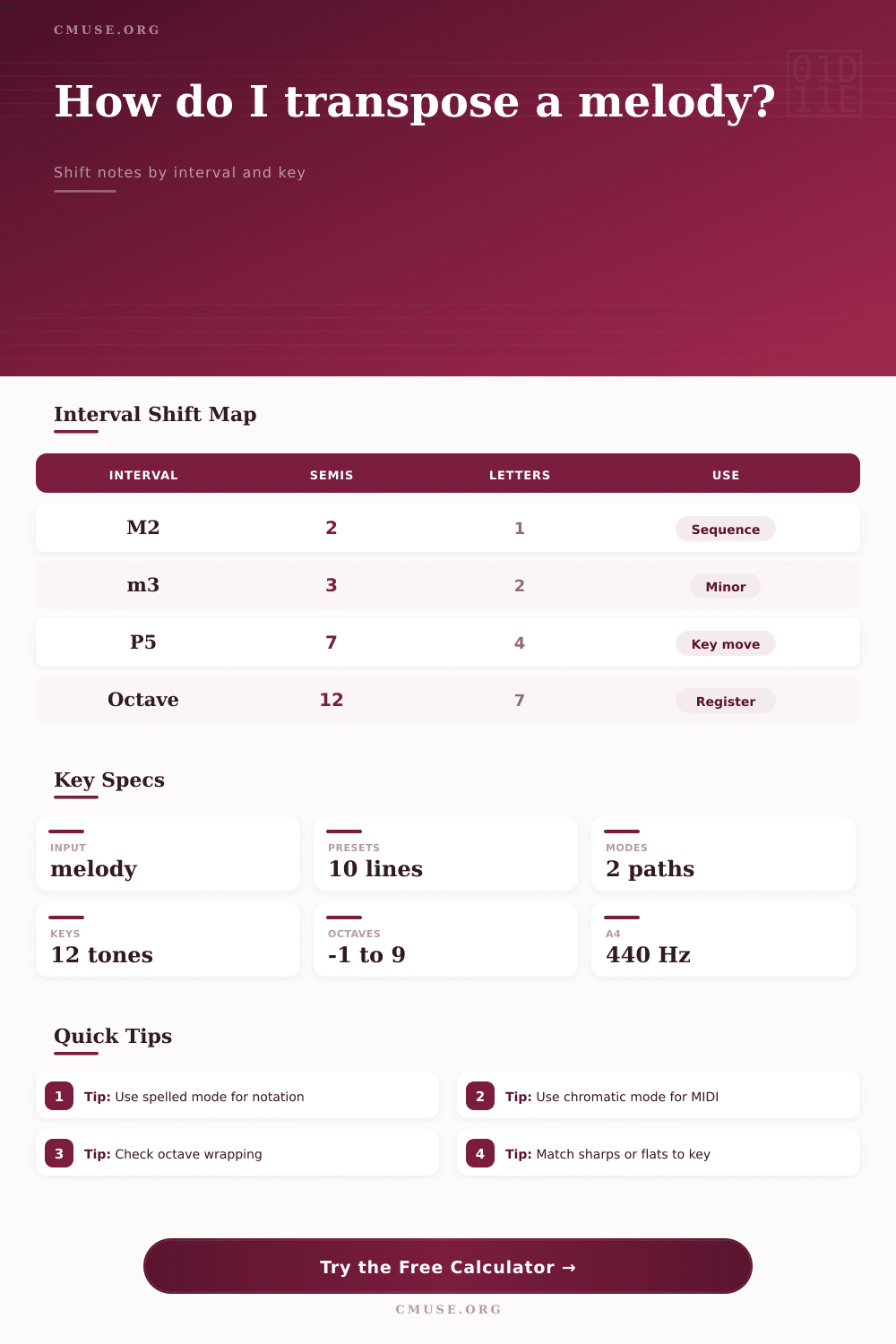
| Minor 2nd / Major 2nd | Major/minor | 1 / 2 | 1 letter | Stepwise sequence, modal shift, vocal adjustment |
| Minor 3rd / Major 3rd | Major/minor | 3 / 4 | 2 letters | Relative key motion, alto transfer, hook reharmonization |
| Perfect 4th / Perfect 5th | Perfect | 5 / 7 | 3 / 4 letters | Instrument transposition, register lift, answer phrase |
| Minor 6th / Major 6th | Major/minor | 8 / 9 | 5 letters | Inversion planning, part exchange, wide contour |
| Octave / Compound 9th | Perfect or major | 12 / 14 | 7 / 8 letters | Register change while preserving contour |
| Destination Key Type | Best Accidentals | Example Keys | Why It Helps |
|---|---|---|---|
| Sharp keys | Sharps | G, D, A, E, B | Preserves common scale spellings such as F# and C#. |
| Flat keys | Flats | F, Bb, Eb, Ab, Db | Avoids awkward enharmonics such as A# in flat-key melodies. |
| C-centered or chromatic | Auto or input | C, Am, modal C | Lets interval spelling or typed note names guide notation. |
| Dense chromatic lines | Project choice | Jazz, film, MIDI | Consistent spelling is often easier to scan than perfect theory spelling. |
| Scale Context | Pitch Set | Fit Reading | Transposition Note |
|---|---|---|---|
| Major / Ionian | 0, 2, 4, 5, 7, 9, 11 | Diatonic percentage | Good for hymns, pop hooks, and classroom examples. |
| Natural minor / Aeolian | 0, 2, 3, 5, 7, 8, 10 | Minor-key percentage | Compare before and after to catch accidental drift. |
| Dorian / Mixolydian | Mode-specific | Modal fit | Useful when raising 6 or lowering 7 is intentional. |
| Chromatic reference | All 12 tones | Always 100% | Best for exact MIDI-style interval shifts. |
Moving the pitches is not enough to transpose as it also involve changing musical context. For example, if you transposed a melody downwards by a minor third then although the pitch is fine, the newly created range could require different singing style from what voice can comfortabley achieve. In this instance, the notes are right, yet line is not. Why?
This is because you must consider practical performance limits in addition to mathematical change of an interval. What is required here is something that tells you where mathematics stops and demands of music begin. The calculator shows you the mathematics; it’s up to you to apply that based off your circumstances.
How to Transpose Music Correctly
So, how do we transpose? We has to work out range, spelling and pitch. If you move a melody upwards by a perfect fifth (seven semitones), this is easy. The tricky bit come with the choice of flats/sharps in the new key. If you’re transposing from C major to G major, you can use either B flat or A sharp. The former sounds just as good than the latter but it’s easier to read in a G major setting.
With the calculator, you can opt for a raw chromatic shift or spelled interval notation. In the case of written music for human player, opt for spelled mode so they can identify scale degree. Only feed a chromatic mode into MIDI sequencer, as it won’t care about how you write things down.
Good transpositions can be ruined by range limitations. Try shifting a piano melody down an octave to make it sound heavier. The problem comes when you check what that produces. Does it drop below the fundamental frequency of a bass guitar? Does it fall off end of keyboard?
The output range card will give you highest and lowest notes of the newly transposed melody. Check this information out before you copy down word. If new lowest note is an E1, make sure your instrument has that ability to produce that frequency. It should of been done in advance instead of rewriting a chart because part cannot be played.
Readability: More so than most know, this applies to key signatures. Playing in a key with many flats, like B-flat major, feels different than playing in one with many sharps, like E major. By using the key centre input the tool can try to guess where you want to go. When transposing up a step (from C to F), the tool tends toward flats; when moving a fifth upwards (C to G), it prefer sharps. This makes a noticeable difference to readability of music.
Unnecessary accidentals trip-up a sax player, while a singer hesitate at a difficult double sharp. It’s about finding way of least resistance for the performer.
The scale fit analysis is one you shouldn’t skip past either. Here you can see what percent of notes are transposed to match selected scale. What this tells you is if you’ve added chromaticism that wasn’t present in original melody. That could have been your intention. However, it more often than not indicate you’ve added an accidental or moved into an unsuitable key.
The page also includes a reference table that maps semitones and letter span sizes for each interval. This allows you to quicky check that you’ve selected the right interval for your purposes.
Transposing a tune keeps it the same melodic form but moves it into another place. The range and spelling describe the package; the interval describes space between them. The distance must be correct for you to recognize the tune. The package has to be correct for you to play it. Listen out for it in your head; double-check key and grid before committing.
Performance is the end-point. It’s what matters. The notes are merely part of the story.