Leap to Step Ratio Calculator
Count melodic steps, leaps, repeated notes, direction balance, and turn rate to describe how smooth, angular, or singable a melody feels.
| Interval motion | Semitone span | Count category | Melodic effect |
|---|---|---|---|
| Repeated pitch | 0 | Repeat | Emphasis, chant, pulse, or lyric clarity |
| Minor second | 1 | Step | Tight neighbor motion or chromatic pull |
| Major second | 2 | Step | Smooth scale motion and singable connection |
| Minor or major third | 3 to 4 | Leap | Open melodic shape without becoming extreme |
| Fourth or fifth | 5 to 7 | Leap | Theme-like lift, fanfare, bass motion, or riff shape |
| Sixth, seventh, octave | 8 to 12 | Wide leap | Dramatic reach that usually needs preparation or recovery |
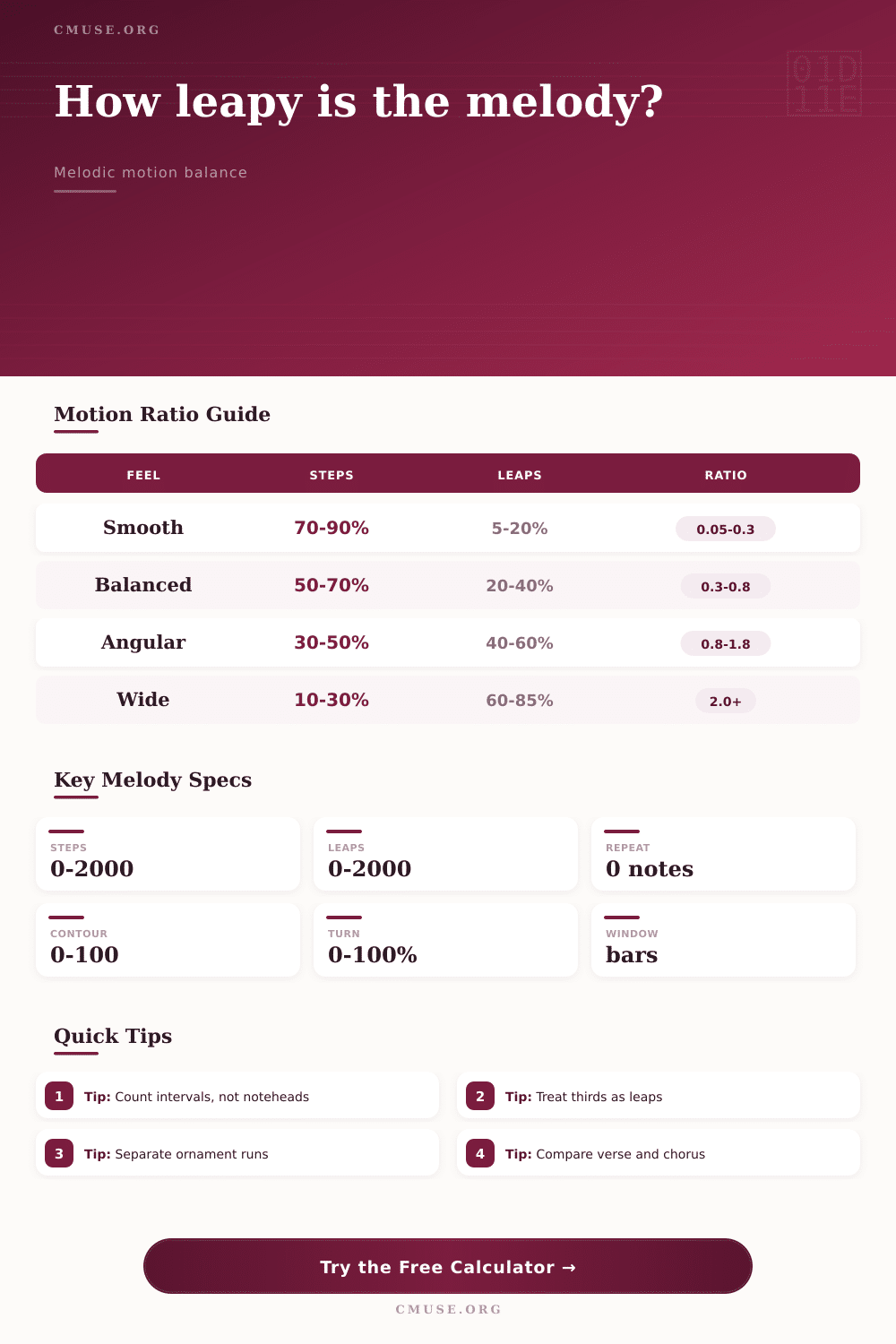
| Leap-to-step ratio | Step share | Motion label | Typical melody use |
|---|---|---|---|
| 0.00 to 0.20 : 1 | 80% or higher | Mostly stepwise | Choral inner voices, folk verse lines, smooth countermelody |
| 0.21 to 0.60 : 1 | 62% to 79% | Singable | Pop hooks, lyric themes, balanced instrumental melodies |
| 0.61 to 1.20 : 1 | 45% to 61% | Shaped | Film themes, guitar riffs, jazz lines with clear contour |
| 1.21 to 2.00 : 1 | 33% to 44% | Angular | Modern motifs, wide arpeggios, technical instrumental figures |
| Above 2.00 : 1 | Below 33% | Leap-dominant | Pointillistic melody, register jumps, intentionally jagged writing |
| Passage type | Typical window | Step/leap pattern | Counting cue |
|---|---|---|---|
| Folk verse phrase | 4 bars | 24 steps, 5 leaps | Mostly seconds with occasional third or fourth lifts |
| Pop chorus hook | 4 bars | 18 steps, 7 leaps | Stepwise approach tones around a few memorable jumps |
| Bebop eighth-note line | 2 bars | 20 steps, 12 leaps | Scale motion mixed with chord-tone skips |
| Walking bass line | 4 bars | 22 steps, 8 leaps | Chord roots may leap while approaches remain stepwise |
| Modern angular cell | 2 bars | 6 steps, 14 leaps | Register contrast and wider intervals are the main sound |
| Contour factor | Input source | High-score behavior | Low-score behavior |
|---|---|---|---|
| Step continuity | Step share | Enough connected seconds to feel singable | Too many large skips for a smooth line |
| Leap recovery | Leap ratio and size | Leaps are balanced by smaller follow-up motion | Wide intervals stack without relief |
| Direction balance | Ascending vs descending counts | The line rises and falls with similar weight | One direction dominates the whole phrase |
| Turn rate | Direction changes | Enough peaks and dips to make a contour | Flat, stuck, or zigzagging beyond the target style |
| Density fit | Bars, beats, and tempo | Interval count fits the phrase length comfortably | The melody is either too bare or too crowded |
| Melody detail | Count as step | Count as leap | Practical handling |
|---|---|---|---|
| Neighbor tone up or down by second | Yes | No | Each note-to-note move is one step interval |
| Chord arpeggio by third | No | Yes | Thirds are leaps even when they sound consonant |
| Repeated lyric pitch | No | No | Use the repeat field so the interval total stays accurate |
| Grace note or quick ornament | Usually | Only if third or wider | Include ornaments only if they are part of the melodic line |
| Octave displacement | No | Yes | Count the written or performed register jump as a wide leap |
Vocal Smooth
High step share, moderate turns, and restrained leap size support clear intonation and lyric delivery.
Hook Balanced
Steps keep the line memorable while selected leaps create lift, arrival, and a strong phrase outline.
Riff Shaped
Moderate leap density can make a motif sound physical, especially when wide moves repeat predictably.
Angular Modern
High leap share and larger semitone spans create contrast, tension, and deliberate melodic sharpness.
In fact, you may hear piece of music where melody seems to walk along and then all of a sudden, with no warning it jumps. It doesn’t feel comfortabley, you think. And that is not an illusion. It is a characteristic of the music you can measure.
Melody frequently get discussed in terms of rhythm and key, but movement from one note to another play a large role in the texture of the line. The way this change gives it more drama or makes it more memorable and even sometimes more singable. This brings me back to the idea that a step is the smallest building block of melodic movement in music. Whether it is major or minor, it move by a single second. This is what bind a melody together.
The Balance of Steps and Leaps in Melody
When you listen to a gentle pop ballad or a folk song, you will mostly be hearing steps. Because they mimic how we speak naturaly, they sound natural. In contrast, leaps are intervals of a third or larger. These bring the line up, energize, and give it a lift. They also gives the phrase its shape and create tension. Too many too close together, however, make for a jagged and difficult-to-follow melody.
Balancing these two forces is what the art of melody writing come down to. But it’s not so simple as counting the notes. Here’s how: After you input the number of intervals you’ve counted (above) the calculator do all the math for you. You don’t need to guess which value converts into which coefficient.
After that, it split out the relationship between steps and leaps. It gives you a contour score that tells you whether your line is angular, smooth, or balanced. It also take into account direction changes. If there are too many ups in a melody, sooner or later you’ll run out of breath. Too many downs feel more like a sigh with no end.
The best melodies turns. They rise, peak, and fall. These turns create the arc that your brain remember.
The other error that many composer fall into is counting repeated notes as steps. They’re not. A repeated note is a pulse. It is a moment of emphasis. It is a pause. It increase the density of the line but doesn’t contribute to its forward motion. Leaps and steps move the melody forward. Counting repeats as steps skews the ratio, making you believe your melody is smoother then it actualy is. The tool separate these out too so you can see the true texture.
And it takes account of the size of the intervals. A minor third upward and a major sixth upward are both leaps, yet they feel different. The average semitone span help clarify this.
Think about what kind of preset you have in that tool. Is it a bebop saxophone run or a walking bass line? One is very different than the other. The bebop sax line leap all over the place to outline complex harmonies rapidly. Meanwhile, the bass line stay put, stepping from one chord tone to another to maintain the groove. Neither is right nor wrong. They just play different roles.
For example, if you’re composing a hook for vocals then you likely need a greater percentage of step. When’s the last time you heard a good vocal hook that didn’t glide across the bar? That’s where the human voice is most comfortable. Wide leaps take precision intonation and breath control. If you write a chorus filled with big jumps, then you’re asking the vocalist to do some acrobatic work rather than express their emotion. That’s where people make a mistake, confusing something complicated with being good.
By contrast, if your piece is a guitar riff, you may prefer leaping intervals. Leaps has an element of power and space about them. They give a taste to the instrument. On the following page is a reference table that shows common ratios for each style. Choral inner voices tend towards a predominantly stepwise line, but moddern angular motifs tend toward a leap-dominant line. Think of the bands above as guides rather than rules. You are aiming to match the motion with the message.
But also consider recovery. Contrary motion describe a situation where one large leap is followed by the next motion moving the other way. It makes for a more manageable big leap and returns the line to Earth. Stacking leaps, on the other hand, creates a dotted effect that sounds disjointed. Following a leap with a step provide the listener somewhere to rest. It is a small thing, but it matters.
You will see this balance reflected in the results’ contour score. It penalises stacked leaps without relief, or lines that simply zigzag aimlessly. Ultimately, melody is all about control. How many times does the line change direction? When do you leap and when do you step? How large are these intervals? These are things you decide. They determine how it sounds.
Numbers give you the tool, you give them the intent. Your instincts are right; use the data as a check. If something sounds flat, what’s your leap ratio? If something sounds chaotic, how continuous is your step continuity? Best melodies take you on a journey in the song. Take one well-placed jump or step at a time.