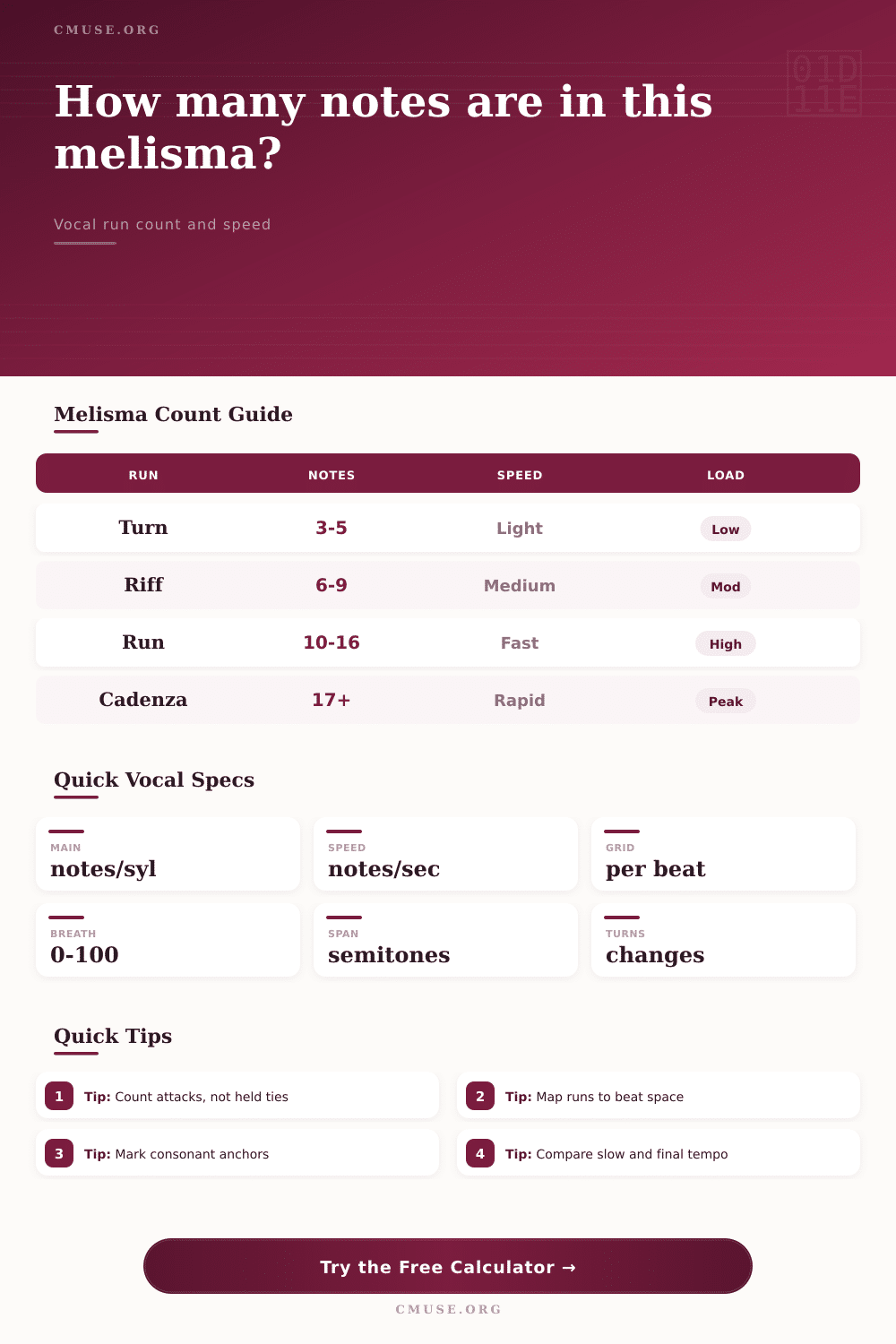
Melisma Note Count Calculator
Measure vocal runs by note attacks, syllable spread, tempo space, subdivision pressure, pitch turns, and practical breath load.
Preset use: Load a typical melisma shape, then replace the counts with the exact attacks and syllables from your score, lyric sheet, or transcription.
Pop and Theatre
Typical range: 3 to 8 notes on one syllable.
Often favors clean placement, lyric clarity, and a short arrival pitch.
R&B and Gospel
Typical range: 6 to 18 notes across a phrase ending.
Higher turn count and vowel continuity make breath load rise quickly.
Classical Coloratura
Typical range: 12 to 40 notes in measured figures.
Subdivision fit and pitch span matter as much as raw note count.
Scat and Taan
Typical range: 10 to 30 notes in short bursts.
Consonants, syllable swaps, and rapid direction changes shape agility demand.
| Count Band | Notes on One Syllable | Common Label | Counting Check |
|---|---|---|---|
| Light ornament | 2 to 4 notes | Turn, grace group | Confirm whether pickup notes belong to the syllable. |
| Short melisma | 5 to 8 notes | Pop run, cadence riff | Count each changed pitch or re-attacked same pitch. |
| Extended run | 9 to 16 notes | R&B run, gospel line | Separate note attacks from slides that do not settle. |
| Long flourish | 17 or more notes | Cadenza, coloratura | Mark phrase boundaries before averaging syllables. |
| Grid | Notes Per Beat | At 90 BPM | Agility Reading |
|---|---|---|---|
| Eighth notes | 2 | 3.00 notes/sec | Comfortable for most measured vocal ornaments. |
| Eighth triplets | 3 | 4.50 notes/sec | Moderate run speed with clear triplet placement. |
| Sixteenth notes | 4 | 6.00 notes/sec | Fast enough to expose uneven attacks. |
| Sixteenth triplets | 6 | 9.00 notes/sec | Advanced agility or a very short burst window. |
| Thirty-second notes | 8 | 12.00 notes/sec | Peak speed; duration and vowel purity need checking. |
| Load Band | Index Range | Run Signal | Measurement Note |
|---|---|---|---|
| Light | 0 to 34 | Short run with spare phrase time. | Breath reserve is likely larger than run duration. |
| Moderate | 35 to 54 | Manageable run with a clear vowel path. | Check consonants and arrival pitch length. |
| High | 55 to 74 | Fast or long melisma inside a tight phrase. | Compare measured seconds with beat-derived seconds. |
| Peak | 75 to 100 | Demanding run, wide span, or little recovery. | Slow-practice the turn map before full tempo. |
| Agility Factor | Low Demand | Moderate Demand | High Demand |
|---|---|---|---|
| Pitch span | 0 to 4 semitones | 5 to 11 semitones | 12 or more semitones |
| Direction changes | 0 to 2 turns | 3 to 7 turns | 8 or more turns |
| Notes per second | Under 4.0 | 4.0 to 7.0 | Above 7.0 |
| Consonant anchors | 0 or 1 | 2 or 3 | 4 or more |
If you attempt to count the note during your own practice session, you might struggle to accurately count them while singing a vocal run. It begins with a syllable followed by some added pitches and before long the phrase becomes a complex maze of breath control and rhythmic precision. Sometimes, this is what separates the full display of coloratura from more straightforward melodic turn. The metric difference feels palpable; yet how are we supposed to quantify it?
This is where analyzing how the performer move becomes just as important as analyzing music itself. Instead, use the calculator above to do math for you. The calculator turns subjective feeling into objective data. It accepts inputs such as tempo, number of notes, and number of syllables. It uses these to calculate breath load and subdivision speed.
Why Use a Vocal Run Calculator
Why is this important? This is because as singers we rely too much on our intuition. When we are pushing technical limits, intuition can let us down. Defining a run in terms of pitch span or notes per second removes the guesswork from your practice routine. You can understand why you might find a line hard even though the tempo feel moderate.
Sometimes you might even be counting notes incorrectly. You may hear two different pitches where there is only slide or glide. But if voice doesn’t clearly articulate a new note then in strict melodic terms, it’s often not considered a note at all. What this means is the tool will ask for complete sung note attacks and filter out any sustained tone that merely last longer. This alters the whole analysis.
What sounds like twelve notes under your fingers could realy be only eight distinct attacks with plenty of portamento. That alters the whole sense of agility a lot. It transforms the piece into an exercise of control rather than a high-speed test.
Another metric that reveals hidden challenges is called “breath load.” Not only is it about having air, it’s about having enough air relative to the demand of the run and its required pressure over a given amount of time. You’ll notice it spikes if you perform a quick run near the end of your breath with lots of directional changes. More breath pressure lead to a higher load index. This is why we’ve found that certain lines may be doable by themselves but are then completely overwhelming in context of phrase. Because it highlights the pressure, you can now shift where you place your breath and change your phrasing prior to the collapse of performance.
In terms of genre, how do they approach the constraints? Clean turns tend to be favored in pop music. In this genre, clear lyrics matter more then a high number of notes. Higher numbers of turns over longer durations are used in the RnB and gospel tradition. This presents a challenge based off vocal stamina. With classical coloratura, there is a need for exact subdivision that fits precisely. They need to lock into beat grid perfectly.
Understanding the stylistic differences sets realistic expectations. It’s not just about number of notes but an analysis of the stylistic vocabulary used. Subdivision speed is an interesting practical way of testing rhythmic accuracy. Basically, it pits the number of notes that you have actualy played against what might of been a theoretical grid like triplets or sixteenth notes. If your run doesn’t fit in the given underlying grid then you’re probably dragging or rushing.
For students and transcribers both, this can be helpful. It gives you a way to check if a line is noted correctly and helps you see if there is any rubato in performance that you should consider. The table on page gives the breakdown of this. Here’s how various grid densities impact the perceived speed.
It’s not about making singing a spreadsheet exercise. It’s about developing a better sense of how you are using your voice. When you know that this specific run requires a lot of breath reserve and a high pitch span, you can use that knowledge in practice to try some targeted strategies. Map out those turns more slowly. Break the phrase at a new place.
Data isn’t a replacement for intuition, but it informs it. The ear and the feel are still there, but now you’ve got a map. That clarity turns frustration into better focus. Next time a run eludes you, you’ll know if it’s because of breath, because of speed, or simply because you were counting the wrong notes.